Category Archives: Uncategorized

November 2013: More Marine Tidbits from Tokyo

Thumbs Up for Further Deep Sea Research
It’s getting a lot colder in Japan and for me, far too cold to dive into the water but the good news is that for marine buffs, deep-sea research is continuing.  Following on from the giant squid footage that took Japan by storm this summer, some small factories in eastern Tokyo hoping to increase business opportunities developed three deep-sea probes collectively called the Edokko No.1. 

Yukio Sugino, the president of a rubber products factory that is involved in the project, said “it’s a compilation of 4 years of work.  I want to show that small factories can play a part in a key area of Japan’s marine resources development in the coming years.” He suggested building deep-sea exploration vessels, believing Japan was lagging behind in the development of marine resources.

On November 21st the three probes left the port of Yokosuka aboard a survey ship owned by the Japan Agency for Marine-Earth Science and Technology (JAMSTEC).  They were released 200km off Chiba prefecture and consisted of 3 vertically connected glass balls, each containing a 3D video camera, lighting equipment and a device to collect mud from the seabed.   One was dropped to about 4,000 meters and the other two to 8,000 meters.  Two of the probes photographed a school of fish that seemed to be a particular species of cusk eel called “Yomino Ashiro” (abyssobrotula galatheae) that lives at over 6,000 meters.  It’s the deepest-living fish known and eats polychaete worms and crustaceans.  Footage of the seabed at 4,000m was also taken.

The role of small factories in the marine field is an exciting one.  Does it mean that people or companies with seemingly no science-related connections or background could play a part in the development of marine resources?  I certainly hope so!

New Island, New Dive Site?
Meanwhile, down in the Ogasawara Island chain about 1,000km south of Tokyo, a volcanic eruption, the first in 40 years in the area, has created a new islet. 

The Ogasawara Islands were formed about 48 million years ago and lie above a subduction zone between the Pacific Plate and Philippine Sea Plate where the Pacific Plate is subducting under the Philippine Plate.  The Ogasawara Islands are composed of a type of volcanic rock called boninite which is full of magnesium oxide and silicon dioxide.

The eruption is said to have occurred about 500 meters south-southeast of Nishinoshima Island, an uninhabited place about 650 meters long and 200 meters wide. 

Since it was first spotted, the islet is continuing to grow because of three craters that are pushing out lava and ash.  If it survives, it could become part of the country’s map.

A 100-meter long stable lava flow has been observed from the air making its way into the sea.  When such a flow occurs, the surface cools and then hardens, increasing the chances that the islet will remain.  The islet has also grown to about 25 meters high and is the first new Japanese land mass in 27 years. 

The Ogasawara Islands has world class diving with beautiful clear water and a huge range of marine life and coral.  Other common sights include green turtles and sand tiger sharks while some shipwrecks from World War Two add something extra to a dive.  Could the recently-formed islet eventually become yet another dive spot for enthusiastic divers? 

October 2013: Daioika or Giant Squid

The Giant Squid - Japan's most popular underwater creature this summer!

The Giant Squid – Japan’s most popular underwater creature this summer!

Being in the ocean is one of the things I really love about Japan but the typhoon season isn’t and this year has been particularly bad.  With a spate of storms last month and this month wreaking havoc with my diving plans, I’ve been staying put on dry land and reading up on the latest marine-related news.

This year the giant squid, or “Daioika” in Japanese, has been all the rage here.  For me, squid are among the sea’s most beautiful creatures and recently they attracted much attention thanks to an exhibition called Shinkai (The Deep) held in Tokyo’s Ueno district this summer which drew more than 450,000 people between July and early October.  The highlight was a preserved specimen on display for all to see, while the exhibition also introduced visitors to the deep sea itself, the latest technology and equipment being used to explore it, the mysterious creatures of the deep and some ongoing projects.

The giant squid is one of the mysteries of the ocean but it became increasingly popular when Japan’s National Science Museum teamed up with NHK and the US Discovery Channel to successfully film it at a depth of over half a kilometer, showing it in its natural habitat for the first time.

Scientists found the squid from a spot some 15 kilometres east of Chichijima (Chichi Island) in the north Pacific and filmed it at a depth of around 630 metres.  Professor Tsunemi Kubodera is a museum researcher and part of the crew that filmed the squid.  This is what he said upon discovering the creature:

“It was shining and so beautiful.  I was so thrilled when I saw it first hand, but I was confident we would because we rigorously researched the areas we might find it, based on past data.  With this footage we hope to discover more about the life of the species.”

Professor Kubodera first began studying the giant squid back in 1998.  In 2006 he successfully filmed one for the first time when it had been hooked and brought up to the surface.  This time, to film it underwater, he suggested using a diamondback squid as bait (giant squid eat smaller squid).  The crew used a special type of blue-light lure and red light for illumination (red light is invisible to the giant squid) and got the giant to attack the bait.  Kubodera’s theory is that giant squid hunt for food by looking up.  Thanks to their huge eyes as big as dinner plates, they can see light filtering down from the surface and create a silhouette of their prey.  They can also absorb more light than their smaller counterparts.  They catch their prey by shooting out their two large feeding tentacles which contain hundreds of powerful suckers.  Eight thick arms guide the prey from the feeding tentacles to a sharp beak in the centre of the arms where it is then sliced into pieces.

Both Kubodera’s sightings of the squid occurred in the same area, about 1,000km south of Tokyo.  Could areas near Tokyo be a huge habitat for the species?

In January this year NHK went on to broadcast its documentary called “Legends of the Deep: Giant Squid” triggering even more interest in the creature.  I’m currently talking to NHK about the possibility of interviewing Professor Kubodera on radio to learn more about his footage and future projects.  As he mentioned in a recent article, “almost nothing is known about the giant squid.  We know nothing about where males and females meet, how they raise their offspring, nothing at all and so our next step is how we can research this.  We may have seen a giant squid in its natural habitat for the first time, but research into this mysterious creature has only just begun.”


August 2013: Kozushima, Japan

Wednesday August 7th to Friday August 9th 2013

Legend has it than in ancient times the gods of the Izu islands met on Kozushima to discuss how to share freshwater but legend and history are not the only things the island is known for.  About 3 hours and 45 minutes away from Tokyo, it’s an ideal destination for a summer weekend break, a tiny paradise that bubbled up from the Pacific Ocean a very very long time ago.  Less touristy than the other islands in the Izu island chain, Kozushima is particularly peaceful with a population of fewer than 2,000.  It’s also relatively flat and its beautiful white sand beaches make it ideal for divers, swimmers and snorkelers alike.  I spent two days on Kozushima and visited the following dive sites:

Saima:  Saima begins at 5m over rocks and boulders teeming with marine vegetation.  The dive is not so exciting to begin with but the best always comes last.  Home to a collection of rocks and boulders, the highlight of Saima are two gigantic structures stretching down to about 20m with dark spots, tiny holes, mini caves and an interesting route to swim through.  It soon becomes obvious that life is abundant here and as we travelled slowly, exploring the walls, something always swam past in every direction – puffer fish and boxfish hovered close by, tiny box fish darted in and out of sight, colourful nudibranchs stuck to the walls feeling the mild current and no doubt enjoying the warm temperature and two trumpet fish appeared looking very chilled out.  At the end of the dive, a school of yellowtails swam by out of nowhere, frantically disappearing into the distance, no doubt in search of the day’s meal.  This is an excellent dive for those who aren’t so confident clearing their ears as you can stop during the descent and use your light to explore the walls.

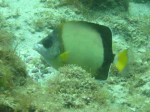
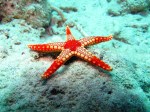
Akasaki:  This is Kozushima’s most popular spot for swimming, snorkeling, try dives and training.  It’s an easy-going experience with warm temperatures, great visibility and mellow currents.  Divers carry their tanks and walk down a flight of steps to the water before donning masks and fins and swimming to about 6m.  The dive takes you over a sheltered sandy and rocky terrain, a carpet of medium-sized rocks.  Akasaki is very sheltered and a macro lover’s paradise.  Hovering overhead and moving as slowly as possible, we found a fantastic array of tiny life forms, an abundance of adult and baby sea slugs, tiny nudibranchs, starfish, crabs dragging themselves across the rocks and various critters curiously poking their heads out of tiny holes in the rocks.  Fish such as bluespotted cornet fish and oriental butterfly fish drifted by, nibbling at the rocks and watching us closely, no doubt used to the large number of swimmers and snorkelers.  This dive is warm, easy, very relaxing and most fun if you have a camera.

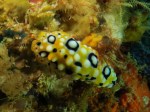
Hiradan Arch:  A 5-minute boat ride from one of Kozushima’s main ports , a cluster of rocks in the open sea looks like a promising site for an exploratory dive.  We descended directly to around 17m and arrived at a huge cave-like structure although it wasn’t a cave, simply a large area with walls caked in nudibranchs and other macro life.  Hiradan Arch reveals an interesting world of nudibranchs clinging to walls of rock and flashing their exotic colours.  We descended past a wall of life, and wrasses (clown coris), groupers (gold ribbon groupers) and blackmouth goosefish swam here and there aggressively, darting into the nearest hiding place at my approach.  The dive can get monotonous as there is nowhere else to go other than the huge cave-like structure but the sun pours in making visibility excellent and it’s a superb place for divers into macro life who want to take close up shots. We saw some extremely flamboyant nudibranchs (ceratosoma trilobatum and phyllidiella pustulosa)

Sanju:  Below the water here is an aquarium-like world packed with fish such as white-saddle goatfish, spotted tail morwongs and golden-striped groupers.  Sanju is a relatively easy dive site (maximum 20m or so) with much to offer despite appearing to be relatively standard at first glance.  Divers descend freely to about 5m of rock teeming with anemones and other critters such as sea goldies twitching over holes and cracks.  Spider crabs are also around, stretching their long legs.   Down at 12m there are more huge rocks that reach up to the surface, full of fish and anemones.  The best part of this dive is the 12-15m area where the sun penetrates best and the water flow is quite smooth making it easy to hover and get some good photos.  Doing the safety stop over the rocks makes for better buoyancy control too.

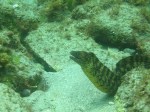
Arima: This is a sheltered bay only accessible by boat.  There are even a few dolphins – we encountered a mother and baby at the surface.  The rocks here are spread out at around 8m and there is a great sandy area at around 12m where you can literally rest face down and look up at the sun streaming through the water.  We spent a good 15 minutes or so scanning the water, waiting for anything to roll in.  With rocks and boulders to our left, we swam across this sandy area and after rounding a corner an incredible site materialized in the distance – a school of goatfish perfectly ordered and resting on the sand in the slight current.  Unbelievably tame, they watched us intently and even let us swim directly above them as we continued on our journey.  The rocks were full of life – eels displaying their menacing jaws, a bright yellow baby box fish appearing like a ray of sunshine and a round ribbontail ray devouring its latest meal.

Tsumari:  Night dive fans will enjoy Tsumari, 5 minutes from the dive school and located at the bottom of a cliff with a small set of steps leading into the water.  Divers walk down the steps carrying their tanks, put on their fins and masks in the water and swim out.  Conditions were perfect for a night dive with flat seas and good visibility.  The bottom is completely sandy. We turned left and began exploring a cluster of small rocks.  The current increased here and we swam straight out with it before reaching an area of concrete beams, perhaps placed there deliberately.  Luckily for us, lobsters blanketed the entire area which made for an amazing start and the beams are home to an array of life, mainly interesting looking shrimps as well as sleeping fish.  The dive is not deep and is fantastic for marine life.  We even spotted an octopus emerging from behind a rock and a huge sea snake slithering away under the glare of our flash lights.  The lights also illuminate some strange and amazing planktonic critters attracted to the glow which gives the dive a nice end as you can sit on the sand, wave your flashlight about and enjoy the show.

Practical information

  • I took the fast jetfoil ferry from Atami near Tokyo with Tokai Kisen ferries (http://www.tokaikisen.co.jp/).  The boat leaves at a convenient 11AM and arrives at Kozushima around 13:00.  A single ticket costs 6,390yen.  There is one vending machine on the ferry and the seats are just like airplane seats.  Bring something to eat and a book to read too.
  • I booked my accommodation through the Kozushima Tourist Office (04992-8-1111) on the advice of Tokai Kisen ferries.  The tourist office found me an inn called Daimatsu (http://www.kouzushima.org/stay/detail.php?no=0035)which charged 13,600yen for two nights for a basic room, dinner and breakfast consisting of rice, miso soup, fish, vegetables and pickles.  Dinner begins at 19:00, breakfast is around 7:00 and everyone eats in the communal room.
  • I booked my dives with Nangoku (http://www6.ocn.ne.jp/~nangoku1/).  Four boat dives and two beach dives comes to just under 40,000yen including tanks, weights and a guide.  The school organizes an excellent night tour of Kozushima and give advice on places to eat or buy souvenirs.
  • A representative from my accommodation came to pick me up at the port and drive me to the inn for check-in.  The inn is about 2mins drive from the port.  The dive school called me soon afterwards and I walked there to prepare for my first dive.  This took about 5mins.
  • Diving equipment can be sent in advance from Tokyo for about 2,500yen using Kuroneko Takkyubin.
  • Immediately upon entering Nangoku you see a huge table with shelves of books, walls of photos and other decorations all around, with the reception desk to your left.  The area for diving equipment (washing, drying, hanging, storage) is up on the deck upstairs overlooking the sea.  A toilet, two showers and a changing room area are also on the deck.  Tea is available as are diving and fish books/magazines .
  • After loading the van with equipment and getting changed into our wetsuits, we drove to the dive sites.  The boat is very spacious and flat with almost no indoor area but a good few places to sit outside next to the engine in the middle.  Equipment is put on when the boat arrives at the dive sites.  Bring your own towel, sunscreen and snacks for the boat journey.
  • Lunch is not provided but after each dive there is a chance to go to a couple of cute restaurants/cafes practically next door to the dive school.
  • Divers are responsible for looking after their own equipment.  When the dives are over, they are free to use the deck to change, wash, hang, dry etc as they like.
  • There are a couple of nice restaurants/bars near the dive school and inn but these close quite early (around 21:30).  Between the port and Akasaki beach is a wonderful outdoor hot spring which Nangoku will book for you and take you to if interested.

August’s dives

Dive1: Saima: depth: 15m, dive time: 41mins, water temp: 30C, entry time: 13:55, exit time: 14:35, average depth: 10m, used a 10L steel tank, 5mm wetsuit and 3kg back plate (no extra weights).  Start pressure: 200 bar, End pressure: 70 bar.  Saw silver-stripe round herrings, eels, spiny lobster, morwongs, porcupine fish, greater amberjacks, sea chubs, trumpet fish, rock porgy, boxfish, abalone, white-lined goatfish, cow fish, Pacific burrfish, spotted tail morwongs, axilspot hogfish.

Dive 2: Akasaki: depth: 5.6m, dive time: 47mins, water temp: 30C, entry time: 15:38, exit time: 16:25, average depth 3.5m, used a 10L steel tank, 5mm wetsuit, 3kg back plate and 1kg extra weight in pocket.  Start pressure: 200 bar, End pressure: 110 bar.  Saw starfish, thalassoma cupido (wrasses), sea biscuits, oriental butterfly fish, bluespotted cornet fish, sea slugs and surgeon fish.

Dive 3: Hiradan Arch: depth: 17.5m, dive time: 39mins, water temp: 29C, entry time: 09:41, exit time: 10:19, average depth 11.4m, used a 10L steel tank, 5mm wetsuit, 3kg back plate and 1kg extra weight in pocket.  Start pressure: 200 bar, End pressure: 70 bar.  Saw blackmouth goosefish, sea slugs (ceratosoma trilobatum, phyllidiella pustulosa), eels, clown coris (wrasses), gold ribbon groupers and another seaslug (phyllidiaocellata).

Dive 4: Sanju: depth: 14.9m, dive time: 42mins, water temp: 30C, entry time: 11:13, exit time: 11:55, average depth: 10m, used a 10L steel tank, 5mm wetsuit, 3kg back plate and 1kg extra weight in pocket.  Start pressure: 200 bar, End pressure: 65 bar.  Saw sea slugs (hypselodoris zephyra), silver-stripe round herrings, sea goldies, morwongs, spider crabs, white-saddle goatfish, spotted tail morwongs and goldenstriped groupers.

Dive 5: Arima: depth: 15.3m, dive time: 48mins, water temp: 29C, entry time: 13:59, exit time: 14:47, average depth: 11.8m, used a 10L steel tank, 5mm wetsuit, 3kg back plate and 1kg weight in pocket.  Saw round ribbontail rays, whip coral gobies, box fish, red lionfish, white saddle goatfish, thread-sail filefish, blackalls, cowfish, boxfish, pufferfish and Christmas tree worms.

Dive 6: Tsumari: depth: 7m, dive time:51mins, water temp: 28C, entry time: 20:22, exit time: 21:11, average depth: 4.9m, used a 12L aluminium tank, 5mm wetsuit, 3kg back plate and 2kg extra weight in pockets.  Saw prawns, porcupine fish, Japanese spiny lobster, octopus, sea congers, Pacific burrfish, anemone hermit crab, parrotfish and wedge sea hares.
July 2013: Shikinejima, Japan

Saturday July 20th 2013

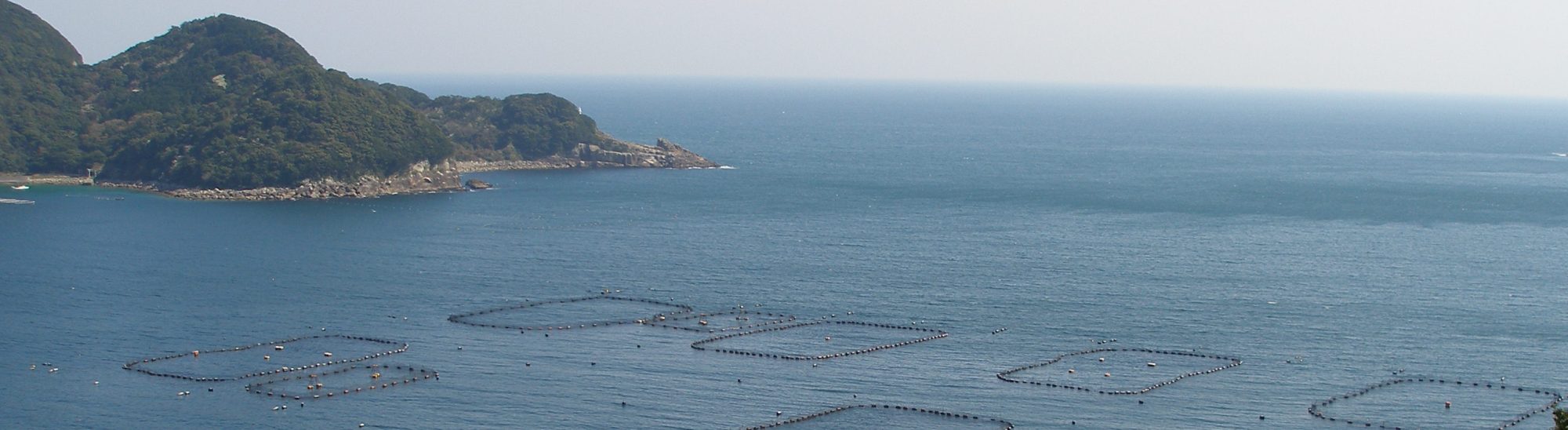
Shikinejima is about 150km from Tokyo and part of the Izu Island chain.  An easy journey by boat (overnight ferry or fast jetfoil) takes you away from the hustle and bustle of the capital and down to a beautiful relaxing coastline comprised of white sandy beaches.  The water here is shallower than the other islands in the chain which makes the snorkeling spots more calm and alluring.  Most of the island features a range of outdoor onsen and the hot water can even be enjoyed while diving.  Shikinejima is not the most obvious diving spot in Japan but the sites below have plenty to offer:

Nakanoura Beach: This is one of Shikinejima’s top snorkeling spots.  Diving at this small sheltered bay is extremely easy as you mingle among the snorkelers and only go to around 9m.  In the distance is a fixed net underwater, sheltering the bay from the open ocean so the water is calm and clear.  Standing on the sand, we put on our fins and masks and descended to 5-6m, swimming in a straight line over a bed of white sand and medium-sized rocks.  This dive is not so tropical and instead offers a range of seaweed and green plants which are a haven for sea anemones, sea slugs, small crabs and shrimps.  Swimming over to a more large rock, I found a group of wrasses ducking and weaving together as I approached.  Closer to the rock, an eel, wary of my large form, slowly swam out as I circled around.  As I waited patiently, it would turn to face me and see if I was still watching before moving back into its home and out of sight.
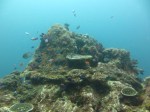
Crossing the sand flats to another cluster of rocks, I found various forms of seaweed growing towards the surface.  Blue emperors and longspine emperors swam out of reach, crabs ducked down out of sight and brown sea slugs rested quietly on the rocks enjoying the movement of the water.  I scanned the sea floor as I went looking for the shape of a flounder or anything else that might be hiding in the sand but no avail although back at the same cluster of rocks I was lucky to spot some sea slug eggs and a couple of trumpet fish hovering nearby.

Uonone: A short boat ride from one of the local ports takes you beyond Nakanoura Beach and into the open ocean to Uonone.  We did a backward roll into the water and descended to around 8-9m.  The rocks are huge, almost no sand exists and the current is mild. The cascading rocks caked in seaweed form gradual walls all around and run down vertically to about 20m but 13-14m is the best area in terms of visibility and marine life.  Sea anemones, home to the clown fish, flourish in a range of colours and as we swam over these at 14m the water became immensely clear.  We then encountered schools of yellowstriped butterfish and largescale blackfish for whom the rocks and seaweed are a nice little refuge while damsel and angel fish appear to thrive as well, pecking nutrients out of the water and swirling here and there.  As the sun shines over the rocks the colours of the soft coral and seaweed are particularly striking.  Having a small light on this dive is highly recommended as plenty of discoveries like crabs, nudibranchs and tiny shrimp also await.

Mikawan: This site is sheltered by huge cliff-like rocks in a small bay.  Away from the waves the surface is extremely calm. We descended down an anchor rope to 6m and were met with a carpet of medium-sized rocks.  What stood out were bubbles of warm water, our very own underwater hot spring, and although the water temperature was quite cold, we could stop and put our hands above the vents to warm up.  Mikawan has a fairly large turtle population and quite a few adults swam gracefully away in the distance going about their business or stayed by the rocks enjoying the vents as much as we were.  One adult, surrounded by warm bubbles, slowly looked up as we passed by before falling back into a peaceful slumber.  In general this site is quite barren and devoid of life except for sea slugs, nudibranchs and the occasional box fish so divers are taken over the rocks to a bed of white sand and organic material that contains even more vents and gets stirred up if you so much as think about getting too close with your fins.  This is a great chance to  study the vents in more detail.  The sand also offers some interesting surprises for those with a keen eye, including sepia stingrays burrowing into the sand and flatfish watching us intently as we floated above.

Practical information

  • I took the overnight ferry from Takeshiba Sanbashi in Tokyo with Tokai Kisen ferries (http://www.tokaikisen.co.jp/).  The ferry leaves Tokyo at 22:00 and arrives at 09:05 the following morning.  Tickets are about 12,000yen return (6,000yen for a single) and include a chair below deck but it is possible to rent warm thick blankets for 100yen each and sleep out on deck.  The ferry only has basic vending machines and a restaurant which is not open at night so it’s advisable to bring your own food and snacks.
  • I booked my accommodation with Shikinejima Tourist Office (04992-7-0357) on the advice of Tokai Kisen ferries.  The tourist office found me an inn called Furusato (http://www.travelroad.co.jp/ship/005/furusato.html) which charged around 5,000yen a night for a basic room, dinner and breakfast consisting of rice, miso soup, fish, vegetables and pickles.  Dinner begins at 17:00, breakfast around 7:00 and everyone eats in the communal room.
  • I booked my dives with Shikinejima Diving Service (http://www5.ocn.ne.jp/~sdsdive/menu_page_1.html).  Two boat dives and one beach dive comes to just under 20,000yen including tanks, weights and a guide.  It then costs 6,400yen to rent a wetsuit, reg, BCD, mask, fins and boots).
  • A representative from my accommodation came to pick me up at the airport and drive me to the inn for check-in.  Afterwards the dive school came to collect me.  This pick up is arranged in advance when booking your dives.
  • Diving equipment can be sent in advance from Tokyo for about 2,500yen using Kuroneko Takkyubin.
  • Shikinejima Diving Service is about 5 minutes from the inn.  Immediately upon arriving you see a huge family house on your right, with an area for diving equipment in the distance.  There is a round table outside for divers to sit and fill in forms.  Next to this table is an area for equipment storage, to wash, hang and dry gear.  A toilet and changing room are inside the house.  No books or magazines available but tea is provided.
  • After loading the van with equipment and getting changed, we drove to the dive sites.  The boat is very spacious and flat with almost no indoor area except a couple of benches in the middle next to the engine where divers can sit.  Equipment is put on when the boat arrives at the dive sites.  Bring your own towel, sunscreen and snacks.
  • Lunch is not provided so after each dive there is a chance to go to the nearest store for food and drink.
  • All entries into the water are backward rolls.  Ascent is up a ladder.
  • After each dive, everyone heads back to the port for a quick break.  A member of staff from the dive school will then drive back with the empty tanks and return with new ones.
  • Divers are responsible for looking after their own equipment.  When the dives are over, they are free to use the school’s outdoor area to change and wash up as they like. The school also drives you back to your accommodation at the end of the day.
  • There are very few pubs and bars near the accommodation and some are only open until early times like 20:00.
  • Cycling is a great way to get around the island although there are many steep hills!  Full day bicycle hire is around 1,000yen and can be arranged at your accommodation.
  • Your accommodation will take you to the port after your stay.
  • I returned to Tokyo on the fast jetfoil which leaves Shikinejima around 13:30 and gets into Tokyo around 16:00.   A single ticket is about 9,000yen.

July’s dives

Dive 1: Nakanoura Beach: depth: 8.6m, dive time: 35mins, water temp: 24C, entry time: 10:01, exit time: 10:36, average depth: 4.9m, used a 10L steel tank, 5mm wetsuit, 3mm hood/vest and 3kg weights (back plate only).  Start pressure: 190 bar, End pressure: 100 bar.  Saw pearl spot chromis, blue emperors, longspine emperors, wrasses, bluespotted cornet fish, striped jack, morwongs, eels, sea slugs, trumpet fish and sea slug eggs.

Dive 2:  Uonone: depth: 14.0m, dive time: 34mins, water temp: 24C, entry time: 12:03, exit time: 12:37, average depth: 9.6m, used a 10L steel tank, 5mm wetsuit, 3mm hood/vest and 3kg back plate with 1kg extra weight in pocket.  Start pressure: 180 bar, End pressure: 80 bar.  Saw damsel fish, angel fish, schools of yellowstriped butterfish and large scale blackfish.

Dive 3:  Mikawan: depth: 11.9m, dive time: 35mins, water temp: 23C, entry time: 14:24, exit time: 14:56, average depth 8.7m, used a 10L steel tank, 5mm wetsuit, 3mm hood/vest and 3kg back plate with 1kg extra weight in pocket.  Start pressure: 170 bar, End pressure: 70 bar.  Saw sepia stingrays, flat fish, turtles, sea slugs and plenty of underwater vents.

July 2013: Amami Oshima, Kagoshima Prefecture, Japan

Friday July 12th to Sunday July 14th 2013

380km south of Kyushu is Amami Oshima, where the reefs are packed with life and coral growth is abundant.  Blessed with cobalt blue sea, colorful coral and ringed in white sandy beaches and cliffs, it’s a mecca for sports like wind surfing and scuba diving with the sea a bright shiny turquoise.  What awaits the diver are beautiful coral reefs and tropical fish of all descriptions.

2 hours after the flight from Tokyo, we found ourselves slowly taking in the underwater surroundings of Kurasaki Beach.  Below us was a carpet of white sand strewn with various coral and rocks.  The site is excellent for refresher dives, try dives and training due to the shallow depths and plenty of sand in which to sit and practice skills.  Spending some time at 5-6m, it wasn’t long before we came across one of the stars of the reef, the clown fish, darting in and out of its home and watching us intently.  But there were also plenty of surprises as we found a couple of tiny whip coral shrimps, perfectly matching the colour of their surroundings.  As the individual whips move around a lot, not only are these critters hard to spot but they are also extremely difficult to photograph.  We also spotted nudibranchs, cleaner shrimps and plenty of angelfish. The area is packed with abundant kaleidoscopic coral growth and the rocks are almost like stepping stones, providing a plethora of sheltered nurseries and safe habitats for the fish while the stable and warm sea temperatures are also a huge advantage, not just for divers but for the marine life as well.

One of the most popular fish in Amami Oshima is the endearing Gilbert’s cardinal fish.  4-5cm and often bright, it lives in large aggregations among the coral in sheltered lagoons and bays and appears to have been researched in more detail across the Ryukyu Islands and Kyushu, according to a 2007 study.  Meanwhile back on Amami Oshima, a trip to In Oasis and Yamamoto Special provide many an opportunity to view these little fish.  The dives at both of these sites begin off a boat and start with huge coral formations that are quite barren, plain with very little signs of life.  But then the rocks end and the white sand spreads out between 13m and 21m, revealing a riot of activity which is why our guide brought us here – to spend some time literally getting up close to the thousands of cardinal fish as well as parrotfish, shrimps, starfish and other creatures hidden under ledges and gathering over the small to medium sized rocks.  Both these dives sites are a paradise for the underwater photographer, with dark crevices, openings, branch, brain and plate coral as well as a range of fish including butterfly fish, clown fish and parrot fish.  The rocks stand alone surrounded by white sand stretching for miles and are an ideal habitat for marine life in terms of dark areas to hide in, rich coral to huddle or shelter against, warm clear water and plenty of nutrients.  Divers can lie across the carpet of white sand and get close up shots of a nudibranch or hover over the branch coral and get a decent look at what goes on within.  The cardinal fish, meanwhile, are steady and focused, numbering in their thousands in tornado formation.  Some of the other fish often swim right up to divers although not necessary out of curiosity – it’s not a good idea to get too close while taking a photo!  The warm water and lack of current means divers can spend a little over one hour here depending on depth and rate of air consumption and as you ascend, chances are you’re likely to encounter a turtle or two at around 13m swimming off into the distance.

Daibutsu Sango, or Buddha Coral, is a bit further out to sea.  The current here is quite strong so we descended down an anchor line to about 13m and arrived at a bed of white sand with lots of tiny rocks and coral formations strewn around us.  Close by at 14-15m was a huge brain coral structure towering high.  Daibutsu Sango is home to a few stonefish so wearing gloves is highly recommended.  Wrasses, groupers and butterfly fish hover around making great subjects for fish portraits while it’s not unusual for the site to be visited by turtles and other pelagic species.  The name Daibutsu Sango refers to the towering structure of brain coral that looks just like a Buddha’s head and which is heavily colonized by majestic angelfish, cleaner fish and sea goldies.

The current at Dessho, another site accessed by boat, is also strong, requiring a very careful descent down an anchor line to 9m where the dive begins with two huge rock formations.  Taking a right turn and staying close to these rocks we soon swam over a bed of even more rocks down to about 21m where the current weakens.  Here the rocks and boulders are at a drop off and seem to form a huge structure, prolific with numerous species such as gobies, Moorish Idols, redfin fusiliers, redtoothed triggerfish, trumpet fish and bluespine unicorn fish.  The area is also encrusted with a few sponges and sea squirts, forming a haven for friendly fishes and a dream studio for the adventurous photographer as huge coral formations create a spectacular backdrop for underwater photography.   Despite the current the beauty of diving at Dessho comes in the opportunities for photography and reef viewing as well as the fact that the water is extremely clear.

Practical information

  • I booked the Amami Oshima trip with Paradise Island Tours based in Tokyo (http;//www.pitdiving.com/travel/)
  • JAL flights from Haneda fly direct to Amami Oshima between 8AM and 9AM and land mid-morning.  It is possible to do at least one dive on the day of arrival.
  • Our school Blue Gate (http://www4.synapse.ne.jp/bluegate/index.html) was there to meet us at the airport and drive us to the school via the supermarket where we picked up a light lunch.
  • Diving equipment can be sent from Tokyo in advance for about 2,500yen, using Kuroneko Takkyubin.
  • Blue Gate is about 30-40mins away from the airport by car.  Immediately upon entering, you are in a big grassy field with one small wooden hut which is the dive school.  Inside the hut is a long table for divers to fill in and sign forms or write up their logbooks.  Next to the table are a few shelves to store dry clothes and other personal items.  There is also plenty of space outside to wash, hang and dry equipment along with a couple of showers and toilets. Books, magazines and cold tea are all available.
  • After loading the van with our equipment, we drove to the nearest port and left the van there during the day.  Most of the dives are boat dives.  The boat is very spacious and flat with the steering wheel and controls in the middle.  Divers set up their equipment on the boat and sit with it during the journey.  Bring your own towel, sunscreen and snacks.  Sweets and tea are provided.
  • Lunch is not provided so don’t forget to bring something light!
  • All entries into the water are backward rolls.  Ascent is up a ladder.
  • After each dive, everyone heads back to the port for a quick break which means the van is stored with a LOT of tanks and other equipment.  Some of the dive sites are about 30mins from the port.
  • Divers are responsible for looking after their own equipment each day, including preparing, washing, hanging and drying.  All the equipment can be stored at the dive school.
  • We stayed at the Amami Sun Plaza hotel (http://www.amami-sunplaza.co.jp/) about 20mins away from Blue Gate.  The hotel room is really clean and spacious with a private shower/bath/toilet, WIFI and other usual amenities such as towels, shower gel, shampoo, soap and toothbrushes.  There is also a beer garden on the roof (3000yen for all you can eat buffet dinner and a couple of beers).  Breakfast is a buffet style and both Japanese and western (rice, miso soup, fish, eggs, cereal, fruit, yogurt, coffee, tea, orange juice etc) but no dinner is provided so we ate out in town.  It’s very easy to find good restaurants with local fish/meat and other dishes and the locals are very friendly.
  • The total cost came to around 130,000yen including return flights, 3 nights in the hotel with breakfast and dinner, 4 dives (guide, tanks, weights) and all transport.
  • There is a bus or taxi available to the airport after your stay.

July’s dives

Dive 1: Kurasaki Beach: depth: 7.4m, dive time: 54mins, water temp: 27C, entry time: 16:12, exit time: 17:06, average depth: 4.6m, used a 10L steel tank, 5mm wetsuit, 3mm hood/vest, 4kg weights (back plate of 3kg and 1kg in pocket).  Start pressure: 185 bar, End pressure: 60 bar.  Saw cleaner shrimps, clown fish, pearl-spot chromis, one band anemone fish, duskyfin bulleyes, two coral wip shrimps, nudibranchs and orange clownfish.

Dive 2: In Oasis: depth: 20.9m, dive time: 43mins, water temp: 27C, entry time: 11:03AM, exit time: 11:43AM, average depth: 11.6m, used a 10L steel tank, 5mm wetsuit, 3mm hood/vest and a 3kg back plate (no weights in pocket).  Start pressure: 185 bar, End pressure: 50 bar.  Saw one turtle, plenty of parrot fish, shrimps and butterfly fish.  Heavily populated with vertical striped cardinal fish too.

Dive 3: Daibutsu Sango, Buddha Coral: depth: 17.7m, dive time: 43mins, water temp: 27C, entry time: 14:49, exit time: 15:33, average depth: 11.9m, used a 10L steel tank, 5mm wetsuit, 3mm hood/vest and 3kg back plate (no extra weights in pocket).  Start pressure: 180 bar, End pressure: 20 bar.  Saw stonefish, nudibranchs, cleaner fish, star fish, purple queens, semicircle angel fish, threadfin red bass, striped blennies, slender sauries.

Dive 4: Dessho: depth: 21.0m, dive time: 38mins, water temp: 27C, entry time: 10:43, exit time: 11:17, average depth: 12.6m, used a 10L steel tank, 5mm wetsuit, 3mm hood/vest and 3kg back plate (no extra weights in pocket).  Start pressure: 180 bar, End pressure: 20 bar.  Saw triggerfish, trumpet fish, bluespine unicorn fish, redtoothed trigger fish (juveniles), blacksaddle file fish, moray eel, redfin fusiliers, moon fusiliers, pyramid butterfly fish, purple queens, moorish idols

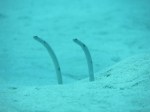
Dive 5: Yamamoto Special: depth: 14.5m, dive time: 68mins, water temp; 29C, entry tie: 12:34, exit time: 13:44, average depth: 10.0m, used a 10L steel tank, 5mm wetsuit and 3kg back plate (no extra weight in pocket).  Start pressure: 200 bar, End pressure: 30 bar.  Saw orange clownfish, whitetail chromis, spotted garden eels, ornate ghost pipefish, seaweed pipefish, blue spot rock cod, banded coral shrimp, Japanese shrimp goby, emperor angel fish and slender sweepers.

June 2013: Yoronto, Kagoshima Prefecture, Japan

Sunday June 16th and Monday June 17th 2013

The last island in the Amami Island chain south of Japan is filled with traditional villages, sugar cane farms and a sandy beach known as the stardust beach due to deposits of dead plankton that look just like stars.  Flying over the brightest coral reef I have ever seen, I soon spot the island as it emerges in the distance, a hidden gem that’s shaped a bit like an angel fish.

Yoronto (or Yoron-jima or Yoron Island) is situated on the southernmost end of Kagoshima prefecture in Kyushu, southern Japan.  With a circumference of around 24km and a population of about 5000, it’s famous for its surrounding barrier and fringe reefs and a climate with an average temperature of about 20C.  Drop offs, arches, tunnels and crevasses feature widely at many of the diving spots as well as some narrow passageways where divers can swim over the star-shaped sand.  We spent two days on Yoronto and visited the following dive sites:

Shinaha is a beach along the northwest coast with a typical water temperature of around 29C.  The dives here are conducted close by, off a boat.  Divers descend along a rope to about 8m and turn right, heading down to about 10m.  This brings them to a vast open area covered in coral.   Between the coral are wide pathways of sand.  Cuttlefish are known to lay eggs and mate here while the area is very common for turtles (2 greeted us upon descent) and sea snakes also slither around so it’s a good idea to keep an eye out during the dive.

Denpoguchi is known for its range of crevasses.  The dive begins down a rope to about 8m and continues into a narrow tunnel down to a little over 15m.  Below is a bed of star-shaped sand and on either side the walls of rock stretch directly upwards, almost like monoliths.  To get the most out of this area, crawl along the sand with a light which you can shine into the dark spaces and openings along the bottom.  This is the home of lobster, prawns (if you look closely), lion fish, butterfly fish, red soldier fish, starfish and nudibranchs including an impressive yellow one with red spots called the Glossodoris cruenta, its frilly mantle moving from side to side.  The sun will shine through as you ascend, providing some great photo opportunities.

The coral reefs and coral mounds at B&G are smaller and the site is a vast area of sand, making it extremely good for trial dives and newly-certified divers.  As there was a first-time diver in our group, we stayed at around 5m exploring the many clusters of coral after descending from the boat (no rope required).  Our first encounter was with a medium-sized anemone, home to a couple of aggressive clownfish and their babies as well as a small crab nestled closely among the tentacles. The fish here are bright and plentiful.  A medium-sized sea slug lay relaxing on the sand, while green damselfish, threadfin butterfly fish, yellow brown wrasses and domino damselfish live quietly in the dark corners of each coral mound. Not the most exciting dive for advanced divers but a great site to practice skills and take close up shots.

Chinsen Amami is a shipwreck at 34-35m.  It lies on its side and is thought to have sunk around May 1993.  With the right planning it’s possible to get up close but due to some new divers in our group, we looked down at the wreck from around 20m.  Visibility is excellent and the ship is crystal clear from above so this is not a good spot if you are scared of heights!  When the current is relatively strong, schools of white tuna and bluefin trevally are known to drift past.  The dive begins with a descent along a rope to 13m and a swim over huge colossal rocks and coral formations until the wreck emerges. The water is bright blue but the area around the wreck isn’t home to much and a more interesting environment awaits on the ascent.  The rocks are large enough to house a purple nudibranch at 18m, clownfish and anemones that all enjoy the little nooks and crannies, while schools of longfin batfish look extremely relaxed as they swim by along with pink square fairy basslets, blue banded snappers and triggerfish.

Any diver who enjoys rocks, crevasses and narrow passageways will appreciate the Double Crevasse, so-called after its range of small and large crevasses and arches.  It’s a good area to see small coral reef fishes darting in and out of branch coral and is one of the main breeding grounds during the spring for turtles and squid.  We descended along a rope once more to 13m and immediately entered our first passageway where a shrimp stared back at us with huge eyes.  Swimming over the star-shaped sand we saw lion fish and some starfish.  The passageways are particularly narrow so buoyancy is key and all equipment should be kept as close to you as possible to avoid tangling. It’s also teeming with macro life and a great site for close up shots.

Practical information

  • I booked the Yoronto trip with Paradise Island Tours based in Tokyo (http://www.pitdiving.com/travel/)
  • JAL flights via Kagoshima leave Tokyo between 8AM and 9AM and land around lunchtime or early afternoon.  It is possible to do at least one dive on the day of arrival.
  • Our school Buku Buku Divers (http:// http://www.buku2.com/main-index.html) was there to meet us at the airport and drive us to the school.
  • Diving equipment can be sent from Tokyo in advance for about 2,500yen, using Kuroneko Takkyubin.
  • Buku Buku Divers is about 10mins’ drive from the airport.  Immediately upon entering, there is a long table for divers to fill in and sign forms.  On the right hand side is an area for equipment storage and on the left an outside area to wash, hang and dry gear, and a couple of toilets and changing rooms. Not much in the way of books or magazines.  Free tea is provided.
  • After loading the van with equipment, we drove to the nearest port and left the van there during the day.  All dives are boat dives.  The boat is very spacious and flat with almost no indoor area.  Divers sit on the floor with their equipment.  Bring your own towel, sunscreen and snacks.  Sweets and tea are provided.
  • Lunch is not provided so don’t forget to bring something light!
  • All entries into the water are backward rolls.  Ascent is up a ladder.
  • After each dive, everyone heads back to the port for a quick break which means the van is stored with a LOT of tanks.  All dive sites are about 10-15mins from the port.
  • Divers are responsible for looking after their own equipment.  The hotel we stayed at has a special area to hang and wash gear so after diving we were driven back to the hotel and sorted out our equipment accordingly.  The next day the school collected us with our equipment.
  • We stayed at the Yoronto Village Pension about 15mins away from Buku Buku Divers.  The hotel room is not so clean (a bit dusty and furniture was old) but it is spacious with WIFI and other usual amenities such as towels, shampoo, shower gel, soap and toothbrushes.  Outside our room was a nice grassy area to sit and have a coffee or read.  Breakfast was Japanese style (rice, soup, pickles, vegetables and grilled fish) and Western (toast, eggs, salad, coffee) the next.  Dinner is excellent – in addition to the usual rice, miso soup, pickles and veg, there are all kinds of Yoronto specialties in terms of fish, meat and alcohol.  Dinner is in a separate tatami straw mat room, very Japanese!
  • There are no bars, pubs and shops close to the hotel.  Having access to a car is highly recommended.  Car hire can be arranged through the hotel, even for a 2hr period and there is a lot to see including the star-shaped sand, camp sites and sugar cane fields.  Very flat and easy to drive around.
  • The total cost was around 85,000yen including return flights, two nights in the hotel with breakfast and dinner, 4 dives (guide, tanks and weights) and all transport.
  • The hotel will drive you to the airport after your stay.

 June’s dives

Dive 1: Shinaha: depth: 10.8m, dive time: 47mins, water temp: 28C, entry time: 14:47, exit time: 15:25, average depth: 7.4m, used a 10L steel tank, 5mm wetsuit and 3kg weights (back plate, no extra weights), Start pressure: 190 bar, End pressure: 80 bar.  Saw turtles and sea snakes.

Dive 2: Denpoguchi: depth: 15.2m, dive time: 46mins, water temp: 28C, entry time: 16:38, exit time: 17:25, average depth: 9.5m, used a 10L steel tank, 5mm wetsuit and 3kg weights (back plate, no extra weights).  Start pressure: 210 bar, End pressure: 70 bar.  Saw lobster, prawns, lion fish, butterfly fish, red soldier fish, starfish and nudibranchs

Dive 3: B&G: depth: 4.8m, dive time: 35mins, water temp: 28C, entry time: 09:15AM, exit time: 09:50AM, average depth: 3.5m, used a 10L steel tank, 5mm wetsuit and 3kg weights (back plate, no extra weights).  Start pressure: 190 bar, End pressure: 135 bar.  Saw green damselfish, threadfin butterfly fish, yellow brown wrasses, domino damselfish, clown fish, anemones and sea slugs.

Dive 4: Chinsen Amami: depth: 22.4m, dive time: 33mins, water temp: 28C, entry time: 10:56AM, exit time: 11:37AM, average depth: 13.3m, used a 10L steel tank, 5mm wetsuit and 3kg weights (back plate, no extra weights).  Start pressure: 200 bar, End pressure: 70 bar.  Saw schools of longfin batfish. pink square fairy basslets, blue banded snappers and triggerfish

Dive 5: Double Crevasse: depth: 14.8m, dive time: 41mins, water temp: 28C, entry time: 12:38, exit time: 13;21, average depth: 10.2m, used a 10L steel tank, 5mm wetsuit and 3kg weights (back plate, no extra weights).  Start pressure: 190 bar, End pressure: 70 bar.  Saw lion fish and star fish.