Category Archives: Uncategorized

June 2013: Freshwater and Altitude Diving, Lake Motosuko, Yamanashi, Japan

Saturday June 1st 2013


Lake Motosuko at the foot of Mt Fuji is a great introduction to freshwater and altitude diving.  Freshwater, or rather lakes, rivers and streams, offer some huge advantages such as excellent visibility and a range of things to see such as rock formations, stalagmites, mangroves and algae.  Freshwater is also less dense than salt water so less weight is needed, but add on altitude diving and there are various points to keep in mind.  The reduced atmospheric pressure at the surface affects depth gauges and when the diver ascends, the rate of change as the ambient pressure drops is far greater than when ascending from a dive in the sea.  Adjusting your dive computer to the equivalent setting is a must.

Every June, hoards of divers and non-divers descend on Lake Motosuko to participate in an annual cleanup project aimed at removing debris and litter from the lake bottom and surrounding areas.  The lake is around 900 meters in altitude and goes down to a depth of around 138m. In the 9th century, Mt Fuji erupted and a large prehistoric lake separated into three smaller ones.  Lake Motosuko is one of the three.  

Before the clean up begins, divers can pick up a map from the organizers, which marks out areas with the most litter.  Once separated into pairs, they are then free to choose where they want to go and head right in so my buddy and I swam westwards, descending slowly.  The lake is caked in thick sediment (ash and silt) so stable buoyancy is crucial.  Kicking hard will stir up the sediment and worsen visibility, making things difficult not just for yourself but also for your buddy and in the worst case you can lose each other altogether.  Each buddy pair also has a mesh bag to put the litter into so the diver with the bag must remain suitably buoyant as his load becomes heavier.  

We swam past a slope of sediment and volcanic rocks at around 5m, strewn with items like fish hooks, fishing lines, beer cans, plastic containers, hair ties and small boxes that once contained takeaway meals.  Here we collected as much as we could before taking a slight right turn and swimming down to around 9-10m.  Near the lake are camp sites, excursion boats and windsurfing facilities so a lot of debris is simply dumped and pollution from various water activities has made the water quite cloudy so despite swimming carefully, visibility was not altogether great.  In terms of fish and plant life, we spotted a lot of weed-like plants and a couple of large grey fish, probably a type of trout as rainbow and brown trout are known to inhabit the lake in addition to shrimp and other smaller fish.  At 16 degrees the water is extremely cold.  Wearing a dry suit is the best option by far but it’s possible to cope in a 5-7mm wetsuit and a 3mm hood and vest underneath.  A hood and gloves are also essential.  Due to the altitude and low temperature, 30 minutes is the recommended time to stay underwater.

Not only does the cleanup help the community of Motosuko and the environment, but it also provides an opportunity for divers to experience something new and practice their skills, buoyancy in particular or even areas such as searching and retrieving.  In other words it’s a great opportunity to help out and gain some expertise.  The amount of litter our group collected, once all the mesh bags were put together, has no doubt had some impact on Motosuko’s environment.

  • My dive group heads to Lake Motosuko on a Friday night and stays at one of the nearby camp sites for the weekend, ready to start our dive first thing on Saturday morning
  • Participation is arranged by our group and tanks are provided by the cleanup organizers.  Divers pay for their own transport to the area and camping facilities such as tent space, food and drink.  Those not keen to camp can also stay at one of the many cottages that are also part of the camp site.
  • For divers keen to arrange their own dives at the lake, the Motosuko Dive Resort, which charges around 12,600yen for 2 shore dives, might be a good option.  Their website is here: http://motosukodiving.com/

June’s dives

Dive 1: Lake Motosuko: depth: 9.4m, dive time: 29mins, water temp: 16C, entry time: 10:00AM, exit time: 10:29AM, average depth: 5.5m,used a 5mm wetsuit, 3mm hood/vest and 3kg weight (back plate as part of BC).  Saw plenty of weed-like plants and a couple of trout-like fish


May 2013: Sydney, Australia

IMG_0188IMG_0194

IMG_0196IMG_0198

IMG_0199IMG_0200

shark-5shark-7

shark-9shark-13

Saturday May 4th and Sunday May 5th 2013

Sydney is often overlooked as a dive destination because of the popular Great Barrier Reef but it’s a hidden treasure trove of sites and marine life ranging from the spectacular to the scary. In May I spent around a week in Sydney and got to explore its underwater world for myself.

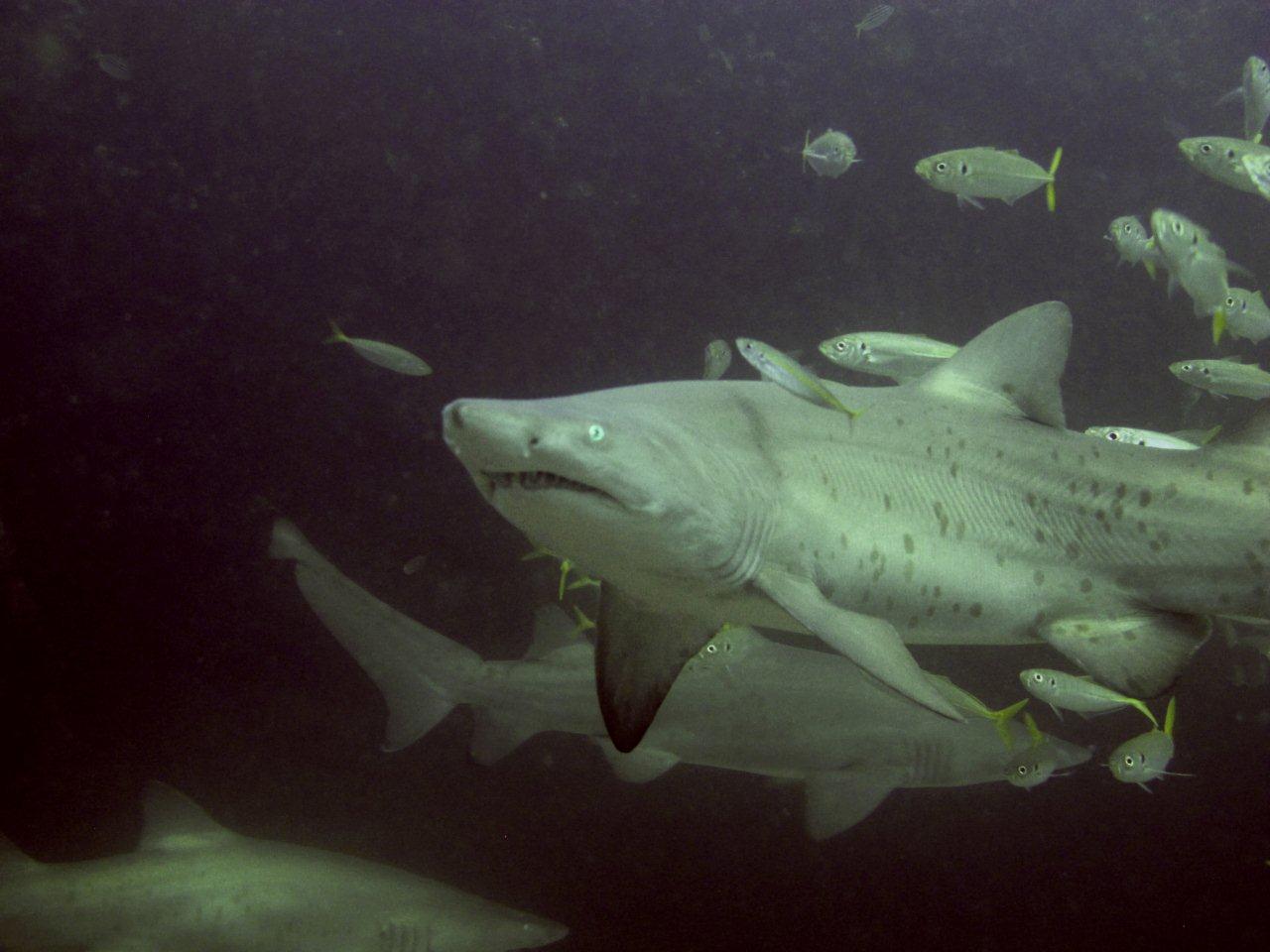
Sharks often spring to mind when we hear the word Australia. Not a nice thought at all but they of all things were waiting for me on the first dive of my trip. Sydney has a fairly big grey nurse shark population and to see the sharks at first hand, divers take a boat from a marina in Manly and travel for roughly 30 minutes past the Opera House, Harbor Bridge and Bondi Beach to a tiny spot in the open sea with a few cliffs in the distance. Not much to behold, but this is the dive site Magic Point.

Peering over the boat into the water, I was glad to know that I wasn’t the only one thinking I’d gone mad as a dozen or so backpackers and Dive Masters were on board with me. I began my descent somewhat relieved at being accompanied by all these people. At Magic Point, divers can generally reach 20m and a bit beyond but to guarantee a better chance of spotting sharks and to have more time underwater, 14-16m is the recommended depth. Magic Point consists of two caves that sit opposite each other, with a sandy area at 14m where divers can kneel and observe all the action. We came to rest here, in front of the larger of the two caves that stretched for about 15m in an east/west direction.

A couple of grey nurse sharks soon made their way out of the cave and swam around us. Although daunting with protruding teeth, there is no record of them ever having attacked a human. Rather, they are shy. At certain times of the year they aggregate together and establish particular swimming patterns that keep them close but with enough personal space as well. A large creature like a diver can disturb this process and stress them out. As a result they disappear, leaving the dive quite unexciting.

The grey nurse sharks were spectacular to behold and once we became more used to what we were seeing, the dive began to feel very relaxing. But there were only so many sharks and photo opportunities we could take, so we headed north to an area of large boulders and a bed of kelp and other seaweed. This is a good place to meet some of Sydney’s other marine life such as cuttlefish, huge sting rays, blue devilfish, yellowtail, sucker fish and pilot fish. The leafy sea dragon in particular is delightful. It’s one of the most elusive creatures a diver will ever get to see, which makes spotting them extremely special (we found a couple of medium-sized ones). Using a pectoral fin on their necks and a dorsal fin close to their tails, they propel themselves slowly, perfectly camouflaged with their habitat and hiding from their predators such as sharks and rays. During the journey back to the boat, the dive ended with a nice touch as a giant ray swam over us as we headed toward 5m for our safety stop.

My next dive site, Shelly Beach near Manly is by far the most popular shore dive in Sydney, thanks to its sheltered location and calm shallow water. In fact, it’s so popular that benches have been provided especially for divers to set up equipment. Facing west, the beach is well protected and conditions are almost always suitable for diving. Fishing and collecting has been entirely prohibited here since 2002 and the marine life thrives.

We arrived on a very hot and sunny afternoon and walked into the water to begin the dive. The sandy bottom makes it easy to put on fins and masks and the descent is slow and simple – a gentle swim down to about 8m over the sand. Our first dive was to the right of the bay (The Right Hand Side) where there is a medium-sized rocky wall. As the dive begins it is not the most exciting due to the lack of coral and macro life. In the shallower depths the rocks are mostly devoid of life.

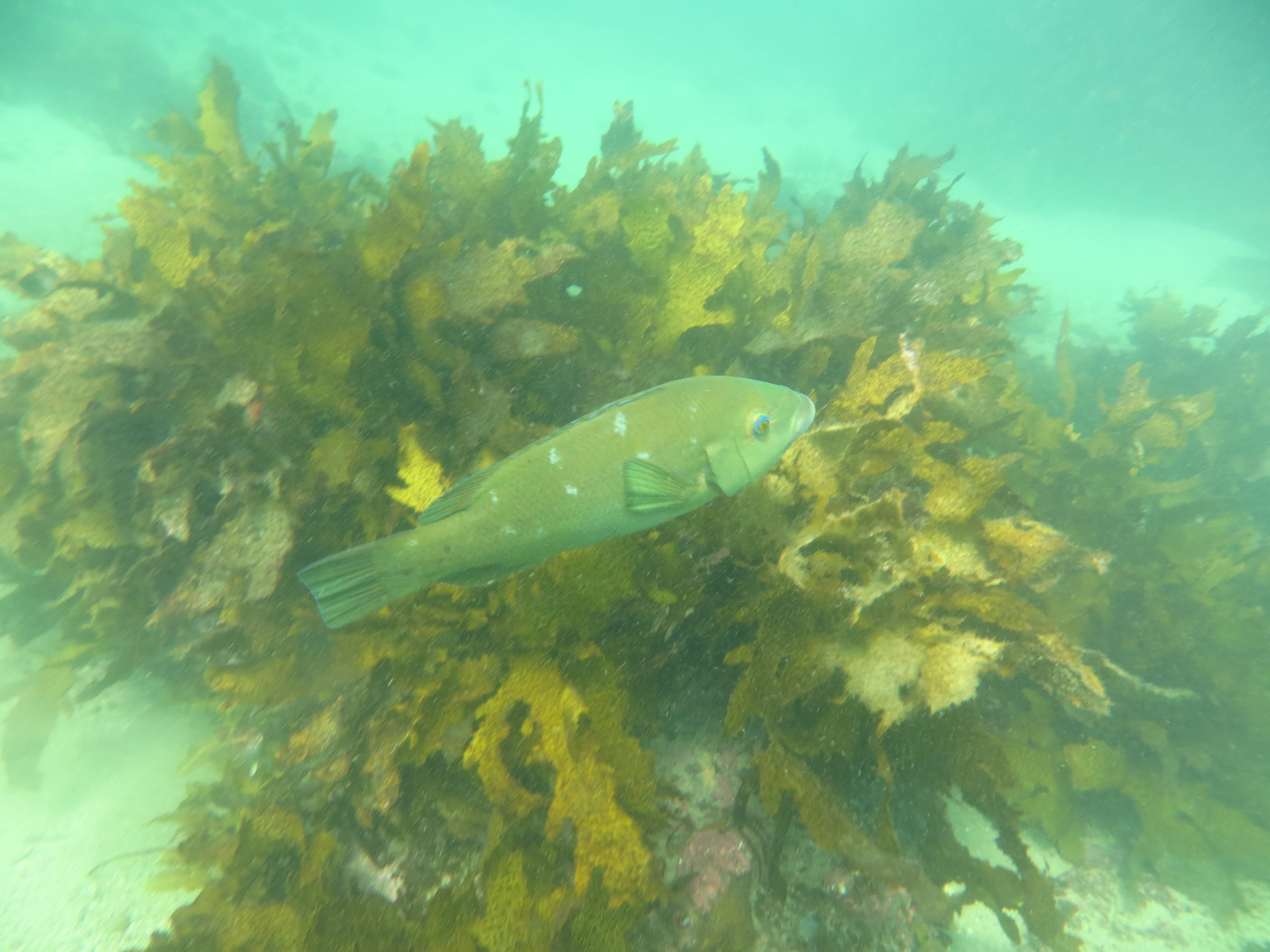
Things get a lot more interesting between 10m and 12m where the wall of rock on the right begins to spread out further over the sand. This area houses a lot more in the way of seaweed and tiny holes for creatures like crabs to hide in. In terms of height, the rocks are medium to high. Our first encounter was with a giant cuttlefish excellently camouflaged against the rock. Straining our eyes we could see him hovering slowly before he swam off, while a couple of blue gropers, possibly male and female, then glided slowly past us followed by a ray shark.

The Left Hand Side was the location of our second dive. Here there is only a small series of rocks and a lot more weedy terrain which is home to a lot of temperate fish life. White sand and a natural reef of tumbled boulders spread out again to about 12m and there is plenty to see although we soon discovered that we were the ones being watched, by a medium-sized flounder well hidden in the sand, his eye poking out at us. We came across more blue gropers and schools of yellow barracudas and long fin banner fish had made a home for themselves too. Blennies darted here and there and juvenile leatherjackets hid among the seaweed. Looking closely, one was even hanging onto a piece. The highlight, mainly for our dive guide, was spotting a turtle, apparently almost never seen at Shelley Beach. The Left Hand Side can also be described as a very deep snorkel. It’s perfect for novice divers, refresher courses and Open Water training.

Practical information

 I spent a week in Sydney from the end of April to early May, staying at the Wake Up! youth hostel near Central Station. All dives were arranged upon arrival in Sydney.
 I booked my dives with Pro Dive Sydney (http://www.prodivesydney.com/divecenter/store/sydney). Their boat leaves every morning around 8AM from the marina at Manly. All divers are expected to make their own way there and the best route is the 30min boat from Circular Quay costing around 17 dollars return.
 The boat to Magic Point has an area in the middle for divers to place their tanks and set up their equipment. Along the edge you can sit, stand and enjoy the view. Warm soup and sweets are provided during the journey. Basic toilet and sink but no area to rinse off/shower after dives. Inside the boat is a medium-sized table and comfortable sofa with books, magazines, Pro Dive leaflets and stamps for logbooks.
 Entry into the water is by forward stride.
 After two dives at Magic Point everyone heads back to Manly, finishing up around lunchtime. No showers are available so you need to bring your own shampoo, shower gel and use one of the showers on Manly Beach. As the dives finish by lunchtime, customers are free to have their own lunch in Manly.
 To dive at Shelly Beach, you need to be at the dive school at around 9AM.
 The dive school is a short 15-20min walk from the marina where the boat from Circular Quay arrives.
 At the school customers renting gear help the dive guides prepare the equipment and load it onto the van. Shelly Beach is a short 15min drive away from the school.
 Parking is available at a council car park at the end of Bower Street. Showers, toilets, changing facilities and gas BBQs are available in the park and a Kiosk cafe and restaurant are located at the waterfront.
 After using the benches to prepare equipment, divers walk to the shore carrying full gear. Entry is a simple walk into the water.
 Dives at Shelly Beach also finish up around lunchtime. After 2 dives you are driven back to the school where showers are provided and there is time to write in log books or have a coffee. Divers also help wash their rental equipment.
 The Pro Dive shop consists of an equipment area, training pool, changing room, two showers and toilets and a shop selling equipment and books.

May’s dives

Dive 1: Magic Point: depth: 20.7m, dive time: 46mins, water temperature: 17C, entry time: 9:39AM, exit time: 10:26AM, average depth: 12.8m, used a 7mm wetsuit and 8kg weights. Start pressure: 220 bar, End pressure: 50 bar. Saw grey nurse sharks, 2 leafy sea dragons, a sting ray, sea urchins and blue gropers.

Dive 2: Shelly Beach Right Hand Side: depth: 7.9m, dive time: 35mins, water temperature: 20C, entry time: 9:25AM, exit time: 10:00AM, average depth: 4.4m, used a 7mm wetsuit and 12L aluminium tank. Start pressure: 230 bar, End pressure: 170 bar. Saw cuttle fish, mauri wrass, blue gropers and a ray shark.

Dive 3: Shelly Beach Left Hand Side: depth: 4.8m, dive time: 40mins, water temperature: 20C, entry time: 11:06AM, exit time: 11:47AM, average depth: 2.7m, used a 7mm wetsuit and 12L aluminium tank. Start pressure: 210 bar, End pressure: 150 bar. Saw more blue gropers, schools of yellowtail barracudas, juvenile leatherjackets and a turtle.

April 2013: The Marine Diving Fair, Ikebukuro, Tokyo, Japan

IMG_4830 IMG_4834 IMG_4835 IMG_4841 IMG_4844 72147_4572032830180_2022434886_n 553818_4572033910207_1411641772_n

Friday April 5th to Sunday April 7th 2013

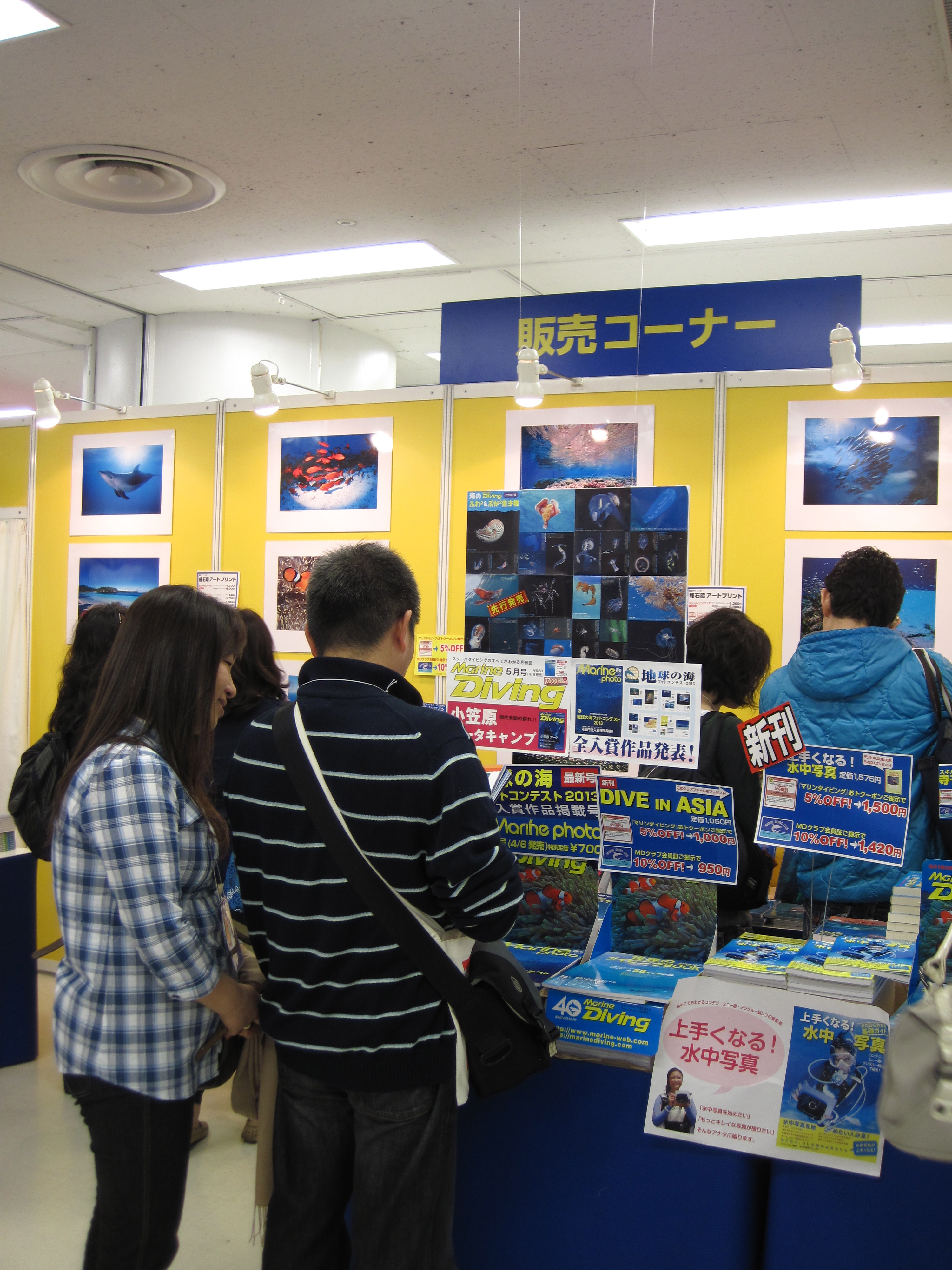
A popular activity and a whole range of dive sites, is the message I got out of this year’s Marine Diving Fair, an annual event in Tokyo showcasing dive schools,  cameras, photos, books and much more which I attended this month.  Although the event was mostly for promotional purposes,  it was also a chance to get some tips on photo editing, learn about travel deals and sit down with doctors to discuss diving-related medical issues.

The event is organized by Japan’s first scuba diving magazine Marine Diver which began in 1969.  I was fortunate enough to meet and talk to the editor who agreed with me that Japan’s diving industry is not that well known in other countries and that more could be done to promote it.

My top 3 highlights of the event were:

1)  Sanriku Volunteer Divers in Tohoku

2) Okinawa

3) Some unexpected dive sites

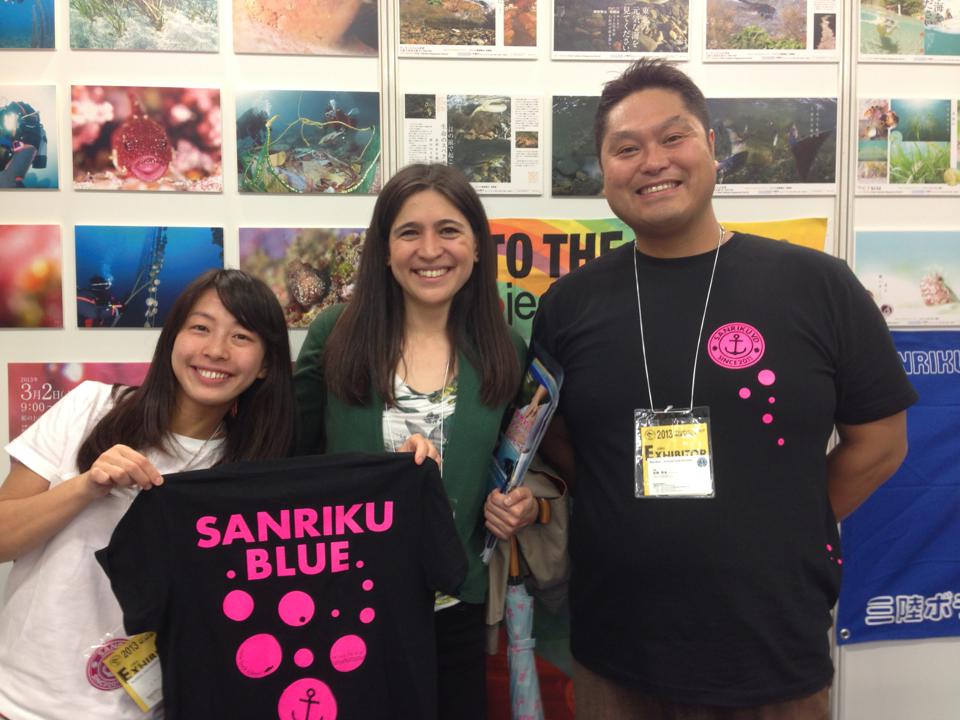
Sanriku Volunteer Divers are a group of divers and fishermen cleaning up after the earthquake and tsunami of March 2011.  I stopped off at their booth to catch up with some people I met while volunteering in late 2011. Although a lot remains to be done, the sea is much clearer, cleaner and full of life.  The leader of the group also runs a tour called the Salmon Swim to observe salmon swimming upstream.  Sure enough, the fish are returning in numbers as the underwater photos on display clearly showed.  One challenge now is the radiation and knowing just how many people will want to dive in Tohoku for fun, even when the debris has all gone.

Okinawa is the pride and joy of Japan’s diving scene and the main feature of this year’s event.   The coral reefs and marine life are world class and I came across a range of schools with staff dressed in traditional costume offering the latest local information and specialties like free samples of sake and seaweed.  Diving is always possible in Okinawa because it’s warm all year and there appears to have been an increase in the number of tourists coming to see the manta rays of Ishigaki or the mysterious ruins of Yonaguni.  The choice of dive sites and types of diving is staggering.  This year some fisheries cooperatives and conservation groups had also joined, highlighting issues such as sustainable fishing and coral preservation.

Over the past couple of years since I began heading under the sea, I’ve found that Japan does come up with some unexpected surprises.  This year’s event had also drawn schools from more obscure areas.  One particularly interesting place was Yakushima off Kyushu’s Kagoshima prefecture.   This island is a popular hiking destination, famous for its forests and having some of the oldest trees in the world.  But the warm Kuroshio current also makes its way by, bringing a great range of fish and in turn, some impressive diving.  I got some information on the topography (tunnels, cracks, waterways) and some dive sites only 10 minutes away from the main port.  Wakayama prefecture south of Osaka and Kochi prefecture in Shikoku have now made it onto my list of destinations as well.  As there is very little information available, these areas are almost always overlooked but I could see from the leaflets and underwater photos that there is much more to them than I think.

The Marine Diving Fair drew a huge audience from across Japan.  I queued for a little over 20 minutes to enter the venue and was struck by just how many people there were.  With such a big interest, the need for such events will only get larger so it’s to be expected that dive schools and other dive-related organisations spend time, money and research into making better products or offering even better services.  Although opinions were varied – one fellow diver did say that the demand for diving will probably not rise that much, given the high cost of diving and unemployment particularly among young people, making them unable to afford trips.  What will happen in future is definitely worth keeping an eye on.

March 2013: Ice Diving, Shiretoko, Hokkaido, Japan

OLYMPUS DIGITAL CAMERA OLYMPUS DIGITAL CAMERA OLYMPUS DIGITAL CAMERA OLYMPUS DIGITAL CAMERA OLYMPUS DIGITAL CAMERA OLYMPUS DIGITAL CAMERA 857289_4147045449392_275085785_o OLYMPUS DIGITAL CAMERA

Saturday March 2nd 2013

Japan’s northernmost island of Hokkaido is a harsh environment in winter with huge amounts of snow and constant blizzards.  The wind is icy cold and the weather very changeable.  Yet even in an environment such as this, it is still possible to dive.   In February, frozen ice from the Sea of Okhotsk breaks up, detaches from the coast and is blown south by a northerly wind. Its journey ends at the northeastern Shiretoko Peninsula and marks the start of the ice diving season, an ideal opportunity for those who want to try something a little more adventurous.

The Shiretoko Peninsula is most well known for its unspoilt national parks with a variety of wildlife including brown bears and deer.  In winter however, it becomes a key area for observing drift ice, either through a short boat cruise or by diving.   Donning a dry suit and entering the ice is the gateway to a whole new experience.

Ice diving is not as difficult as it sounds but it is an advanced form of diving that is risky and there are several points to bear in mind.  Number one, you are diving in an enclosed environment with only one entry and exit point.   Although the layers of ice above you are floating, they are huge, heavy and close together, making it impossible to get out should you become lost.  Before the dive, a hole is dug and a small area is then created to set up equipment.   Through the hole goes a long rope which is fixed at around 3.5m.   Divers must never lose sight of it.

Number two is the incredibly high risk of hypothermia.  The water temperature is usually around 0 to -2 degrees and the dives are kept to within 10m.   The length of each will vary depending on how comfortable everyone is.  A 5mm hood and special thick gloves are essential and the dry suit must be zipped properly and double checked to prevent water seeping in.   If any diver feels cold, they must signal to ascend immediately, at which point their dive comes to an end.

Number three is the risk of equipment freezing.  When the pressure of air flowing from the cylinder into the first stage regulator is dramatically reduced, a lot of heat is lost as well.  The water surrounding the metal parts of the regulator is cooled and if the water is already very cold, as it is during an ice dive, it can cause the regulator to freeze.  A design with an environmental seal and a band that goes around the head securing the regulator firmly into the diver’s mouth can prevent this.  In addition to dry suits, weights and the usual equipment,  back-up scuba gear, tools to cut a hole into the ice, a shelter, rope, extra hoods and gloves must also be available in addition to a number of staff on standby, stationed around the hole.

Chashikotsuzaki, our dive site, is small and simple.  Out in the frozen open sea, our hotel was clearly visible in the distance as we held onto the rope and began to ascend, getting used to our dry suits, judging how much air was in them and practicing adding and releasing air accordingly.  The rope ended at 3.5m and before us was a collection of extremely large rocks.    With no current, crystal clear visibility and staff on hand, the dives were calm and relaxing.  At first glance the site doesn’t look exciting but a closer inspection of the rocks brought us to an array of small sea urchins, starfish and an collection of plain-looking anemones in addition to a tiny fascinating green shrimp with no English name, very well camouflaged against the bright green kelp.  The combination of sunlight and the extraordinary formation of the ice sheets above creates an interesting and ever-changing array of colour with a fascinating range of shades.  Around us, tiny species of jellyfish and plankton drifted slowly by but the highlight tends to be the ice at the surface, which reinforces the whole concept of ice diving as you look up and gaze in wonder and it offers some excellent photo opportunities as well.

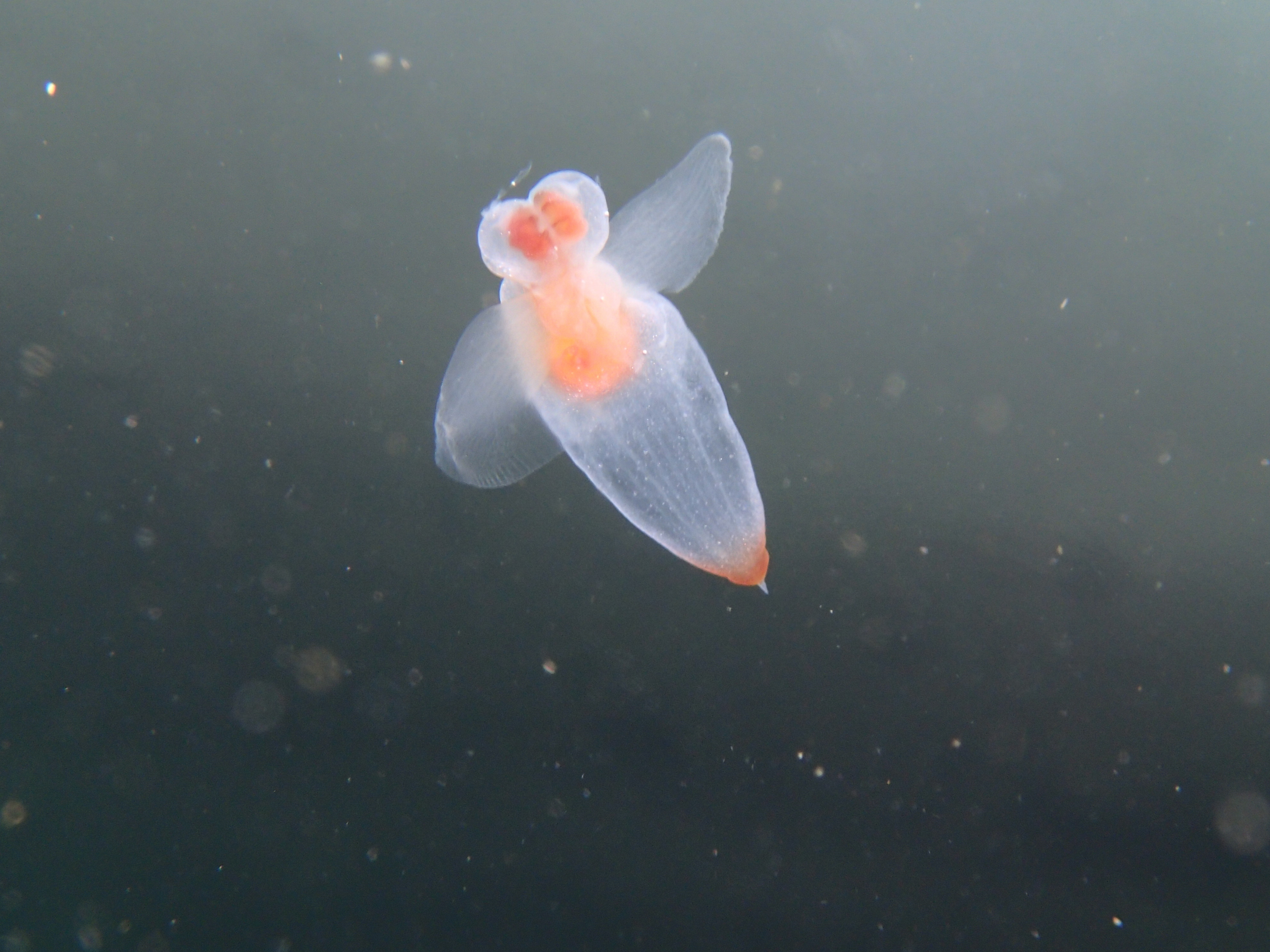
For those more curious about the marine life, the star of the show is the Clione, a type of sea slug also known as a Sea Angel.  Its name fits perfectly.  An extremely tiny creature, almost a dot in the distance and impossible to spot, the Clione has a transparent body, wings and cute ears, making it look a lot like an angel.   It’s born swimming in the ocean and continues to do so until it dies, never once touching the bottom.  As it flaps its wings it almost seems to be flying, and is said to be able to survive a year without any food.  Usually they will eat other swimming sea snails.

If the spirit of adventure and unusual challenging diving appeals, then ice diving is an absolute must.  The day is more of an introduction and with a basic Open Water license anyone can have a go but courses are available for those who wish to train in earnest.  Given the extreme cold, not many are keen on trying again so most people who go ice diving tend to be repeaters and there are some good points –  in addition to the marine life, clear water and feeling of satisfaction at having attempted something different, a long soak in the hot spring and a cold beer afterwards makes the whole experience worth it.

Practical information

  • We took a direct JAL flight from Haneda to Memanbetsu at 17:55 which takes a little over 1hr 30mins (cost around 25,000yen return ticket)
  • At the airport we hired a car for the 2hr or so journey to Dolphin Hotel (Iruka Hotel) which is also a dive school.  Their website is: http://www.iruka-hotel.com/en/index.html
  • Iruka Hotel is right next to the sea.  Outside is a separate area for baths (shampoo, shower gel etc provided, tiny changing room) and a car park.
  • The hotel is stunning and the facilities are excellent.  There are lockers for shoes, vending machines (beer 250yen), spacious dining area, outdoor deck, sea views from rooms, bookshelf and boots to wear for walking around in the snow
  • Rooms are en-suite with tatami floors and futons.  Free WIFI also available
  • Japanese-style breakfast begins at 7:30.  Fish, miso soup, rice, cabbage, egg, seaweed, cod roe, pickes….tea (Japanese style) and coffee available all day
  • Preparations for diving begin around 9:00.  The dive site can be seen from the dining area and is a short 10min walk away.  We put on our dry suits in the storage room and took the rest of our equipment (masks, fins, dive lights, cameras, hoods, gloves etc) to the dive site ourselves.
  • At the site, a rope is set to about 3.5m.  Entry is a short shallow walk to the hole, before holding onto the rope and sliding in.
  • The price (30,000 – 50,000yen, flights not included) includes 2 dives and all equipment rental.
  • After dive 1 there is an hour or so toilet/coffee break, weather depending.  After dive 2 and before dinner is some free time.
  • Staff will clean and look after all your equipment but you can bring your own masks, fins, dive lights or cameras.
  • Dinner is also Japanese style – rice, miso soup, raw fish, octopus, pickles, seaweed etc.
  • The day of the return flight is a non-diving day.  Because the weather changes rapidly and can get bad there are limited things to do but it’s possible to drive to a few souvenir shops to buy presents, go to a lookout point to take photos of the frozen sea, or take a cruise (the Aurora cruise, 3,500yen or so) for a close-up look of the ice.
  • The return flight to Tokyo leaves around 20:30

March’s dives

Dive 1: Chashikotsuzaki: depth: 4.9m, dive time: 34mins, water temp: 3.3C, entry time: 10:57AM, exit time: 11:35, average depth:  2.4m, used a 10L tank, dry suit and 5mm hood.  Saw the clione, starfish, sea anemones, short-spined sea urchins and comb jellies

Dive 2: Chashikotsuzaki: depth: 5.2m, dive time: 35mins, water temp: -0.5C, entry time: 13:07, exit time: 13:40, average depth: 2.2m, used a 10L tank, dry suit and 5mm hood.  Saw the clione, starfish, sea anemones, short-spined sea urchins, small thin fish called eelpouts, comb jellies and a green shrimp (kusairomoebi in Japanese)

February 2013: Miyakojima, Okinawa, Japan

IMG_0062 IMG_0066 IMG_0073 IMG_0075 IMG_0078 IMG_0081 IMG_0082 IMG_0093 IMG_0097 IMG_0105 IMG_0151 IMG_0161 IMG_0164 IMG_0176

Monday February 18th and Tuesday February 19th 2013

Not to be confused with Miyakejima further south of Tokyo, Miyakojima lies about 300km southwest of the main island of Okinawa.  It’s a relatively flat place, made up of limestone and surrounded by smaller islets offering spectacular coral reefs, huge tunnels, rocks, arches and caves.  Two ocean currents run north past the island; the Taiwan Warm Current in the East China Sea which travels alongside mainland China, and the Kuroshio current which begins east of the Philippines.

Miyakojima is well known for its large number of limestone caves and arches.  Most of them are winding, horizontal to stepwise tunnels which open out into more sandy wide areas and smaller coral reefs.  The location of their entrances of course varies, some are as deep as 40m to 70m and some inner parts  can be almost or totally dark.  Because of the low energy of the seawater in the area, the sediments found along the bottom are generally very fine.   A lot of the main dive sites that offer this kind of environment can be found along the north coast of Irabu island, one of the many islets surrounding Miyakojima.   Here are some of the sites we visited:

The Overhang is almost at the central north coast and typical visibility is around 25m.  Descent is a giant stride from the boat and then along a rope to about 10m.  The area is very open with rocks and boulders dotted around.  Turning left and continuing down to 15-18m brought us to an opening with a number of smaller rocks which house a huge variety of coral and are home to linear blennies, emperor shrimps (if you look very closely) and plenty of semi circle angel fish streaking by.  The surfaces of the rocks, around 12m, are where the water is clearest.  Under the glare of the sun you can spot white spotted puffer fish, peach fairy basslets and coral groupers.

The Cross Hole is about 15mins away and offers a range of underwater caves and small cliffs.  Swimming down to about 15m, we arrived at the bottom of one huge rock formation.  Some of the rocks are almost like monoliths.  Here we turned left, heading down to about 18m and came to a small series of rocks clustered together.  White spotted puffer fish and yellow fin goatfish hover about while schools of yellow spot emperor fish flit around.  Next to these is a dark entrance into a small tunnel which is part of a massive rock.  Once inside, we swam straight up.  Its dynamic shape is impressive, offering a glimpse of interesting limestone formations and sea life different to usual coral gardens.  The exit is shaped slightly like a diamond and the sun shining through as we emerged was spectacular.

The W-Arch is 5mins or so away from the Cross Hole.  We used a rope to descend to around 6m.  Below us was one huge rock to the right and another on the left that had separated into two parts. We swam down to the left rock and arrived at a slight crack or opening at the side at around 11m, where schools of Indo-Pacific Sergeants darted in and out.  We moved on to about 18m before turning right towards another rock and swimming into a small entrance.  This led us down into a small area of dead coral, sand and bits of rock where we could literally sit and look up at the sun streaming through the openings.  The fish were bright and plentiful.  Yellow long nose butterfly fish had made a home for themselves in the dark corners, while coaxing a lionfish to swim towards the sun for a photo was perhaps not the best thing to do as he darted off, his fins bright red, leaving us with not the best of pictures.

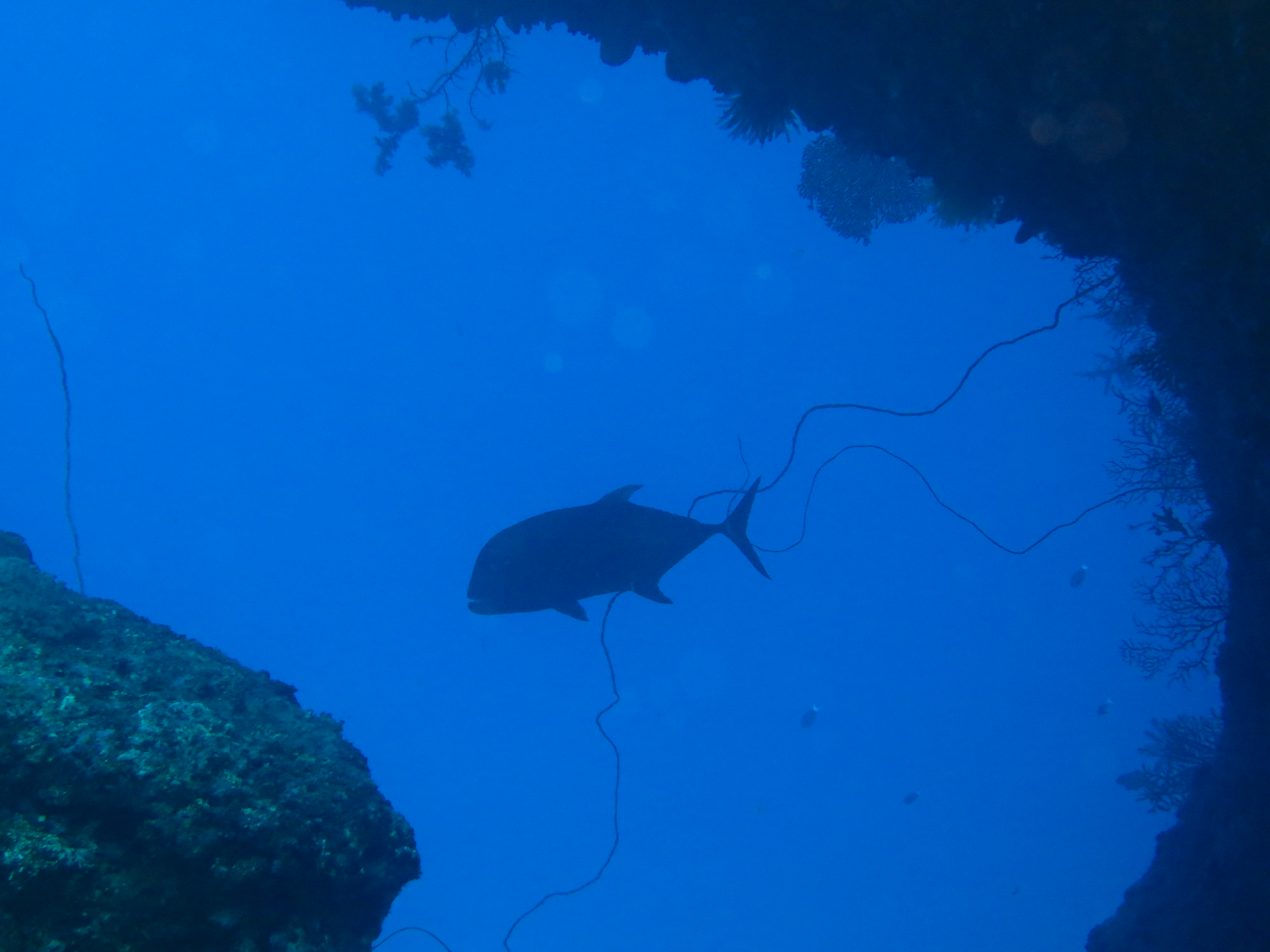
The highlight of the L-Arch is a 30m point through a tunnel which took us to the home of one giant trevally drifting slowly past. Next to us was a medium-sized boulder where we could hide and watch him from afar.  The water is extremely blue but isn’t home to much else, so heading back up the tunnel to 22m we found a more interesting environment, including rocks large enough to carry various coral species such as brain and table coral and hide lion fish, Indo-Pacific Sergeants, Black Fin dart fish, and tiny squat shrimps.  At 18m is a much smaller rock where we spotted a school of Indo Pacific Sergeants hanging around close to the sand.  For the rest of the dive, we stayed between 10m and 5m and came across more lion fish and blue striped snappers.

The focus of Gakeshita is one large rock surrounded by some smaller and perhaps even not-so-exciting ones that divers can meander through.  The maximum depth is around 22m with the large rock’s surface lying between 8m and 12m.  A huge variety of marine life has taken up residence here.  The rock’s surface is covered in an array of anemones that all shield varying kinds of clownfish including the orange clownfish, skunk clownfish and two-banded clownfish.  Some hide away as divers approach while others are more aggressive and can try to attack as you take a photo.  We also saw trumpet fish, shaded batfish, purple queens, a clown triggerfish, peach fairy basslets and yellowfin goatfish.  This site is good for beginner to intermediate divers to get a feel for two totally different things – coral gardens and limestone.

We were also able to swim into one rock before inflating our BCs and surfacing into an extremely humid pitch black dome.  As we rested at the surface, the swell from the open sea began to enter causing the water level to rise and with it atmospheric pressure.  As the swell receded, the air pressure went down, making our ears feel slightly uncomfortable, but soon we were met with a misty sheet of vapor hovering over the surface.  Such vapor is created when the water level rises and falls in an area of high humidity and there are said to be very few places to observe this while diving.  The ocean seen from inside the dome was a transparent blue and along with the vapor, formed an almost mystical sight.

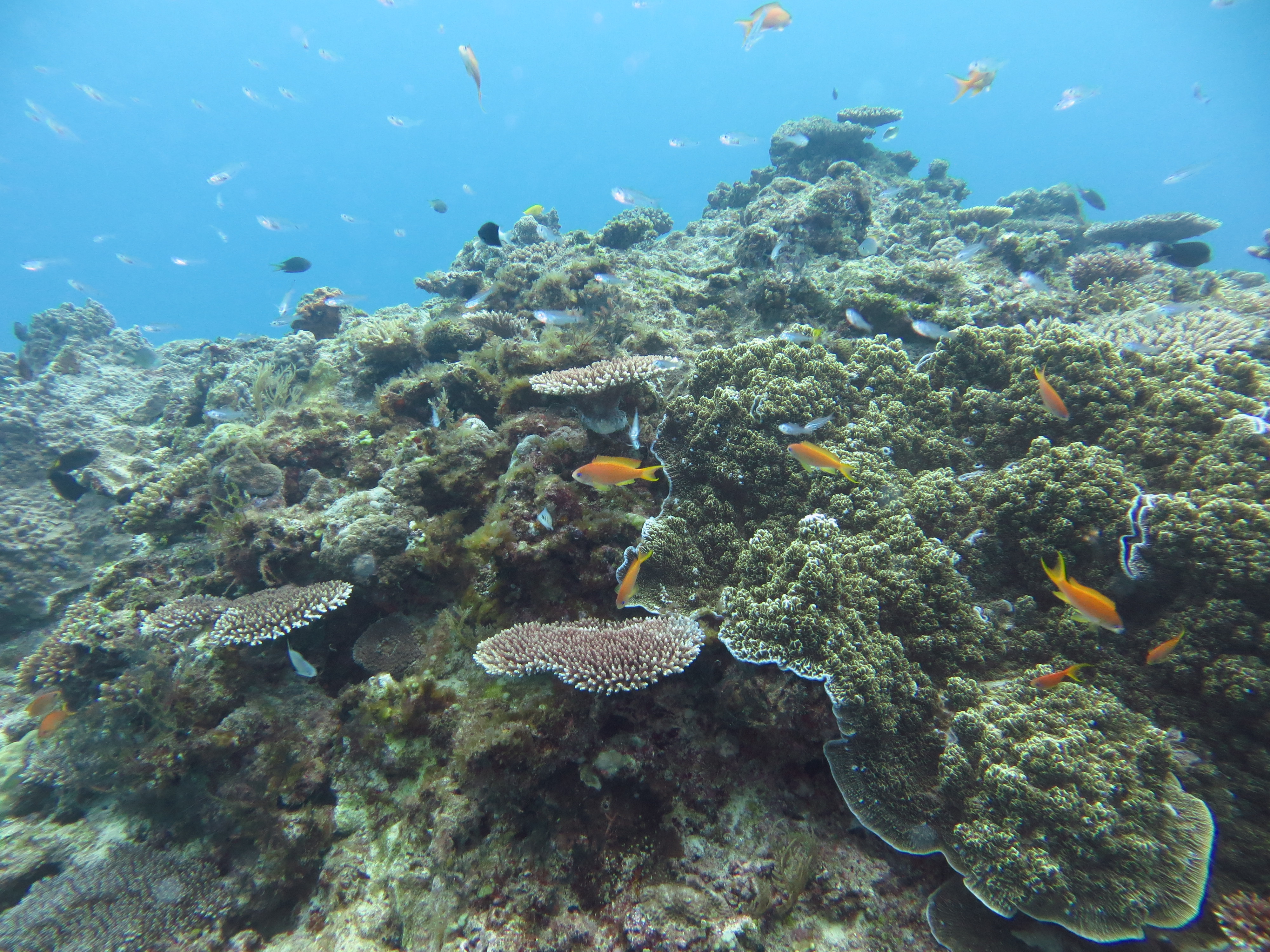
Wataguchi Garden is extremely accessible and will appeal to beginners or as an easy relaxing dive at the end of a long day.  Coral gardens (staghorn coral, gorgonian fans and table coral) met us upon descent, while nearby a ray emerged, shaking off its sand camouflage and disappearing into the distance.  The maximum depth is 11-12m, visibility is pristine and the water not too cold.  The dive consists of meandering between different rocks and coral heads along a bottom of pure white sand.  After a good deal of sea snakes, black spotted puffer fish, white backed anemone fish and even an adorable medium-sized puffer fish drifting slowly by with huge eyes, we spent the rest of our time swimming between each rock, all of them a lot more spread out that we thought.

Practical information

  • I booked the Miyakojima trip with Paradise Island Tours based in Tokyo (http://www.pit-diving.com/travel/)
  • JTA flights direct to Miyakojima leave from Haneda airport at 6:55AM, getting to the island around 10:15.  Return flights to Tokyo leave around 20:00, arriving at 22:35.
  • Our school Dive Kids (http://www.divekids.jp/a/frame1.htm ) was there to meet us on arrival and drive us to the school.
  • Diving equipment can be sent from Tokyo in advance for about 2,500yen, using Kuroneko Takkyubin.
  • Dive Kids is about 5mins’ drive from the main port.  On the left side is a huge area to wash, hang/dry equipment and take showers (no shampoo, conditioner and soap provided), while next door on the right is an area to fill in log books, complete with an outside terrace, plenty of books and magazines on marine life, and free coffee.
  • After being picked up at the hotel, we drove to the port and left the van there during the day.  All dives are boat dives.  The boat is very spacious with an outdoor deck and an upstairs for catching more sun.  Bring your own towels, sun cream and any other necessary items but sweets, tea and coffee are available all day.
  • Lunch is Japanese style and homemade.  We had takikomigohan (fried rice seasoned with soy sauce and vegetables) and tonjiru (miso soup with pork and vegetables) accompanied by pickles, kimchi and hot tea.
  • 2L bottles of warm water are available on deck for divers to pour over themselves when exiting from cold water.  There is a shower but it wasn’t in use.
  • All entries are giant strides from a small platform.  Ascent is via a ladder.
  • On the school’s white board, the staff draw a detailed map of every dive site you visit, along with fridge magnets of different fish.  This helps immensely when completing your dive logs and gives an excellent idea of what was seen and where.
  • We stayed at the Seiru Inn Hotel about 10mins drive away from Dive Kids.  The hotel is clean and spacious with WIFI and other usual amenities available such as towels, shampoo, soap and toothbrushes.  Breakfast is a buffet of rice, miso soup, bread, various vegetables and fish, eggs, tea and coffee.  Check out is 11AM.
  • Close to the hotel are a few good izakayas (Japanese style pubs) to go to for dinner.  The best is Usagiya which is next door to the hotel, offers salads, soups, small meat dishes (cubes of fried beef), raw fish and some live music accompanied by drums and the sanshin shamisen.  Customers can (or rather should) dance!
  • There is a range of convenience stores and general shops nearby.
  • The total cost was 80,000yen, including return flight, 4 boat dives including tanks and weights, two nights in the hotel with breakfast, and all transport.
  • Dive Kids will also drive you to the airport after your stay.

February’s dives

Dive 1: The Overhang: depth: 24.2m, dive time: 33mins, water temp: 22C, entry time: 11:53AM, exit time: 12:28, average depth:  12.4m, used a 10L tank, 5mm wetsuit, 3mm hood/vest and 2kg weights. Start pressure: 200 bar, End pressure: 40 bar.  Saw white spotted puffer fish, peach fairy basslets and coral groupers.

Dive 2: Cross Hole: depth: 24.0m, dive time: 37mins, water temp: 22C, entry time: 13:42, exit time: 14:20, average depth: 12m, used a 12L tank, 5mm wetsuit, 3mm hood/vest and 1kg weight.  Start pressure: 170 bar, End pressure: 20 bar.  Saw white spotted puffer fish, yellow fin goatfish, yellow spot emperor fish, Indo-Pacific Sergeants and their eggs, sweepers and humphead parrot fish

Dive 3: W-Arch: depth: 16.1m, dive time: 38mins, water temp: 22C, entry time: 15:20, exit time: 15:58, average depth: 10.3m, used a 10L tank, 5mm wetsuit, 3mm hood/vest and 2kg weights.  Start pressure: 180 bar, End pressure: 20 bar.  Saw trumpet shells, magenta dottybacks, lion fish, Indo-Pacific sergeants, black fin dart fish, firefish (in schools) and yellow longnose butterfly fish.

Dive 4: L-Arch: depth: 30.8m, dive time: 33mins, water temp: 22C, entry time: 09:41AM, exit time: 10:04 average depth: 14.4m, used a 12L tank, 5mm wetsuit, 3mm hood/vest and 2kg weights.  Start pressure: 200 bar, End pressure: 40 bar.  Saw Indo-Pacific sergeants, black fin dart fish, squat shrimps, blue striped snappers, giant trevally, lion fish and firefish.

Dive 5: Gakeshita: depth: 16.1m, dive time: 46mins, water temp: 22C, entry time: 11:05AM, exit time: 11:51AM, average depth: 8.6m, used a 12L tank, 5mm wetsuit, 3mm hood/vest and 1kg weight.  Start pressure: 180 bar, End pressure: 40 bar.  Saw trumpet fish, shaded batfish, purple queens, orange clownfish, clown triggerfish, peach fairy basslets and yellowfin goatfish.

Dive 6: Wataguchi Garden: depth: 12m, dive time: 46mins, water temp: 22C, entry time: 14:22, exit time: 15:08, average depth: 9.1m, used a 12L tank, 5mm wetsuit, 3mm hood/vest and 1kg weight.  Start pressure: 170 bar, End pressure: 70 bar: Saw goldlined sea bream, coral groupers, semi circle angelfish, black spotter puffer fish, arrow cardinal fish, sting rays, sea snakes, white backed anemone fish and one porcupine fish.
November 2012: Into The World of the Rescue Diver, Yugawara and Osezaki, Japan

Saturday November 9th and Sunday November 10th 2012

Becoming a Rescue diver is just that – learning how to rescue others underwater and at the surface.  Mention to a non-diver that you’ve been taught some rescue skills, and it feels good when they tell you how impressed they are.  But as Rescue divers, are we really 100% confident that we can put our skills to good use, jump in and save the day?

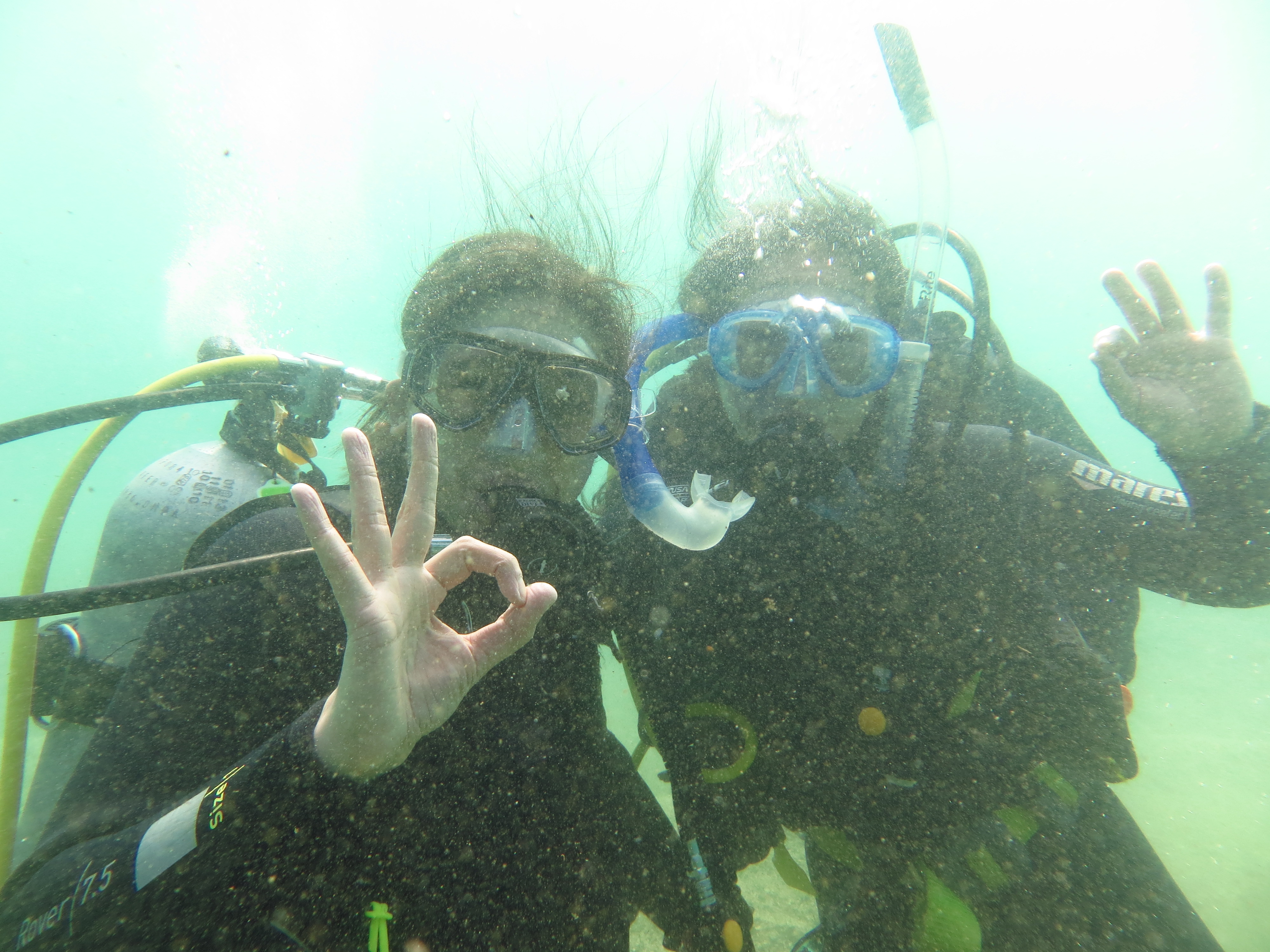
Designed to exert a considerable physical toll, the training consists of a pool session and two days in open water.  The course comes with a theory/knowledge section and a practical element.  The textbook and theory are vast, covering a variety of issues such as signs of stress, treating injuries, bites, stings, equipment, first aid, general health and safety and rescue skills, culminating in a multiple choice test of 75 questions and a quick group discussion on the correct answers.  The practical side consists of tasks like out-of-air emergencies, towing, lifting an unconscious diver from the bottom, removing a victim from the water and responding to panic.

The word rescue immediately conjures up the notion of saving and helping others but the number one rule a rescuer must understand is not to put their own safety at risk.  For example, a diver panicking at the surface, kicking and splashing around, can actually be hazardous so keep a safe distance and talk to the victim to identify the problem.  If the victim continues to panic, get below the surface so they do not lunge at you, pull off your mask or mouthpiece or push you underwater.  Then grab the victim’s legs or back of the BC, get directly behind them and inflate their BC. Both divers must be fully buoyant when above water and usually a slight reassuring touch or talking to them gently is enough.

If the victim is unconscious, lie them flat on the surface with BC fully inflated and check for breathing.  If there is no sign of this, remove the mask and mouthpiece, tilt the head backwards and begin mouth to mouth.  As you do this, you will need to tow the victim back to shore, and this is easiest when both victim and rescuer are not wearing their equipment.  Removing equipment must be done by the rescuer while towing and offering mouth-to-mouth.   The victim is then hoisted onto the rescuer’s back with their arms over the rescuer’s shoulders, while the rescuer carries them (like a piggy back) out of the water.
Other tasks, especially in the pool, are designed to test students slightly, such as breathing underwater with no mask for 60 seconds, swapping masks with buddies, turning off air and a bit of free diving practice – swimming down to 5m to pick up a 4kg weight belt and rescuing others by free diving as well.   CPR and oxygen administration are also part of the course, oxygen being the treatment of choice for decompression illnesses as it speeds up the elimination of inert gas from the tissues.

The two days in open water are both challenging and fun – constantly on the alert and suddenly being presented with various scenarios like panicking divers, general dives during which your buddy suddenly becomes unconscious and out-of-air situations, all of which make the student perform the skills learned in the pool and in particular react quickly and show a sense of urgency, not simply rescuing but also identifying the need for a rescue and deciding what needs to be done, why and by whom.  This is another challenging yet fundamental part of the course – knowing how to rescue, knowing the layout and other features of the area in which you will be rescuing, what tasks to give to which person and why.

Most new rescue divers, myself included, are not comfortable with the idea of jumping in and saving the day, in other words carrying out an actual rescue.  But the course is  good for increasing your comfort and confidence, and reinforces the idea that diving is also about being aware of your buddy, their equipment (keeping an eye on it, knowing where everything is, how you might remove it if required) and possible problems that could arise.  I was told that hopefully I would not need to use the  skills I learned for a very long time if ever, but in case I do, I know at least some simple things like how to support a victim’s neck while towing.  And that it itself made the whole course worth it.

(Many thanks to Osamu for his photos of the rescue course – fortunately he did not require rescuing!)