Category Archives: Uncategorized

April 2012: Tulamben Bay and the USAT Liberty Wreck, Bali, Indonesia

Sunday April 29th 2012

For the next few days into early May I’ll be exploring the crystal clear waters of Bali with some fellow divers.  Also known as the Island of a Thousand Puras or the Island of the Gods, Bali lies between Java and Lombok.  Just 140km by 80km, there are bright green rice paddies, pristine beaches and volcanoes, the main one being Gunung Agung which the polite and friendly locals consider sacred.  The island is also famous for sugar cane, coffee, fruit and vegetables, woodcarving, handcrafts and sarongs.  But despite the beauty and appeal around us, it’s the sea that has brought us here.  We flew into Denpasar and arrived in Candidasa on the northeast coast for the start of our Bali adventure.

Originally a less well-known diving destination, Bali has now become something of a tropical paradise with plenty of varied and widespread dive sites.  The main ones are north and northeast, with everything on offer from small nudibranchs, shrimps and crabs to cuttlefish, lion fish and huge wrasses.  As the sites are widely spaced out around the island, there is plenty of driving involved to get from one to the next.  Divers can enjoy deep drop-offs, coral ridges, coral gardens, the Lombok Strait (a deep water trench containing powerful currents that can be nerve-wracking for a beginner but also offer great visibility and a bit of a challenge!) and one of the most famous wrecks in the world, the USAT Liberty where our dives kicked off today.

The USAT Liberty sank during the Second World War after being torpedoed by a Japanese submarine in the Lombok Strait.  Today it lies 9-30m deep in Tulamben Bay, an area of black sand and rock.  The 120m-long wreck is of course huge, and clearly shows just how quickly a marine ecosystem can develop – it is teeming with life.

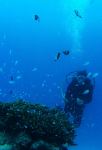
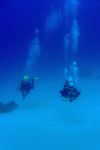
Our guides carried our equipment down to the pebble beach and helped us prepare.  We geared up at the water’s edge and wobbled across the pebbles to enter the water.  Upon descent, we swam straight ahead, watching the pebbles disappear and be replaced by a black volcanic sandy slope around 8-9m.  Before too long, the outline of the wreck began to emerge.  Visibility wasn’t the best and made the wreck seem quite eery, slowly emerging from the dark depths below.  On approach we swam left alongside the ship which is decked in sponges and soft coral fans, both host to an array of marine creatures such as wrasses, butterfly fish, angel fish, eels, parrot fish and a huge swirling school of big eye jack fish almost immediately upon descent.  The wreck is full of nooks, crannies, ledges and crevices which are great spots for getting up close to anything interesting and taking photos.  Together with our guide, my buddy and I stayed quite close to the surface as it had been a while since our last dives, but we looked down at the huge impressive formation spread out below us, and had enough sunlight to clearly see the different fish and coral.  With water temperatures between 29-31 degrees Celsius, the dive was extremely comfortable.

While wrecks appear deep, dark, mysterious and even dangerous, for many they are educational, exciting and an adventure.  A basic wreck dive such as ours today involves simply swimming alongside or over the vessel, admiring all the creatures that have made the wreck their home, and taking lots of pictures.  It gets more risky when the diver decides to penetrate the vessel.  One thing to be aware of is the possibility of becoming caught or tangled up in something, so carrying a dive knife is a good idea.  There is always a chance of problems – becoming lost, being left in the dark (if your light fails) or injury (accidentally touching sharp parts of the wreck) .  Some vessels can contain hazardous materials such as heavy containers or metal which mustn’t be interfered with.  Before the dive begins, it’s vital to be familiar with the layout of the wreck and know what you might see during the dive.  In case of poor visibility, it is always useful to carry a light (one main and one backup) and having a guideline attached outside the wreck for ascent and descent could be handy.  Buoyancy control can also make a dive much more fun, as you are not kicking up sand and silt and thus spoiling any photo opportunities.   Above all, a wreck is an underwater graveyard and it’s vital to respect it as such.

Although still slightly apprehensive about wreck diving, swimming over the USAT Liberty made me understand why so many divers enjoy the adventure and excitement that a wreck has to offer.  Exploring the vessel gave me a good introduction to more challenging dives, which I hope to build on in future.  The Liberty is also a great start to diving in Bali.

April’s dives

Dive 1: USAT Liberty: depth: 11.9m, dive time: 54mins, water temp: 31C, entry time: 11:00AM, exit time: 11:54AM, average depth: 7.68m, used an 11.1L aluminium tank, 5kg weight belt and 5mm wetsuit.  Saw nudibranchs, parrot fish, Moorish Idols and jack fish.

Dive 2: USAT Liberty: depth: 8.5m, dive time: 58mins, water temp: 31C, entry time: 14:30, exit time: 15:28, average depth: 5.14m, used an 11.1L aluminium tank, 6kg weight belt and 5mm wetsuit.  Saw Moorish Idols, fan coral, anemone crabs and parrot fish.
March 2012: The Challenges A Diver Faces, Osezaki, Shizuoka, Japan


Saturday March 17th and Sunday March 18th 2012

It goes without saying that scuba diving is not just about swimming in warm tropical seas admiring colourful fish and coral.  It’s also about entering cold water with zero visibility in pouring rain, losing confidence over basic skills, and getting used to some unfamiliar things such as dry suits.

Scuba diving attracts a lot of people and getting to know the underwater world is a thrilling experience, but divers can face an array of issues.  Every dive is different, and there’s no knowing how things will develop, so it’s vital to be as prepared as possible, aware of what might go wrong depending on the day’s conditions and think about what you might do in a problematic situation.  As the dives got underway on Saturday morning, I was already feeling apprehensive.  This is usually the first indication that the dives could be tricky.  The more nervous you are, the more likely you are to panic and not know how to proceed.

Looking back on my March weekend in Osezaki which turned out to be slightly more difficult than other dive trips, I researched some of the problems I experienced and read up on how to solve them.  Here’s what I found.

Poor visibility: Entering murky water and seeing next to nothing is no fun, and of course difficult without the necessary skills.  Poor visibility is even harder if you are far from the shore or swimming fairly deep.  The first thing to keep in mind is to look around, be aware of any wave action or currents and evaluate the environment you are in.  Better still, make sure you are familiar with the dive site and talk to your buddy and the other divers about it and what to expect.  You also need to know your position and that of your buddy’s.  If you lose each other, start swimming to the surface.  The most important thing above all is staying calm.  It helps to carry a dive light, use a stable descent and ascent line, swim slowly and plan your dive well, discussing signals (sound as hands may not be that visible), how deep you will go, for how long, and which parts of the site you intend to explore.

Buoyancy:  Easy diving is all about achieving neutral buoyancy, but getting there is certainly a struggle.  Constantly adding air or letting it out of your BC to stay at the required depth is annoying, and can greatly affect air consumption.  First of all, it’s  important to have the right amount of weights on your weight belt.  To find out, when you are at the surface make sure that you are at eye level with the water with no air in your BC.  It’s good to note that saltwater is denser than freshwater, so you will need more weights to dive in the sea.  As you enter the water with your BC fully inflated, you are positively buoyant.  To descend you need to become negatively buoyant, so you deflate the BC and exhale.  As the descent is quite quick, it’s good to add air to your BC and breathe in until your descent stops and you are still in the water.  This is neutral buoyancy.  It also helps to swim slowly and horizontally, clip your octopus, console and other items close to you, breathe steadily and continuously, stay calm and patient, practise often, and observe other divers.

Ear clearing: Get this one wrong and you could end up with an ear injury or worse still, impair your sense of hearing.  The pressure change underwater is huge, especially at the first 10m.  As normal pressure levels are reduced, air inside the ear becomes compressed.  The water outside the ear increases in pressure and leads to “squeeze,” that uncomfortable feeling.  It’s important to begin equalizing as soon as possible at the surface and then repeat every metre until you reach your required depth.  Some divers wiggle their jaws from side to side, others swallow but the most common method is to blow the nose gently while pinching the nostrils together.  A small crackling or popping sound means you have successfully cleared your ears.  In addition, relax and take slow deep breaths.

Buddy communication:  Communicating with your buddy is a must for a fun and successful dive.  Rather than take risks, it’s much more important to communicate openly if you are unsure about anything.  The standard buddy check involves checking each other’s gear so you know where everything is, how they work and whether they are functioning.  BCs, weights (are they fastened properly and how do you release the belt if necessary?), air content, gauges, regulators and octopus (breathe from them to make sure they work), slates, lights and cameras must all be looked over.  Afterwards, you need to discuss a dive plan (aim, course, entry/exit points, max. depth, and time underwater).  You also need to establish the amount of air you will need, who will lead and if you will dive to the left or right of your buddy.  Talk over communication signals (for example how you will tell each other it’s time to ascend), and what you will do if separated.  If you are unsure about anything or don’t feel confident diving with your buddy, make this crystal clear.

Of course, achieving all this doesn’t happen overnight.  My next challenge is to apply the above information to some upcoming dives in Bali!

February 2012: The Ins and Outs of the Dry Suit, Osezaki, Shizuoka, Japan

Saturday February 11th 2012

Women and dry suits are apparently a match made in heaven. Dry suits are good for us because we get colder much easier than men do, because the rate in which blood vessels near the surface of the skin constrict to retain heat happens much faster and more often for us than it does for men. We also have a much larger surface area over which to lose heat. Temperature aside, when the dry suit is removed we are “dry,” which lets us skip a shower and just wash our hair, saving plenty of time.

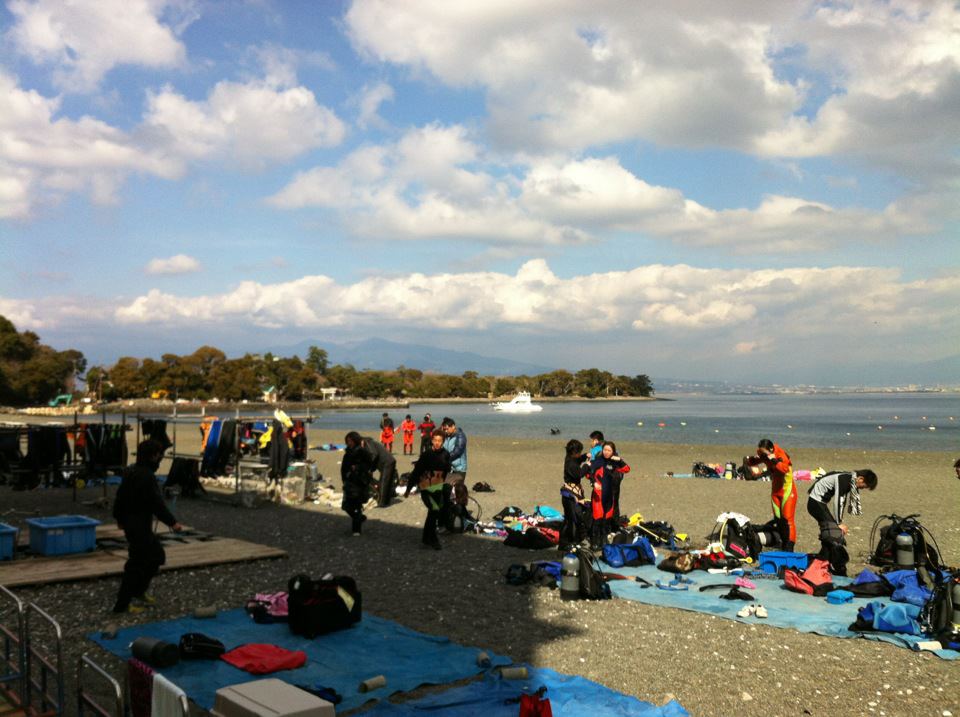
With this, I headed to Osezaki in Shizuoka Prefecture in early February for my first dry suit dive this year. Osezaki is one of the most tranquil and isolated locations on the Izu Peninsula, offering great views of Mt Fuji on a clear day and access into the water from a beach and dive school located across the sand where divers can set up and store their equipment. My dive group offer most of their training down in Osezaki, and speak highly of the abundant marine life, schools of squid and many other creatures you can spot.

Underneath my dry suit I wore some plain yoga pants and some insulated undergarments (turtlenecks and leggings). The first thing I noticed upon donning the suit was how loose it was, with tight seals at the wrists, necks and ankles to keep water out. The suits themselves hold air inside the material, and are mainly worn when operating in very cold water, diving for long periods of time and when the diver won’t be moving around much, for example when remaining still to take photos.

During the dive, buoyancy and weight control were the hardest and most different to diving in a wetsuit. Because of water pressure upon descent, the air and the clothing between the suit and your skin compresses, and you can really feel it. This is called “squeeze.” It feels weird and even painful, but pressing the inflate valve located on your chest puts air into the suit from your tank, and relieves the feeling. The valve is connected to the tank via a low-pressure hose. The dry suit can also act as a BC. It’s easy to revert to back to the BC to help with buoyancy, but using two separate valves for more air is just confusing, so it’s more convenient to put air into the dry suit and leave the BC as an emergency life vest.

We also learned how to vent air using the exhaust valve on the left arm. To make sure all the air leaves the suit, the valve is located at the upper left arm, so we practiced lifting our left shoulder and elbow. It’s also possible to vent air automatically. Rotating the actual valve (which I could do on my dry suit) will allow air to escape when pressure in the suit is a little over ambient pressure.

I needed quite a lot of weight to descend smoothly (around 11kg) but having the minimum amount will allow you to add a minimum amount of air to your suit to control buoyancy. The weight belt can also help minimize the amount of air that goes towards your legs and feet.

Of course a dry suit keeps you warm and you can choose what you wear underneath and have some control over your level of comfort.  But they cost a lot more than a wetsuit, and maintenance is expensive too.  As I found, divers require some additional skills and more work on buoyancy (while in a wetsuit you don’t have to worry much about this) and the suit is quite bulky.

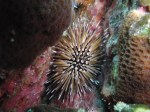
Dry suit information aside, Osezaki was a top dive site with an abundant marine life. Visibility was surprisingly good, and immediately upon descent we began swimming downwards across the sand until we reached some concrete boulders teaming with sea urchins and various species of small critters. The bay’s calm waters are ideal for training with many sheltered and calm areas.  There is also plenty for the more experienced diver.  Deeper down are large soft corals, sea whips and schools of squid which some of the others spotted but I was (and needed to be) focused on my dry suit so we stayed at around 12-13m and had a nice cruise around. As I hadn’t dived in a while, I had some minor ear clearing problems but was soon able to reach the bottom to practice venting air from the dry suit, and on the ascent relaxed a lot more, becoming completely mesmerized by a huge school of red fish with large dark eyes swimming among the concrete boulders just above the sea urchins.

I much prefer the tropical marine environment over colder waters, but was pleasantly surprised at how comfortable the dry suit was, and how the overall feeling underwater is not much different to diving in warmer environments.  I can see why women would prefer dry suits, but shorter hair is much better than long hair, to get the suit over your head through the tight neck seal.

2012: What Next?

In 2011 I discovered diving. Well, not an actual discovery as I’d had a taste of it the year before, but I decided to take things into my own hands by making a decision to dive once a month. My attempt to do this began after a short trip to New Caledonia back in 2010, when I signed up for a trial dive. 20mins or so underwater was all it took for me to make the link between diving, my interest in marine biology and my childhood holidays on Sado Island learning how to snorkel, and to know that I would be enjoying a lot more dives in the future.

As the year began I was very regimented and determined to complete my attempt. Things got off to a shaky start with a couple of trips in January and February to Ishigaki in Okinawa to see the famous manta rays which didn’t appear once. After that came the March 11th earthquake and tsunami and all notion of diving went out the window for a while, before I settled last minute on a tiny school in Atami. As of May things really kicked off as I discovered the joy and beauty of squid laying their eggs in Miyakejima, the warm tropical seas of a very hot Kumejima in June, and the fun of joining a dive group and meeting others with whom I shared some fantastic summer dives on a couple of islands south of Tokyo. I also learned not to mess with typhoons, as the weather destroyed any attempt to dive in September but things picked up in Okinawa and then in New Zealand. In both those destinations I got my first taste of deep diving, navigation, night diving and finding out what it’s like to dive in cold water. During my attempt I experienced some very different things – marine environments, stunning fish and other creatures, cold water, various skills, trying underwater photography, the fun and relaxation of swimming slowly among the fish as you literally enter their environment, sea sickness, diving with a hangover, unbelievable exhaustion, damaged skin and hair, huge bills on flights and rental gear, buying dive gear, I could go on forever. I am sad that my attempt is over but delighted that I did it and what I found most of all is that this is just the beginning. Diving once a month certainly does not make you a better diver.

So for me, 2012 is all about training. In a few weeks I’ll finish up an online marine biology diploma and start focusing on my Advanced license. If this goes well and I feel confident enough I’d like to try other courses like Nitrox or Rescue. I will be diving for fun too, including a week in Bali and hopefully here and there in Japan where the sea is much more beautiful and interesting than we realise. Of course I want to keep blogging, not just about diving but perhaps general marine issues or topics that involve Japan.  Sometime this year I intend to return to Rikuzentakata which was badly affected by last year’s earthquake.  I’m keen to see how the abalone farms are doing, and how the reconstruction and current situation are affecting the fishermen there.

I’ve sometimes been asked what my favourite dive spot was last year. It’s a hard question to answer as it depends on so many factors such as sea conditions, how you felt on the day or how your dive guide was, but May usually comes to mind. Of course the dives were enjoyable for all the usual reasons – warm blue water, plenty of marine life, good weather and some smooth dives.  But it was also a turning point, as my diving world began to grow with the discovery of other divers and options.

In diving there doesn’t seem to be any end goal. Something new is picked up all the time and today I am still struggling with basic skills. The road I am on is long, but I’m sure it will be just as fun and exciting as 2011 was.

December 2011: Island Bay, Wellington, New Zealand

Saturday December 24th, 2011

As I entered the waters of Island Bay near Wellington to complete my attempt to dive once a month, I couldn’t help thinking how different this experience was going to be compared to Japan. Because of its famous cold water, Wellington is a place most divers would probably choose not to go to. Its unique underwater world remains unknown to most visitors but the seas are forests of seaweed and kelp packed with a varied marine life. It’s certainly not tropical Okinawa, but what’s down below is just as fascinating.

Island Bay is a protected marine reserve, where nothing can be removed from the water. As a result, the area is full of information for Wellington’s marine biology students who come here in abundance during term time to study, and divers can observe an extremely rich variety of plants and animals. Situated about 5km south of Wellington city centre, Island Bay is a quaint suburb with churches, shops, cinemas and public transport all a short 10 minute walk away from the beach. Two scuba diving companies offer regular shore dives, boat dives and snorkeling tours. There is also plenty for the keen marine biologist – a small marine education centre, and the Victoria University coastal ecology laboratory.

My chosen dive shop was two doors away from my accommodation. At Splash Gordon, I was advised to do two easy shore dives, where I could enter slowly and get used to Wellington’s famous cold water, instead of jumping straight off a boat which would have been a shock to the system after Okinawa’s warmth. Today’s group had 8 members, most of them newly-qualified and about to do their first certified dive. I was paired up with Grant, a Wellington local due to start his Dive Master course with the school, so we opted to do our own thing while the others followed the guide. After loading all the equipment we drove for 5 mins to Bait House, a little bay tucked behind a small car park and some trees. The entry point was a short rocky path surrounded by tide pools on either side. Once deep enough we could swim out into the open sea, which looked extremely inviting under the scorching sun. As I walked across the slippery seaweed and rocks, I understood what was meant by the cold but was more impressed by the visibility. Already I could spot tiny fish sitting on the rocks, and mountains of plants to wade through.

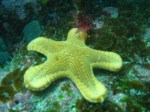
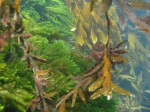
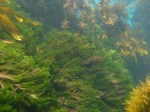
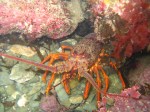
As the dive began, I started to feel like Harry Potter in the 4th film when he swims in the murky lake close to Hogwarts School. The water was far from murky, but the rocks around us were caked in long thick green seaweed and darker kelp, so much so that we had to push them away with our hands to create paths. We were literally swimming through forests, stopping occasionally to search for crabs, starfish, and other interesting specimens we could photograph. Bait House is made up of rocky reefs, which are weedy and crawling with marine plants, but deeper down are pebbles and more heavy sand. The average dive in Wellington tends to be around 12m, and at Bait House we remained just above 10, giving us ample time to get used to the cold, relax and focus on what was around us. Visibility was excellent, the water was fresh and clear, and the huge surrounding rocks provided us with narrow tunnels we could swim though. Every single crack and hole in the rocks contained a crayfish, huge ones resting on the sand below, and younger ones retreating into the cracks or sticking out their long pincers as we swam by. The cold water gave me a slight headache and there was a noticeable current but my buddy Grant knew the area well, and I was in good hands as I followed him past mountains of rock formations and rested on the pebbles below to observe the marine life around me. Island Bay doesn’t have a lot of fish but to compensate, we were spoiled by the huge amount of crayfish, starfish, sea anemones and even a white nudibranch family. Looking very closely, I could see mum and two babies.

Mermaid Kitchen just opposite the shop was the location of our second dive. I was greeted by swimthroughs, canyons and an array of marine life as I descended into one of Island Bay’s main dive sites with three other divers. During the afternoon the current seemed to have picked up and visibility was a lot worse than in the morning, but we descended to about 11m and entered even more swimthroughs further out at sea. There was no end to the huge amount of marine plants. Once again we cruised through them and found various tiny crabs and sea anemones. Most common were the crayfish also spotted this morning, deep purplish red and orange with rows of depressions across their tails and the swimming crab, a large creature that grows to about 8cm and uses its paddles for swimming or digging backwards into the sand. I was struck by the goby-like fish resting on the huge kelp that swam away the moment I tried to take a photo, and the blue cod perched in the sand thanks to their large pectoral and pelvis fins. The dive site is a photographer’s paradise with a range of colour (green, brown and pink seaweed) and a chance to discover the tiny details and patterns of seaweed, sea anemones, abalone and starfish.

It’s easy to overlook an area like Island Bay and head straight for warm tropical waters.  Such environments are perfect for divers and it’s much easier to relax and take your time when you’re in warm water surrounded by lots of colourful fish.  Sure enough my fellow divers today were concerned that I wouldn’t enjoy Island Bay after diving in Okinawa, but New Zealand has just as much to offer.  With the right wetsuit, the water is extremely comfortable, offering excellent visibility and a chance to see up close animals, plants and colours that can’t be found in tropical regions.    As a diver, I felt more than anything how important it is to have an open mind – to consider less popular or well-known areas and be open to discovering new creatures or new plants, even if they may not look particularly beautiful, or the water you are in is slightly cold.  I would highly recommend Island Bay as a top dive site.

Practical information

  • I booked two dives with Splash Gordon (http://www.splashgordon.co.nz/).  Originally I had planned to join them on their boat but switched to two basic shore dives.
  • Two dives with full gear hire cost 120 dollars or just over 7,000yen (such a bargain compared to Japan!)
  • The school has a big area at the entrance selling plenty of dive gear.  On the first floor is a huge area at the back for divers to set up or wash equipment, have a barbecue and fill in log books.  Upstairs are two classrooms for students learning how to dive.  No showers are provided.  Many divers drove to the school for the day and back again to get changed.
  • Hot tea and coffee is available.
  • Divers use their own cars to get to the dive site so I got a lift with a fellow diver after loading all our equipment into the car.
  • Lunch is provided by the school.  After dive 1 we drove back to the school for a barbecue of sausages, bread rolls, onions, ketchup, and plenty of tea, coffee and fruit juice.
  • You are responsible for all hired equipment.  The area to wash equipment in is extremely spacious – wooden tables and benches, a big tub of water for wetsuits, boots, masks, fins and snorkels, and a smaller tub for cameras.

December’s dives

Dive 1: Bait House: depth: 9.8m, dive time: 40mins, water temp: 13C, entry time: 11:06AM, exit time: 11:46AM, average depth: 4.6m, visibility: 8m, used an 11.1L aluminium tank, 11kg weight belt and 7mm wetsuit.  Saw crayfish, nudibranchs, sea anemones, forests of seaweed and kelp, banded wrasse, common triplefin, butterfish, beadlet anemone, kina (sea urchin)

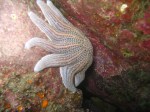
Dive 2: Mermaid’s Kitchen: depth: 11.3m, dive time: 37mins, water temp: 13C, entry time: 13:59, exit time: 14:36, average depth: 6.7m, visibility: 3-5m, used an 11.1L aluminium tank, 11kg weight belt and 7mm wetsuit.  Saw more crayfish, strapweed, coralline algae, 7-arm starfish, cushion star, and blue cod.

November 2011: Naha and the Kerama Islands, Okinawa, Japan

Sunday November 27th 2011

Although conditions were good on land as we woke up this morning, we’d decided to avoid another trip to the Kerama Islands due to yesterday’s rough crossings and increased winds.  We were disappointed at not being able to go to the islands once more, but I was delighted to know that we would still be relatively far out at sea with a better chance of good visibility and marine life.

We were picked up early in the morning and driven to the boat in order to set up our equipment and go over some final checks before beginning our journey.  Reef Encounters’ boat is large and spacious, with an area below deck to store tanks, a spare room below for storage or changing out of wetsuits and plenty of seating areas indoors and outdoors.  Our dive guide had brought along some soup which she heated up inside, a perfect addition to our journey as we spent most of it outside on deck feeling the cold wind.

Our destinations today were Ginowan Garden and Araha Beach.  Ginowan Garden is a simple dive, a cruise over some flat coral gardens.  It’s also not far from the Ginowan Pinnacles, the largest structure on the Ginowan coastline where pinnacles of reef come upwards to the surface.  The coral we saw on our first dive was distinctive and varied – mushroom, soft and hard corals.  We began by striding off the back of the boat and using the anchor line to guide our descent and allow for better control.  A slight current slowed us down somewhat but after arriving at 24m we were able to spend half an hour or so indulging in some adventurous sightseeing and forgetting the more challenging dives we’d planned for later on.  We discovered plenty of clownfish tucked away in mountains of coral formations and even near to the sandy bottom, safely concealed in sea anemones.  The corals had plenty of small little holes, cracks and crevices full of surprises.  Again we came across more trumpet fish (according to information online the Triton Trumpetfish were brought over from the Philippines to battle the Crown of Thorns starfish that destroys coral), a big puffer fish, sunset wrasse, surge wrasse, orange dashed gobies, striped wetlips, and checked under the mushroom coral for more lion fish.

Ginowan Garden is ideal for divers who wish to stay close to Naha or do not have time for a long boat trip to the Kerama Islands.  We returned here for dive 2 and this time I began to get a lot more familiar with the area, and comfortable hovering over the massive amount of coral below.  We stayed at 18m which offered some excellent visibility and a longer dive time.  Taking a flashlight to poke around underneath the coral is highly recommended too.  The site gives a good balance between coral and sandy patches, is ideal for practising navigation and photography, and a great place to appreciate just how beautiful and complex life underwater can be.  We found nudibranchs, yellow striped goatfish, red spotted blennies and even got to chase a small cuttlefish during our ascent.  We spotted him quite unexpectedly, and as we were relatively shallow there was plenty of sunlight shining straight over him, making him very easy to spot as he quickly swam away from us and over the coral out of sight.

Araha Beach was the location of our third and final dive.  We spent time a fair distance away from this popular family spot with soft sand and a giant wooden play structure that looks like an old ship.  Araha is one of the area’s busiest beaches with promenades and picnic tables, located close to shopping areas.  Far away from this, I got to experience my first deep dive over 30m, as a taste of things to come when I take my Advanced course next year.

There are many discussions as to why people dive deep.  At first glance, it doesn’t seem appealing – cold water, more water pressure and not much marine life, but some divers trade a long dive for a deep one to explore a well sunk wreck, search for different marine life or enjoy some ocean currents that are very strong on the bottom.  Others describe a feeling of excitement, relaxation as the sound of bubbles dies away (water pressure makes the sound echo much less), and a chance to explore sites that are difficult to access.  But deep diving is a skill in itself, requiring plenty of practice and tutoring.

I was delighted at getting through the dive.  What I’d read about the dark depths of the ocean were indeed true.  After swimming down for a while, I noticed that my eyes had begun to pick up different colours.  My green fins had turned yellow, and my dive guide’s mask had become blue.  We all know that less sunlight underwater makes everything dark but the most important reason for low visibility underwater is the weakening of the refraction capability of human eyes.  When light travels through water it is refracted, absorbed and scattered differently to when it travels through air.  As it passes through the water it is absorbed, with red disappearing first, followed by orange, yellow, green and then blue.  Using my flashlight here turned out to be a good exercise in revealing some startling colours that would have gone unnoticed.  As expected I also became extremely cold.  Water is a much better conductor of heat than air.  The water that comes into contact with your body during a dive warms up, expands and quickly carries the heat away from you.  I also consumed a lot of air quickly, due to the cold, perhaps anxiety and the heavier exertion of breathing at depth, so we could only stay at 34m for about 8 minutes.  Most of the dive was taken up by the ascent and descent.  It was thrilling to enter the realms of 30m or so, but I realised that when deep diving it’s important to have an objective, and not just dive in for the sake of it.  As we ascended my breathing became more slow and deep, and we cruised past semi circle angel fish, banner fish, giant clam shells, wrasses and puffer fish.  The best dives however, are always at much shallower depths.

Next month my attempt to dive once a month comes to a close in the waters off Wellington New Zealand.  I am looking forward to putting to use once again the skills I’ve picked up this year, and comparing New Zealand’s waters with Japan’s rich variety.

Practical information

  • My friend and I booked to spend the weekend with Reef Encounters (www.reefencounters.org) located about 30mins north of Naha city.
  • We took an evening flight (20:00) on a Thursday direct from Haneda to Naha with ANA, and returned on Monday leaving Naha at 19:00.  Total cost was around 30,000yen – very cheap for Okinawa!
  • When we arrived in Naha we paid around 4,000yen for a taxi ride (around 30mins) to the Hambi Resort (http://www.hambyresort.com/), located in the area of Chatan near the dive school.
  • The school has a big area at the entrance selling dive gear and text books.  Further behind is an office/classroom type area where you can sit and fill in log books, and an outdoor space to wash and hang gear.  One shower and one toilet.  No tea/coffee facilities.
  • We set up our equipment at the school and loaded it on to the van before driving off to our destinations.  No lunch is provided so we made frequent stops to the supermarket and convenience stores to stock up on water, lunch and snacks.  As there were no other customers except us, we relaxed a lot over the three days and took our time.
  • The dive school’s boat to the Kerama Islands is basic and spacious, located at the marina about 20mins drive away from the school.  We had an area below to change into our wetsuits, hot water, areas to sit indoors and on deck, and seating areas up top.
  • You are responsible for all hired equipment.  Back at the school, the area to wash equipment in is extremely spacious – two big tubs of water for wetsuits, books, masks fins and snorkels, and a smaller tub to soak cameras in.
  • We stayed in a small room at the Hambi Resort with a bunk bed, paying around 3,000yen a night.  No breakfast or dinner provided so we had to look around at nearby restaurants.  There weren’t many!  Most close early and open late but we did find a Mexican and Brazilian restaurant, and went to a nice night market and cheese cake cafe, where we got cheese cake for breakfast.  Kitchen and cutlery are available for your own cooking, and showers were excellent – towels, shampoo, shower gel, hairdryers all provided.
  • On our last night (Sunday) we booked into a hotel in Naha city and spent all of Monday in Naha, mainly walking around Kokusai dori, one of the main streets filled with souvenir shops, before boarding our flight back to Tokyo.

November’s dives

Dive 1: Ginowan Garden: depth: 24.2m, dive time: 34mins, water temp: 25.5C, average depth: 13.2m, entry time: 10:32AM, exit time: 11:06AM, used a 12L aluminium tank, 7kg weight belt and 5mm wetsuit.  Saw big puffer fish, nudibranchs, finger and plate coral, yellow boxfish (young adult), sunset wrasse, surge wrasse, anemone shrimp, striped wetlips, orange dashed goby

Dive 2: Ginowan Garden: depth: 18.6m, dive time: 45mins, water temp: 25.4C, average depth: 10.2m, entry time: 12:08, exit time: 12:53, used a 12L aluminium tank, 7kg weight belt and 5mm wetsuit.  Saw colourful soft coral, nudibranchs, chased a cuttlefish, yellowstriped goatfish and red spotted blennies

Dive 3: Araha Beach: depth 34.6m, dive time: 33mins, water temp: 25.3C, average depth: 18.3m, entry time: 14:31, exit time: 15:04, used a 12L aluminium tank, 7kg weight belt and 5mm wetsuit.  Saw semi circle angel fish, banner fish, giant clam shell, slingjaw wrasse, star puffer