Category Archives: Uncategorized

November 2011: Naha and the Kerama Islands, Okinawa, Japan

Saturday November 26th 2011

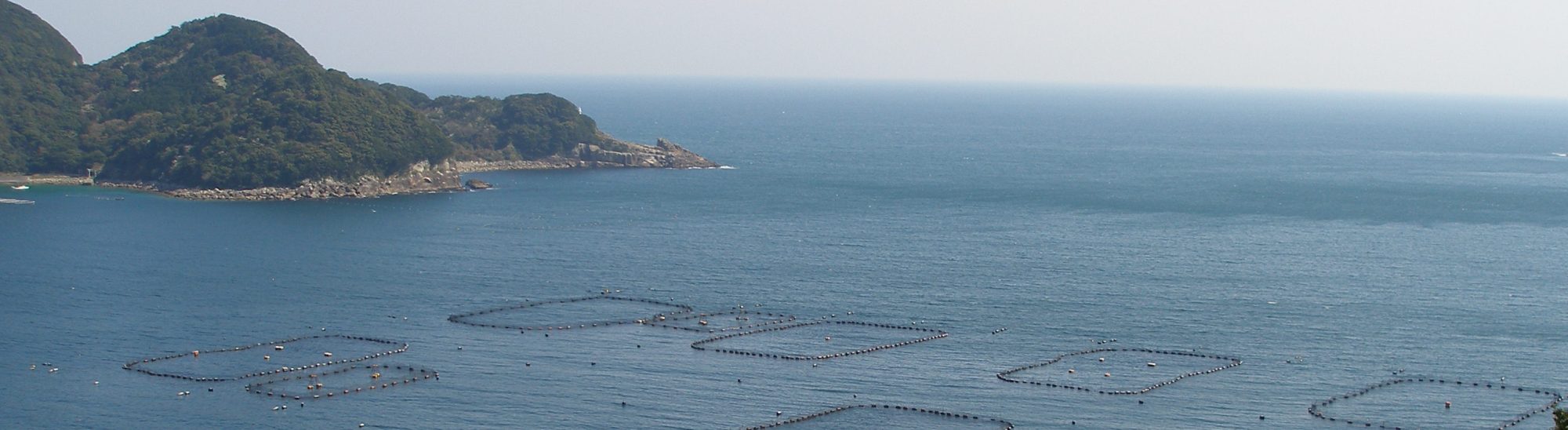
The Kerama Islands are a popular getaway about an hour from the Okinawa mainland, full of unspoiled beaches and coral gardens that are rated highly among scuba divers.  Three main islands are in the group: Tokashiki, Zamami and Aka-jima, in addition to many more small and uninhabited islets.  Water visibility ranges from 40 to 50m.  Over a thousand kinds of fish and 330 different types of coral are said to inhabit the crystal clear blue waters.

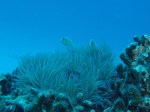
Today’s destination was these magnificent islands, and after an early pick up by our dive school, we were soon on the school’s boat and beginning our journey to Toma off Zamami island.  Conditions were extremely rough, but after an hour’s journey the water soon became calm as we entered a small bay with other diving boats close by.  I looked over, able to make out the coral structures below.  The water was clear and blue.  We hadn’t even begun our dives and already the islands were living up to their reputation.

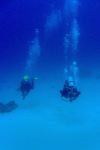
As we were attempting some more challenging dives this weekend, my friend and I were told to plan our dive and navigate together, remembering what it means to dive with a buddy, to look out for each other and stay close.  One of the golden rules of diving is to never dive alone.  It’s important to stay within a reasonable distance from a buddy so you can reach each other quickly if a problem occurs.  Unfortunately we still have a lot to learn in this area, and it particularly hit home to me just how vital it is to check your buddy’s equipment, see whether it’s properly set up, make sure you know where it all is in case you need it in an emergency, and agree on hand signals, a maximum depth and bottom time limit so you are both comfortable during the dive.  Upon descent we got so excited at everything around us that we tended to swim away from each other to look at different things, and decide to go in a particular direction at the last minute.  Not sticking to any concrete plan wasn’t the right thing to do but the dive itself was smooth, and the waters offered plenty – butterfly fish, yellow box fish, striptailed damsel fish and various types of crustaceans.

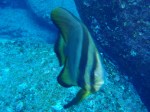
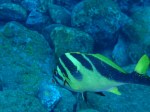
We stayed at Toma for our second dive in which we got to relax a little and follow our guide while taking photos.  This time we were able to appreciate the water and the various creatures.  We took it easy on our descent by using a rope, which saved us from focusing on skills like buoyancy control and ensured a smooth route to the bottom where we all gathered before beginning the dive.  The corals around Toma are huge and vast, providing an excellent environment in which to spot some interesting marine creatures, even using a flashlight to light up the darker areas underneath the coral where plenty of life may be hiding.  Much of the dead coral provides a good area to hold onto during a safety stop, or just to hover while taking a photo.  We began at 8m and swam slowly past walls of coral before we hit a sandy bottom at around 19m.  From here we were able to adjust and practice buoyancy, get accustomed to the warm water and slowly make our ascent while thoroughly observing what was around us. We came across plenty of damselfish, a clownfish and her baby peering out at us from beneath their sea anemone home, a longfin spadefish, the same yellow, black and silver kind seen last month in Hachijojima, and a rare archilles tang, a black fish with a striking orange and white lining along the fins and tail.  By far our best discovery was an adult octopus, hiding deep inside a small crevice.  As we poked it, it became agitated, pulsating and giving off the most extraordinary light show while concealing itself through camouflage.  At one point it seemed to have lines of electricity swiftly running through it, blue, then yellow, and soon it was the same colour as the coral and we began searching for it again.  Later I discovered that what we saw was probably a form of counter-illumination, in which creatures such as squid are able to use their light-producing organs to create a sparkling glow.  This is sometimes done to attract prey and for signalling.

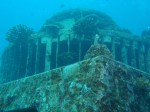
Having monitored the sea conditions between Naha and the Kerama Islands, things didn’t look too good with possible bad weather approaching from the evening into Sunday morning, so we decided to complete our last dive of the day closer to Naha so we could safely return to port.   As we headed to the site of Ginowan Shallow Lake, I was so seasick that I doubted being able to complete my dive but I was told to get into the water as quickly as possible to escape the swaying of the boat.  Having donned my gear, I was soon heading out for what would be an easy wreck dive.   As Ginowan Shallow Lake is just off the mainland, visibility was nowhere near as good as the Kerama Islands, and it was a lot more rocky.  We used a rope for our descent and swam to about 16m to explore a simple medium-sized ship.  Shipwrecks are attractive because they are artificial reefs covered in marine life and many discoveries await.  Divers also like to take a close look at the different parts of the ship, and enjoy the thrill of observing things that normally cannot be seen up close on floating vessels.  Our dive was non-penetration diving, in which we stayed outside the boat, taking in the propellers, the hull and getting a feel for the structure.  We started at the very bottom, ascended over the vessel and down again.  I was struck by the different algae, shellfish and other creatures sticking to the boat.  It really was an artificial reef.  We came across small little windows and peered into complete darkness, except for a slight movement here and there as a fish darted by.  We saw greensnout parrotfish, decorated gobies and some anemone fish close by.

This weekend is leaving me with a lot to take in, and experiencing wreck dives, night dives and navigation just shows the obvious – that diving isn’t only about fun, it’s a skill in itself that takes lots of time to develop.  Being able to dive at the Kerama Islands (and Okinawa in general) has been a treat.  I have never tired of the endless dive sites and rich marine life of Japan’s south, and practicing my skills in top conditions has been a huge advantage.  The Kerama Islands and rest of Okinawa, with its variety of dive sites for both the novice and the experienced diver, will always be highly recommended.

November’s dives

Dive 1: Toma, Kerama Islands: depth: 14.5m, dive time: 51mins, water temp: 26C, average depth: 10.2m, entry time: 11:21AM, exit time: 12:12PM, used a 12L aluminium tank, 7kg weight belt and 5mm wetsuit.  Saw yellow box fish, top shell, butterfly fish and damsel fish.

Dive 2: Toma, Kerama Islands: depth: 25.8m, dive time: 58mins, water temp: 25C, average depth: 8.9m, entry time: 13:41, exit time: 14:39, used a 12L aluminium tank, 7kg weight belt and 5mm wetsuit.  Saw 1 giant octopus, skunk anemones, damselfish, archilles tang and longfin spadefish.

Dive 3: Ginowan Shallow Lake: depth: 16.8m, dive time: 35mins, water temp: 25.2C, average depth: 10.7m, entry time: 16:47, exit time: 17:25, used a 12L aluminium tank, 7kg weight belt and 5mm wetsuit.  Saw anemone fish, clark’s anemone fish, greensnout parrotfish and decorated gobies.

November 2011: Naha and the Kerama Islands, Okinawa, Japan


Friday November 25th 2011

This year Okinawa has been a key destination for me, offering some ideal dive sites in which to practice my skills.  As my attempt to dive once a month draws to a close, I found myself back in the clear blue waters of Japan’s south, completing my November dives close to Okinawa’s main city of Naha and enjoying a day trip to the Kerama Islands.

This month I was able to share the joy of diving with a friend, who joined me for a weekend with Reef Encounters, a school 30 minutes from Naha on the Okinawa mainland.  There we teamed up with a top diving instructor who had been with us on Hachijojima in October.  The famous Kerama Islands had been saved for Saturday, so today consisted of 3 beach dives near Naha, to slowly ease back into things.

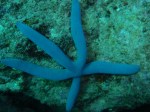
Conditions at our first spot, Sunabe Water Plant, were rough.  A flight of stairs led directly to some concrete boulders but the tide was already quite high and we could clearly see the challenges ahead.  Watching the strong waves, I realised that we needed to get to the bottom of the water fairly quickly but not having dived for the past 6 weeks, I felt a little apprehensive.  Fortunately we were able to set up higher on land and carry our equipment straight down the steps to the concrete boulders which were big enough to lean against to put on our masks and fins.  Crawling across some slippery rocks into the water, we struggled to descend.  Divers use up much more air and energy in this kind of situation, which shortens dive time as a result, but we remained at around 10m and were soon rewarded with a vast coral garden spreading out for miles and crawling with fish.  We drifted past the common blue starfish, sea urchins and the usual angel and butterfly fish, before coming across a poisonous sea snake.  Staying a little distance away, we observed him from afar as he eventually slithered off into the deep blue.  Sunabe Water Plant had plenty of sand with no tunnels or crevices to swim through, making it an ideal site for brushing up on dive skills, provided the water is calm.

After lunch we drove to the other side of the Okinawa mainland for our second destination, Kin Red Beach.  Conditions here were calmer, and entry couldn’t have been more simple: straight down about 5 steps into the warm shallow water, sitting on the sand to don masks and fins.  This time we swam downwards, reaching the deeper areas slowly, which allowed for some smooth ear clearing.  As the sea was calm, we were given a chance to use our compasses and practice navigation.

Navigating your way underwater is no easy task.  But knowing where you’re going and where you are at any given moment makes a dive much more enjoyable.  After looking around at the rocks and sea walls above the surface, we began with a good look at our entry point underwater.  Knowing whether it’s sandy, rocky or full of coral can act as a landmark and help on the way back.  Our entry point wasn’t much to speak of.  Lots of sand, bad visibility and nothing which could serve as a landmark.  The cloudy water did make me a little nervous but we successfully navigated our way to the first rocky patch teeming with sea urchins and a baby lion fish swimming above.  Our next task was to take a right turn towards the sea wall, spend some time exploring and then swim back near to the wall until the water became shallower.  The sea wall was covered in sea urchins and algae and surrounded by fish including the trumpet fish chilling out close by.  Getting out a flashlight and shining it over the algae was most exciting, to get a feel of the different crabs and discover a baby crab, shrimp or fish hiding away.  The site was full of sand, and any fin kick created huge sand clouds, making visibility even worse.  As we swam back closer to the sea wall, I had to keep reminding myself that a compass is used underwater in exactly the same way as it is on land.  Being in the water does throw you off course, when really things are much simpler than they seem.

We stayed at Kin Red Beach for our third and last dive of the day which ended up being a night dive.  As I want to take my Advanced diving course next year, our guide suggested that during the weekend we tackle some more challenging dives.  My last night dive in Oshima taught me that it is definitely not something to be taken lightly, but seeing the sea come alive with nocturnal creatures and smaller organisms reflecting against the moonlight provides a very unique experience.  I look back on my dive in Oshima as a challenge overcome, and having dived in today’s spot earlier on, I felt much more prepared.  Crabs came out of their holes to hunt and scavenge, the same baby lion fish from the previous dive made an appearance again and a sleeping trumpet fish stayed completely still even though we shone our flashlights over him.  The sea urchins and anemones seemed a lot bigger, perhaps extending their spine and tentacles but the biggest highlight of all was phosphorescence.  Turning off your flashlight, then waving your hands around or rubbing them together creates an impressive light show as plankton reacts to being agitated by emitting light.

Having touched upon some of the more difficult elements of diving, it’s really hit home that I have a lot more to learn.  However, the beach dives today served as good preparation and a taster of things to come, and fortunately have only motivated me even more.

November’s dives

Dive 1: Sunabe Water Plant: depth: 10.9m, dive time: 37mins, water temp: 25.6C, average depth: 7m, entry time: 13:06, exit time: 13:43, used a 12L aluminium tank, 7kg weight belt and 5mm wetsuit.  Saw blue star fish, a sea snake, sea urchins, bug soft coral garden.

Dive 2: Kin Red Beach: depth: 10.6m, dive time: 1hr 6mins, water temp: 25.1C, average depth: 5.5m, entry time: 16:17, exit time: 17:23, used a 12L tank, 7kg weight belt and 5mm wetsuit.  Saw trumpet fish, crabs, sea urchins, baby lion fish

Dive 3: Kin Red Beach: depth: 7m, dive time: 29mins, water temp: 25C, average depth: 4.8m, entry time: 18:47, exit time: 19:16, used a 12L tank, 7kg weight belt and 5mm wetsuit.  Saw trumpet fish, crabs, sea urchins, baby lion fish and far too much sand!

November 2011: Sanriku Volunteer Divers, Tohoku, Japan

The night bus from Tokyo to Tohoku is around 7 to 8 hours.  I woke up an hour before arrival time and peered out of the window expecting to see debris and destruction, images of the tsunami coming to mind, but instead we were driving through the mountains passing quaint Japanese-style houses.  This, I later learned, was the main road to Rikuzentakata, one of the areas worst hit by the March 11th quake and tsunami.

Fellow volunteer Sawako came to meet me at the bus stop around 7am.  We drove back to our accommodation discussing the different tasks we had to do over the next few days.  Sawako then explained how traumatised some of the fishermen were.  “Sitting with them for 5 mins, even just listening, will help a lot” she said.  Her words made an impact, and gave me the motivation to get stuck in.

From Nov 2nd to 4th I volunteered in Tohoku with Sanriku Volunteer Divers, a group from across Japan who are coming together to help the local abalone fishermen, mainly pulling debris from underwater.  As the March earthquake had caused such a devastating tsunami, I set about researching what I could do as a diver when one day, a random online search took me to Sanriku Volunteer Divers.

The group was established by Hiroshi Sato, nicknamed Kuma-san or “Teddy Bear.”  On March 11th he was working as a dive guide in Thailand and went straight home when the earthquake struck.  He began helping in the affected areas when a fisherman suggested that as a diver, perhaps he could help pull out the debris that had been washed out to sea.  And so began a massive underwater cleanup.  As word spread, more and more divers began to join in, and Sanriku Volunteer Divers was born.

When I emailed the group I offered to dive, but was told it was best left up to the more advanced.  As I discovered, it certainly wasn’t fun diving.  Divers are often underwater alone and must be 100 percent comfortable with equipment and any potentially dangerous situations such as getting tangled up in the ropes or stuck among the debris.  They tend to work at around 6-10m and constantly ascend to help lift the rubble or explain to those on land that a particular item could be tricky and require specialised removal equipment.  Therefore good ear-clearing skills are a must.

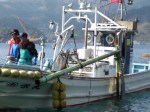
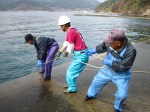
Our daily routine went something like this: quick breakfast and departing around 8AM.  The areas we were assigned to were about an hour from where we were staying, so we arrived just after 9AM and began preparing the ropes, untangling them and fixing a lead weight to each one while the divers set up their equipment.  Mornings and afternoons were spent pulling out as much stuff as we could find, after which we were rewarded with a quick soak in the local hot spring before heading back for the evening.  My role was to stay on land and help pull out the rubble.  The biggest pieces such as tree trunks were removed using cranes on the fishermen’s boat.  A light truck was often used to pull other objects while each volunteer on land including myself was paired up with a diver.  The diver would descend, while I threw the rope out and waited for the signal.  Two tugs later and I would be pulling out fishing nets, fishing equipment, tree branches, poles, plastic bags or trays.  The sea was also littered with buoys marking the spots where more heavy objects had been found.  These were then lifted out with the arrival of the fishermen’s boat and crane.  From a distance, the areas we worked in seemed fine.  The sea was calm, visibility was pretty good and compared to immediately after the quake, a lot of debris at the ports had gone.  But as we found more and more objects at each attempt, including plastic and broken bottles, carpets, car tires and wood, it became obvious that a lot still needs to be done.  The saddest moment of all was finding a woman’s handbag and a snowboard.

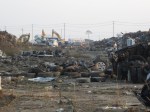
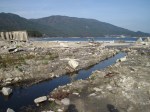
The nearest big area to our accommodation was Rikuzentakata, which we drove through each day on our way to the ports.  What used to be a populated coastal town had been swept away with nothing left except piles of crushed cars, debris and buildings reduced to steel structures.  The cleanup operation has been huge and impressive, much of the rubble has now gone, but there really was nothing, nothing to describe what I saw and how I felt.  I seemed tiny, standing in the middle of such open flat land.  My pictures give no idea of the impact and scale of the disaster.  You really need to be there to feel it.  The town’s trees were all uprooted and washed away, except for one single pine tree now known as the Miracle Pine Tree.  Having survived the tsunami, it is now a symbol of hope for Rikuzentakata.

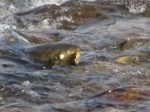
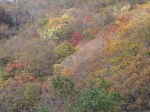
That feeling of hope remains amidst the debris and air of tragedy that hangs over Tohoku.  Life goes on, and Kuma-san really wanted us to understand that there is more to the area and that we can enjoy ourselves in Tohoku too.  During my stay I was taken for a drive through the mountains to see the most beautiful autumn leaves, and later we got to see the “salmon swim,” hundreds of salmon returning and running upstream from one of the bays.  This is said to be one of the area’s highlights, and I marvelled at the hundreds of fish desperately fighting to make it upstream in the crystal clear water.  We stayed in a house that once belonged to Kuma-san’s grandmother in law.  Now a base for volunteers, it was warm and homely with bedding, communal area, kitchen and space for diving gear, all for a reasonable 2,000yen a night.  There was plenty of room for around 10 of us, and I became chef for two nights, cooking spaghetti bolognese, curry and salad for 9 hungry divers.  Remembering Sawako’s words, I spent time with the fishermen too.  I met one who simply can’t watch any tsunami footage, and another who was out at sea 10mins from land when the water suddenly started moving violently and he knew that something was seriously wrong.  The group are small and not well known, yet I have been deeply moved by how determined the members are to help, how passionate they are about diving and the ocean, and how important it is to enjoy the volunteering despite the huge tragedy.  My time in Tohoku was not one for tears.  It was a chance to do my bit to help, form new friendships, have fun and see for myself the damage left behind and what needs doing now and in the future.  What I learned most of all and what really hit home is that every tiny little thing I did, including making my mum’s special salad dressing and mixing it into a huge bowl of salad, really did count.

Click here to read more about Kuma-san and the group:

http://www.livinggreenmag.com/august_2011/community.html


October 2011: Hachijojima, Japan

Sunday October 9th, 2011

This morning at 5:30AM we left our accommodation hoping to spot some hammerhead sharks in Nazumado. Although pretty tired, I was keen to get into the water, and felt quite relaxed having been at the site yesterday afternoon. When we reached our entry point the sea was pretty calm, and although possible currents were mentioned during the briefing, they were the last thing on my mind as I entered the water more gracefully than yesterday.  Unfortunately however, I wish I had been more prepared.

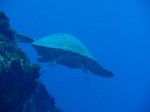
Currents are great in that they carry in food (plankton) to an area which attracts more fish, and that makes the area an interesting one to explore but for divers they can be intimidating and a huge challenge due to their unpredictability and divers’ natural urge to fight them. My descent and ear clearing both went smoothly and I felt comfortable going deeper but it soon became apparent that something was not quite right. Already at 5 or 6m we were clinging onto rocks trying not to get swept away. When the water flow is strong it’s vital to stay close to the sea floor as the current is always lesser down there, so I swam near the rocks, slowly attempting to swim straight out to yesterday’s arch and rock formation, but visibility, fish, buoyancy and ear clearing were all forgotten as the current became my main focus. In the end we were unable to swim through the arch as the water pushed us back, and just as I reached half a tank of air our guide called off trying to find the hammerheads and told us to remain close to the entry point for the remainder of our dive to assure a safe ascent. Although we were restricted in where we could go, we still managed to spot some beautiful creatures including some turtles struggling against the current a bit more gracefully than we were, and one Golden Spadefish swimming close to us by himself. He’d also joined us yesterday in Nazumado.

After such an eventful dive, breakfast was so welcoming and soon we were ready to visit a new site called Yaene on the west coast of the island. The sun was pretty strong and the bay quite sheltered. It seemed really inviting, perhaps offering a possible easy dive after this morning’s currents.

According to my dive group, Yaene is a simple site with an easier entry and exit. The bay is more protected with less waves and surge. There are some beautiful schools of fish even in shallow areas around some cement structures. The site consists of macrolife such as nudibranchs and offers a few large arches, and a relaxing dive for beginners when the water is calm.

On this dive I learned more than anything how important it is to stay buoyant.  As divers we are always told to get up close to the reef and examine all the details, and yet we aren’t allowed to touch anything. Skilled underwater photographers are amazing at getting their masks within inches of a delicate soft coral, and retreat without doing any harm. So what’s the secret?

Things in Yaene began really well. I descended smoothly and visibility was crystal clear. We spent the first few minutes in a straight line swimming out towards deeper waters. Soon we were down to 18-19m. There were no arches this time but plenty of huge rocks, concrete boulders and a sandy surface with 2 rays that almost seemed to be playing with each other, staying close together and swimming amidst the sand. We also came across more juvenile angel fish, a yellow trumpet fish, wraught iron butterfly fish and a school of barracuda types early on in our descent. Unfortunately during this dive I completely lost control of my buoyancy and ended up rapidly ascending to the surface from around 10m.  This can be extremely dangerous depending on how deep you’re ascending from and how fast, as nitrogen gas bubbles form in the body tissue rather than being exhaled.

So what is the secret to achieving the perfect buoyancy? Here are some tips I found online:

  • Make sure you are carrying the correct weights. To get an idea of your proper weight, when you are on the surface you should be at eye level with the water with no air in your BC, carrying a full tank.
  • Remember that in a wetsuit, you will become less buoyant as you descend.
  • Patience! After adding and releasing air from your BCD, it takes time to take effect.
  • Stay horizontal and make sure your kicks propel you forwards and not upwards.
  • Keep your console etc clipped close to your body to prevent drag.
  • Breathing – exhale and hold it until you start sinking, then take shallow inhales.

After an eventful start to the day I really wanted a smooth underwater journey, so when our group leader offered a boat dive for the afternoon, I opted to follow him and let him guide us in shallower waters. After lunch we took a fishing boat out to Idesari in the open ocean. Like Hachijojima’s other dive sites, Idesari too is full of complex arches with plenty of tunnels and small areas to swim through. As we looked over the boat, the visibility was so clear that we could already make out the rocks below. Having put on our equipment on the boat, we descended by forward stride and used the anchor rope to meet at the bottom. The water temperature was a slightly colder 22C, but it made everything more clear and crisp, and soon we were drifting past Moorish Idols, lined cheek wrasses, surge wrasses, small soldier fish, porcupine fish and sea anemones. There was so much to keep us occupied that I could have stayed down there forever. The dive clearly showed me just how tropical and unspoilt Hachijojima really is.

This month was pretty eventful – a strong current and lack of buoyancy control provided for two very unexpected and different dives. But as our group leader pointed out, experiencing those was actually a good thing, that not all dives are smooth and that to improve it’s vital to experience tricky situations as well. I’ve started to feel much more relaxed underwater, and love the feeling of blocking everything else out and fully focusing on the dive itself and what’s around me. My group’s trips will soon end as winter approaches, but mine will go on as I prepare to head to Okinawa’s Kerama islands next month for my November dives.

Practical information

  • Like last August, I joined Discovery Divers on their regular Hachijojima trip usually held in September.
  • We met at Takeshiba pier near Hamamatsucho-station on the Yamanote line around 9:20PM, to take an overnight ferry departing at 10:20PM. Because the trip was arranged last minute we were unable to reserve an area below deck so we slept on deck and rented blankets at 100yen each. You can borrow as many blankets as you like!
  • The boat is basic, but offers vending machines, a restaurant and a spacious deck. Journey time from Tokyo is around 11 hours.
  • Our dive school was Hachijojima Regulus Diving (http://www.edit.ne.jp/~regulus/).
  • The school is about a minute from the port by car.  It has a separate room upstairs to leave bags, a reception area, spacious wooden deck for guests to write up their log books or have lunch, terrace to hang rented equipment after use, separate concrete area to prepare and wash equipment, shower rooms, and toilets.  Shampoo and shower gel are provided.  The reception area has books and magazines on the underwater world, including an excellent one in English all about fish.
  • Hot and cold tea and sweets are available in the reception area where guests help themselves.  No coffee.
  • The staff weren’t involved in our dives but it is possible to arrange private dives directly with them.
  • We moved around by van, loading and unloading equipment ourselves.
  • All entries are beach entries – walking into the water carrying equipment.
  • Lunch is provided – a boxed lunch containing either meat or fish.  All lunches come with rice, meat/fish, vegetables and some pickles.
  • You are responsible for all hired equipment.  The area to wash equipment in is extremely spacious – two big tubs of water for wetsuits, books, masks, fins and snorkels, and two medium-sized tubs to soak cameras in.
  • We stayed in a big modern Japanese-style hotel/inn about 5 mins away from the dive school.  3 to a room, sleeping on the floor, with breakfast and dinner provided.  Dinner: rice, miso soup, sashimi, deep-friend fish, salad, extremely balanced, filling and healthy. Breakfast: rice, miso soup, fried eggs, natto (fermented soy beans), nori seaweed and tea.
  • I paid a 20,000yen deposit to the group for the trip, followed by another 45,000yen on the night of departure (this covers you for 4-5 dives, accommodation, equipment rental, boat tickets, dinner and breakfast).
  • We took the slow ferry back to Tokyo on public holiday Monday.  The journey is about 12hours, and a return ticket is around 10,000 to 15,000yen.  It’s a long journey, a full day on the boat, so best to bring books and plenty to do.  We had a great journey home, taking photos, chatting and chilling out over plenty of beer!
  • It’s also possible to fly, on a 45min flight direct from Haneda airport.  A return trip costs just over 21,000yen if booked early.

October’s dives

Dive 1: Nazumado: depth: 11.7m, dive time: 46mins, water temp: 21C, entry time: 6:39AM, exit time: 7:20AM, used a 12L tank, 3kg weight belt and 5mm wetsuit.  Mainly focused on surviving the strong current!

Dive 2: Yaene: depth: 18.9m, dive time: 47mins, water temp: 26C, average depth: 8.2m, entry time: 11:22AM, exit time: 12:05PM, used a 12L tank, 3kg weight belt and 5mm wetsuit.  Saw one turtle resting on a ledge, some parrot fish, and two cowtail stingrays.

Dive 3: Idesari: depth 16.3m, dive time: 37mins, water temp: 22C, average depth: 10.3m, entry time: 15:05, exit time: 15:42, used a 12L tank, 3kg weight belt and 5mm wetsuit.  Saw nudibranchs, Moorish Idols, lined cheek wrasses, surge wrasses, soldier fish, porcupine fish and anemones.

October 2011: Hachijojima, Japan

Saturday October 8th, 2011

This year October’s second weekend was a 3-day one, and full of diving as my group and I successfully made another attempt to head to Hachijojima after last month’s typhoon forced us to call off our trip.

Hachijojima is located in the Philippine Sea, about 287km (178 miles) south of Tokyo. Part of Tokyo prefecture with a population of around 8,500, it is consistently warmer than mainland Japan thanks to the warm Kuroshio current. As the island is volcanic, its beaches are black and sandy, but it boasts a variety of scuba diving points and is famous for sea turtles and underwater lava bridges. Visitors can also surf, visit some botanical gardens or hike to the top of Hachijo-fuji, a Mount Fuji-style mountain and the highest point on the island.

Hachijojima is way out there. The journey is a long 12 hours, but with no typhoons or gale force winds we had a very smooth crossing. Following our arrival we were soon heading to our dive school, a 1-min drive up the road. Very accommodating, with free hot and cold tea and sweets, I was impressed with the wooden stairs, tables and outdoor areas we could sit in, and the little terrace we could use to dry equipment and towels. Being extremely keen to get into the water, preparations were immediately underway to head over to Sokodo, one of Hachijojima’s main dive spots located next to the port where we arrived.

Like in Oshima two months ago, my group sent us some information on the possible dive sites we would visit during our trip. Here’s what they said about Sokodo:

  • Hard and soft corals like those in the Philippines or Thailand.
  • A triple arch that runs almost up the surface and is surrounded with plenty of marine life (blue ring octopus and turtles).
  • Care should be taken on the navigation back, not to get stuck on the wrong side of the sea wall.
  • Intermediate to experienced level, 12m to 24m.

Entry into Sokodo was down some slippery steps into slightly choppy seas, and then out of a sheltered bay area towards the triple arch. Visibility in the beginning wasn’t so good, but down below it was still a feast for the eyes as we came across seaweed, anemones and small sea urchins. The arch we eventually arrived at is formed in quite a complex way, with other tunnels and crevices close by, offering divers some interesting routes to swim through. Hachijojima was formed by the eruptions of two now-extinct volcanoes. Tubes, caves, bridges and other structures were created as lava poured into the sea. There were also some huge concrete boulders close by, covered in plants, shellfish and a plethora of fish. We spotted some black and yellow ones called Banded Boarheads resting quietly at the bottom of the arch and peering suspiciously up with huge eyes. We also came across a juvenile semicircle angelfish and juvenile emperor angelfish, both said to be rare to spot. Parrotfish, Moorish Idols and a variety of tropical fish gave the sea plenty of colour.

After a short break back at the dive school for lunch and filling up the tanks, we were soon off to Nazumado, our second and last dive of the day. This site is about 30 mins from the school, and according to my group the entry is challenging, particularly if there are waves or surge, but the site’s main attraction is its nice arch close by with a rich marine life including the famous Yuzen, or Wrought Iron Butterfly Fish, that only lives in Hachijojima and slightly further south. Currents are common and significant, so new divers are advised to stay close to their guide, in moderate depths.

Venturing into the water at Nazumado was definitely difficult. Fully geared up, we walked down from the car park along a concrete slippery area and held onto a rope to enter the water, but the waves washed up against us making it hard to put on our fins and masks. The easiest way to overcome this (but it does take practice!) is to put on your mask, inflate your BCD and hold your fins so that once in the water you can float at the surface, put on your fins and prepare your mask before descending. It doesn’t make for a graceful entry, but you have to laugh at yourself, and in the end all the struggling is worth it, as Nazumado is one of the top five diving spots in Japan with plenty on offer. Black stone tide pools frame the ocean. Green sea turtles swim over the rocks and arches, and hammerheads and thresher sharks also make an appearance, mainly between May and July. The underwater rocks and arches were our destination this time too. Close to the entry point the water is shallow enough for beginner and intermediate divers, but for the more advanced, it suddenly becomes deep beyond the rocks, and offers even more terrain to explore.

I stayed with some others near the main arch closest to the shore, where the sea turtles congregated and four or five slowly glided by. Fishes of all shapes and sizes swam slowly past us as I stopped to examine the many creatures surrounding the arches. Swimming through we discovered some small red soldier fish with huge eyes perfectly suited to their dark environment. Nazumado is well known for its colourful array of life, including a lion fish that seemed to be camouflaged against a rock. Despite the difficult entry and exit, this dive was certainly as spectacular as I’d heard and well worth diving into.

It felt so good to be with the group again and I definitely satisfied my craving to get into the water. We ended the day with a much-deserved soak in the island’s free outdoor onsen and a filling evening meal back at our accommodation. The sea and winds were so calm, that I knew our diving adventures the next day would continue under more great conditions.

October’s dives

Dive1: Sokodo: depth: 14.1m, dive time: 53mins, water temp:23C, average depth: 9.4m, entry time: 11:44AM, exit time: 12:30PM, used a 12L tank, 3kg weight belt and 5mm wetsuit.  Saw Banded Boarheads, juvenile angelfish, juvenile butterfly fish, huge clam and Moorish Idols.

Dive 2: Nazumado: depth: 11m, dive time: 45mins, water temp: 23C, entry time: 15:12, exit time: 16:00, used a 12L tank, 3kg weight belt and 5mm wetsuit.  Saw green sea turtles, lion fish, soldier fish, sea urchins and sea anemones.


September 2011: Baby Turtles in Shimoda

I’m really disappointed at failing my attempt to dive once a month following the cancellation of my September dives.  I’d been looking forward to joining my dive group in the crystal clear waters of Hachijojima, 12 hours south of Tokyo by ferry, but when an approaching typhoon forced the group to call off the trip, I knew that the right decision had been made, and that it was not worth taking any risks in the path of an oncoming storm.  To ease my disappointment, I joined some friends on the island of Kozushima, about 8 hours south of Tokyo, where we camped, snorkeled and swam under excellent weather.  However, we ended up heading to the mainland on our second day after discovering that the typhoon was heading our way, and spent a night camping in a popular area called Shimoda full of good beaches.  While hanging out on the beach that night, we saw some baby turtles heading out to sea.

Knowing how rare it is to witness this by chance, we were really moved with what we saw, and as I can’t write about diving this month, I decided to go online and find out more about these turtles instead.

To break open their shells, the hatchlings use a caruncle or temporary egg tooth, an extension of the upper jaw that falls off soon after birth.  They then take about three to seven days to head up to the surface.  Once there, they make a complete circle around their nest before instinct drives them towards the water.  They start crawling to the sea towards the brightest horizon and can apparently set an internal magnetic compass which is used for navigation away from the beach.  As they reach the water, they dive into the waves and are carried out into deeper waters.  They settle themselves in areas with floating seaweed where they can be camouflaged and find food.  The currents then carry them for years unless they are eaten by predators. They spend their first few years growing and eating in nearshore areas.  Once they reach adulthood, they then head to a new feeding ground.  The males never leave the water once they enter, but the female makes the long trip back to her natal beach to lay her eggs.  It was nice knowing that the turtles we saw will eventually return to Shimoda!

Some other interesting facts:  The sex of baby turtles depends on temperature.  If eggs are incubated at less than 28 degrees, all the hatchlings turn out to be male.  If they are incubated at 35 degrees or warmer, they are all female.  Any temperature between 28 degrees and 35 degrees produces both males and females.  They are also said to detect the angle and intensity of the Earth’s magnetic field and determine latitude and longitude once out at sea.

Seeing them has more than made up for this month’s lack of dives!