Category Archives: Uncategorized

August 2011: Marine Life in Canada

With a coastline of 240,000km, Canada is one country teeming with all things marine – research facilities, diverse underwater creatures (lobsters, crabs, starfish, sea urchins, scallops, cod) and delicious seafood.  I was able to check these out for myself during a mid-August visit to Nova Scotia (Halifax), and of course ate plenty of fresh scallops and salmon along the way.

In all honesty, the idea of diving or studying in colder waters like the Atlantic has never really appealed to me, but a visit to the Bedford Institute of Oceanography near Halifax was well worth it and gave me a good insight into a different marine environment to my dive destinations in Japan.  The institute is a huge government ocean research facility, which studies fish stocks, shellfish, marine plants, coastal planning, ocean management and reducing risks from possible hazards.  Over 600 researchers, engineers, technicians and support staff are based there.

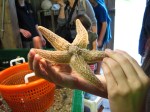
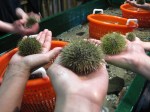
I participated in a guided tour, which began with a series of wall panels outlining the institute’s research and the marine life around Halifax.  I was struck by their Titanic exhibit which included a model of what the wreck is like now.  It wasn’t just about the accident though, the wreck is a habitat for a variety of fish and shellfish, and offers researchers much information.  An expedition to the wreck was held in 1991, and we got to see some images from this too.  Afterwards we entered the laboratories where I was able to see the students’ fish specimens and their notes on topics like population and behavioural monitoring.  Our tour ended with a visit to the Sea Pavilion, where a range of “touchable” animals are kept.  Starfish, sea cucumbers, lobsters and sea urchins were among the many creatures that we could quite literally pick up.

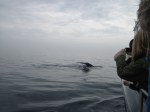
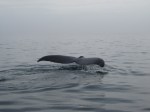
I also got to delve into the world of whales during my visit, thanks to a whale-watching tour along the Bay of Fundy.  Our boat departed from Brier Island, a feeding ground for dozens of marine species.  Blue fin tuna, seals, gannets and petrels all gather there, but what we were really after were humpback whales.

My marine biology course papers give some fun facts on these animals:

l       120 degree vision on either side of the head enables them to see to the sides and rear.

l       They can roll their eyes backwards to see in air as well as water.

l       They dive for up to 40mins (sperm whales hold their breath for well over 2 hrs and dive to around 2,000m).

l       They consume 1 to 1.5 tons of food a day.

Whale watching tours are very hit- and-miss, but ours proved successful in more ways than one.  The boat ride through the early morning fog brought us to our first designated spot.  The weather was clear and the sea was eerily calm.  Within a few minutes our group was leaning over the boat, waiting silently for any hint of movement.  Knowing the best areas to see whales requires lots of experience and knowledge, and our captain and guides had plenty.  The captain especially really seemed to know the waters, as he headed off in the correct direction whenever we heard or felt anything.  We watched in wonder as some beautiful whales, including a mother and her calf, came really close to the boat, circling gracefully and calmly around us and diving in and out of the surface.  Because they can’t always be seen, it was really special to be right next to them that day.  After a good 3 to 4 hours out at sea, it was time to head back to reality.

Canada certainly doesn’t give off a warm tropical vibe and isn’t the world’s top dive destination, but at the end of the day somebody’s got to don that dry suit and brave those colder waters, to study what’s happening down below, monitor the whales, or find out more about shipwrecks.  My visit to Canada really got me thinking about that.

August 2011: Oshima, Japan

Sunday August 21st 2011

Despite last night’s drinking, this morning we woke up reasonably early, although a planned 5am dive had to be cancelled, not just because of a late night, but also because of bad weather.  Rough seas, some rain and winds were the main challenges we faced today.

When diving in bad weather, it’s important to understand the flow and direction of the waves, be aware of strong currents, and be prepared to descend quickly.  Divers must be 100% ready to head underwater immediately upon reaching the surface.  This means no stopping to adjust fins, masks or check other equipment (or if absolutely necessary this should be done extremely quickly).  Today we had planned on visiting a new dive site, but conditions were such that we decided to stay at Akinohama, now a familiar spot to everyone.

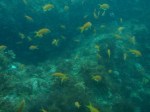
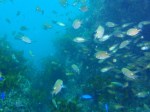
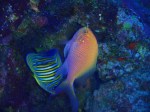
Visibility was miles better than yesterday.  The current had washed away the sand and sediment leaving behind some reasonably clear water, but having stupidly put on my mask without cleaning it properly at the surface, it soon began to cloud up.  With my vision becoming more and more limited, I realised there was no way I would last the entire dive, and also couldn’t remember how to clear it.  Fortunately I managed to signal to my buddy in good time, and our guide was soon with us, ready to show me what to do.  After a few attempts I was able to remove the mask from my face to let water through, tilt my head upwards and breathe out through my nose to remove the water, leaving a crystal clear mask.  The rest of the dive went well, we descended to 21.4m over a large area of rocks, while our guide pointed out various soft coral and showed me how to get some good shots by setting my flash and moving close.  These are apparently the two most important things when taking photos underwater – making sure the flash is on, and staying close to the animal or plant you want to photograph.  Our highlight was spotting a school of catfish hovering above a rock.  They weren’t swimming, they were just resting in the same position forming a medium-sized ball, watching us and staying alert.  Another fish I saw that’s often seen in Akinohama and throughout the rest of Oshima, is the sea goldie, a small orange/gold fish, up to 7cm long with a violet streak below the eye.  Males can be up to 15cm, and tend to be a more fuchsia colour.

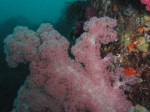
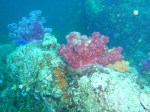
We were back in Akinohama for our second dive, and I was fully calm and knew what to expect as we entered the water, gathered at the buoy for our descent and quickly headed downwards.  The sea was still pretty rough even a few metres down at the bottom of the rope so we swam further on, perhaps a little fast.  When my buddy developed minor ear-clearing problems at the start of the dive, I was able to stay close by as our guide helped out, and stay within sight of the 3rd diver in our group.  Today I really learned about the importance of having a buddy and being able to look out for him/her.  This can be applied to our everyday lives too – communicating clearly, developing trust and understanding others are all necessary each day.  On this dive we discovered some beautiful pink soft coral which we were able to get really close to, and we also came across a brownish orange and white scary-looking creature, a member of the starfish family.  Other highlights were more moorish idol (black, yellow and white with a long extension protruding from the dorsal fin, and long snouts), trumpet fish, box fish, and more nudibranchs.

This year’s dives have made me much more appreciative of the marine environment, and I’ve become more keen to explore other subjects on land, like exhibitions, oceanography centres and aquariums.  There’s something very thrilling and inspiring about experiencing the other part of our planet, seeing such a huge range of species up close, and comparing fragile coral reefs with rocky sandy areas.  Scuba diving offers a lot of adventure and risk, but it really makes you appreciate what is going on underwater.  Next month I’ll be joining the group for possibly their last trip this year before the weather cools down.  We’ll be even further south than Oshima, on Hachijojima, where the weather should be warmer and the waters more tropical.  The Kuroshio current should also bring with it even more interesting fish, which I’m looking forward to seeing.

Practical information:

  • Like last month, I joined Discovery Divers on their regular Oshima trip.
  • We met at Takeshiba pier near Hamamatsucho station on the Yamanote line, around 10pm, to take an overnight ferry departing at 11pm.  The group had reserved an area below deck where everyone sleeps on the floor next to each other.  The floor is extremely hard but blankets can be rented for 100yen each.  No limit to the amount of blankets you can borrow, unless they are running short!  A single ticket on the overnight is roughly 5,000yen to 7,000yen.
  • The boat is basic, but offers vending machines, a restaurant and a spacious deck where most people stay to enjoy the cool breeze and views.  It’s also possible to sleep there too, with the rented blankets.
  • Our dive school was Global Sports Club (http://www.global-ds.com/english/no-1-informatuon.html)
  • The school is about 15mins from the port by car.  It consists of a log cabin for guests to leave their bags or sit and write up their log books, a reception area, and large deck for eating, and setting up equipment.  The log cabin is filled with books and magazines on the underwater world.
  • Tea and coffee are available in the cabin and reception area.  Guests help themselves.
  • The school staff weren’t involved in our dives, but it is possible to book private dives directly with them.
  • We moved around by van, loading and unloading equipment ourselves.
  • All entries are giant stride entries or simply walking into the water carrying equipment.
  • Lunch is provided – a boxed lunch containing either meat or fish.  All lunches came with soup, rice, meat/fish (salmon) and vegetables, some pickled.
  • You are responsible for all your equipment during your stay.  The area to wash equipment in is extremely spacious – one big tub of water to wash wetsuits, boots, masks, fins and snorkels, and 2 medium-sized tubs to soak cameras in.
  • Around 6 toilets are provided, and 3 very warm and comfortable showers.
  • We stayed in a basic Japanese-style hotel/inn a few mins’ drive away from the dive school.  3 to a room, sleeping on the floor, with breakfast and dinner provided.  Dinner: rice, miso soup, cold soba noodles, some sashimi, melon, vegetables, eggs, extremely balanced and healthy.  Dinner begins at 8pm, and last orders must be in by 9pm (beers were ordered and paid for separately).  Breakfast: western-style, basic salad and ham, fried eggs, toast with jam, tea and coffee.
  • I paid a 20,000yen deposit to the group for the trip, followed by another 20,000yen on the night of departure (this covers you for 3-4 dives, accommodation, equipment rental, boat tickets, dinner and breakfast).  Extra dives cost 1,500yen.
  • We took a fast ferry back to Tokyo on Sunday.  The journey is about an hour and a half, and costs around 5,oooyen to 7,000yen for a single ticket.  This gets you a seat.  The inside is a bit like an airplane, and the boat is extremely fast.  No deck – everyone stays indoors.

August’s dives:

Dive 1: Akinohama: depth: 21.4m, dive time: 33mins, used a 10L tank, 3kg weight belt and 5mm wetsuit.  Saw striped eel catfish and sea goldies

Dive 2: Akinohama: depth: 14.2m, dive time: 48mins, used a 10L tank, 3kg weight belt and 5mm wetsuit.  Saw moorish idols, trumpet fish, box fish, soft coral, more catfish and nudibranchs


August 2011: Oshima, Japan


Saturday August 20th 2011

August saw me join up with last month’s dive group for a weekend of intense diving.  As we all headed to our destination, I was delighted at the possibility of diving at least 6 or 7 times – an excellent chance to practise my skills, get more used to being underwater, and perhaps venture into something new.

This month’s destination was the island of Izu Oshima, about 100km south of Tokyo and 22km east of the Izu Peninsula.  The island is part of the Izu island chain (which includes Miyakejima where I dived in May) and is well-known for its volcano Mt Mihara.  The island’s close proximity to the mainland means it draws plenty of tourists from Tokyo.  Although not as tropical as places like Okinawa, it still serves as a top dive spot.  It also has rugged coastlines, plunging cliff faces, black-sand beaches, forests and clear seas.

My dive group organised everything and provided good information.  A few days before departure, they sent us a document on the dive sites we were due to visit.  Here are some of the details I received:

Nodahama – a shallow site, 15m or less, with a large arch called “Fish TV” because the arch often looks like it’s filled with fish.  Possible to see rays, crabs, lobster, clownfish, sea anemones.  Generally protected from currents.

Akinohama – divided into a number of zones from 4m to 40m.  Soft coral, crustaceans and hard coral.  Excellent for night dives.

Ohnohama – angelfish, turtles, tuna, and sometimes hammerheads.  Most parts of the sites are 18m or less.  Ring of rocks and hard coral can be found.

We spent the weekend with a dive school called Global Sports Club, which by coincidence was the same school my friends and I visited briefly last month, although we weren’t able to dive then due to bad weather.  The school is a 15min drive away from the port, a very homely place with a cozy log cabin to rest in and leave bags, free tea and coffee, and a large deck next to the reception area where divers can comfortably set up their equipment.  We got to the school around 5:30AM after a long overnight boat ride from Tokyo, but despite this some of the group were planning to head into the water first thing.  Although I’d only slept for around 4hours, I felt wide awake and decided to join them.

By around 7:30AM I was literally jumping into the water for my first dive of the day in Akinohama.  This site, on the northwest coast, is said to be the most popular on Oshima.  A group of rocks stretches out into the sea like a pier, and serves as a convenient entry point.  We entered the water taking one giant stride and gathered at a buoy to begin our descent.  We followed the rope downwards and after gathering at the bottom, began swimming onwards.  Unfortunately visibility was poor, the water was a little rough and there was a slight current which made buoyancy control quite difficult but having said that, there was an array of marine life on offer.  Swimming amongst the walls of rocks and sandy seabeds, I was able to spot moorish idols, plenty of soft swaying coral and a huge orange nudibranch nestled beneath a rock, possibly the biggest I have ever seen and apparently quite rare.

Immediately following the first dive I began asking where our next destination was, and after a brief trip back to the dive school to unload the empty tanks and pick up new ones, we were on our way to Ohnohama for dive 2.  This site is relatively far away south from the dive school, but still reachable.  It’s popular for its varied hard coral and a ring of rocks that divers can swim around, all located at roughly 24m.  Such a depth is ideal for a diver like myself who is still finding her feet but happy to try going deeper.  Ohnohama is reached by a long flight of steps leading down from the car park to the beach, so we put on our equipment at the car park and walked down the steps.  The steps literally stop in the water, which makes entering a little challenging.  Some divers sat down to rinse their masks and put on their fins, while others did the same by standing and leaning on their buddies.  Ohnohama has a rope attached to some rocks, so we were able to walk into the water following the rope and swim further out where it was still shallow, to meet our guide.  Compared to Akinohama, the current was a lot stronger, and we had to descend further relatively quickly, in order to escape the waves crashing against the rocks.  Despite the current, my buoyancy control was much smoother.  I spotted the ring of rocks and hard coral, and enjoyed swimming around them looking at angel fish, schools of silver fish and one medium-sized dark grey fish biting away at the coral as well as various kinds of colourful wrasse.

After lunch we headed out to Nodahama in search of Fish TV.   Nodahama is another good site for beginners, reasonably shallow, easy to enter, and known for its rocky beach, interesting rock formations and plenty of fish.  Because of its shallow depth, the site is ideal for those who are doing their underwater tasks as part of the PADI Open Water course.  The beach is quite interesting, and has a steep cliff on the right and lava rock formations on the left.  With a clear image of Fish TV in my mind, I was particularly looking forward to diving in this area.   Like Ohnohama we had to set up and put on our equipment at the car park before walking about 200 metres down the steps to the beach.  By this point I’d become pretty confident in doing things myself, and going over everything one last time with my buddy, in particular where our extra mouthpieces were located in case one of us ran out of air.   Entry at Nodahama was very simple.  We literally walked into the water following a guide rope, and then gradually swam downwards.  This type of descent is pretty comfortable as you can take your time slowly swimming, and before you know it you’re down at a reasonable depth and face to face with the rich marine life.  Unfortunately visibility was pretty bad, to the point where we had to use torches and our guide decided to abort our swim to Fish TV as he wasn’t confident he could see everyone in the group despite the torches.  Although extremely disappointed, I still managed to see some of the creatures up close.  The rock formations were huge, teeming with soft coral, kelp and plenty of areas to get close to and shine some light over.  I came face to face with moray eels, sea anemones, sea urchins and even some poisonous cat fish.

By the end of dive 3 I was beginning to feel pretty tired, but the group had organised a night dive and I was keen to join them and head underwater in the dark for the first time.  This dive turned out to be the highlight of my first day on Oshima and I really enjoyed myself.  What’s so attractive about night diving is the chance to experience a different underwater environment, as many marine animals are nocturnal.   Seeing an explosion of different colours in underwater light, and concentrating on details under a narrow range of light are also reasons why night diving is so popular.  Akinohama where I dived this morning was our destination, and there the first-timers were thoroughly briefed on what to expect.  Upon entry I could see everyone’s torches so I wasn’t too worried, but buoyancy control was unbelievably difficult.  I had no idea how close or far I was from the rocks below, and the light from a torch is not enough to figure this out.  Often I kept ascending rather than descending, and it took a long time to get into a more stable position.  Keeping track of my buddy was also challenging.  I constantly looked around to make sure he was there, and often shined my torch in the same spot as him which is a good trick to learn in order to keep track of one another.  Shining the torches over our hands, we were also able to signal to each other, checking that all was ok, and that we had enough air.

The marine life at night is definitely different to the daytime.  I saw lots more schools of fish, some big, some small, the area seemed to be more crowded with fish compared to during the day.  I also saw more moray eels than usual and even some lobster, but the best part was shining our torches over a small cuttlefish eating a shrimp.  He promptly spat the shrimp out after we’d approached, and then proceeded to change colour, to look like the rock beneath him.  Night diving is undoubtedly an excellent chance to see marine life displaying all kinds of behaviour.

Although the rest of the evening was pretty rushed (after the dive we had to quickly head back to the dive school, unload everything, wash our wetsuits and other equipment, and head over to our accommodation for dinner) and I was quite tired, I was extremely satisfied with today’s achievements.  All the dives had been smooth, I’d been relaxed and very much looked after.  As one of our members will soon be leaving Japan, we ended the evening with farewell drinks which included some champagne.   That was the perfect ending to a really good day.

August’s dives

Dive 1:  Akinohama: depth: 15.4m, dive time: 41mins, water temp: 23C, used a 10L tank, 3kg weight belt and 5mm wetsuit.  Saw moorish idols, soft coral and a huge orange nudibranch.

Dive 2: Ohnohama: depth: 13.4m, dive time: 34mins, water temp: 23C, used a 10L tank, 3kg weight belt and 5mm wetsuit.  Saw angel fish and wrasse.

Dive 3: Nodahama: depth: 10.1m, dive time: 56mins, water temp: 23C, used a 10L tank, 3kg weight belt and 5mm wetsuit.  Saw moray eels, poisonous cat fish and sea urchins.

Dive 4: Akinohama: depth 16.4m, dive time: 39mins, used a 10L tank, 3kg weight belt and 5mm wetsuit.  My first night dive, we dived in between 6pm and 6:30pm.  Highlight was spotting a cuttlefish eating a shrimp.  Also saw moray eels, some lobster and generally much more fish, particularly in schools.
July 2011: Atami, Shizuoka Prefecture, Japan

Saturday July 30th 2011

A month since my last dives in Kumejima and I was itching to get back into the water, but July turned out to be pretty hectic and unpredictable, to the point where I wasn’t sure whether I would complete my mission to dive once a month. Last weekend some friends and I headed south of Tokyo to an island called Oshima but our day of diving was called off due to high waves from a typhoon that had passed the area a few days earlier. July has also been quite cloudy and wet, so I was placing my hopes on a trip to Atami that I’d booked with a dive group in Tokyo.

Ever since I started diving properly this year, I’ve been by myself, looking up dive schools online, making the necessary arrangements alone and diving with a guide. As fun as those trips have been, it’s not the same as diving with others, staying in touch and swapping stories. So I was really eager to head out with this new group.

I dived in Atami back in March, so I knew roughly what the dives might be like and what we might see, but still felt slightly nervous at the prospect of heading underwater with new people of different levels, and in particular being more responsible for my own gear and well-being. On my previous trips, a lot of the dive schools looked out for me, reaching out to adjust my buoyancy and in some cases taking my hand to guide me to the right areas, but deep down I knew that the time had come to start doing those things myself.

I travelled down to Atami with my friend’s husband, and we were soon picked up at the station and taken to the school, Atami Scuba. As we unloaded our stuff, got our bearings and introduced ourselves to everyone, I was struck by how friendly the others were, how excited they were about getting into the water, and how good it felt to be around others who enjoy diving as much as I do. All our equipment had been prepared, and it was easy talking to everyone and finding a buddy for our first dive of the day. The group leaders gave some excellent detailed briefings, and made sure that we’d paired up with the right people.

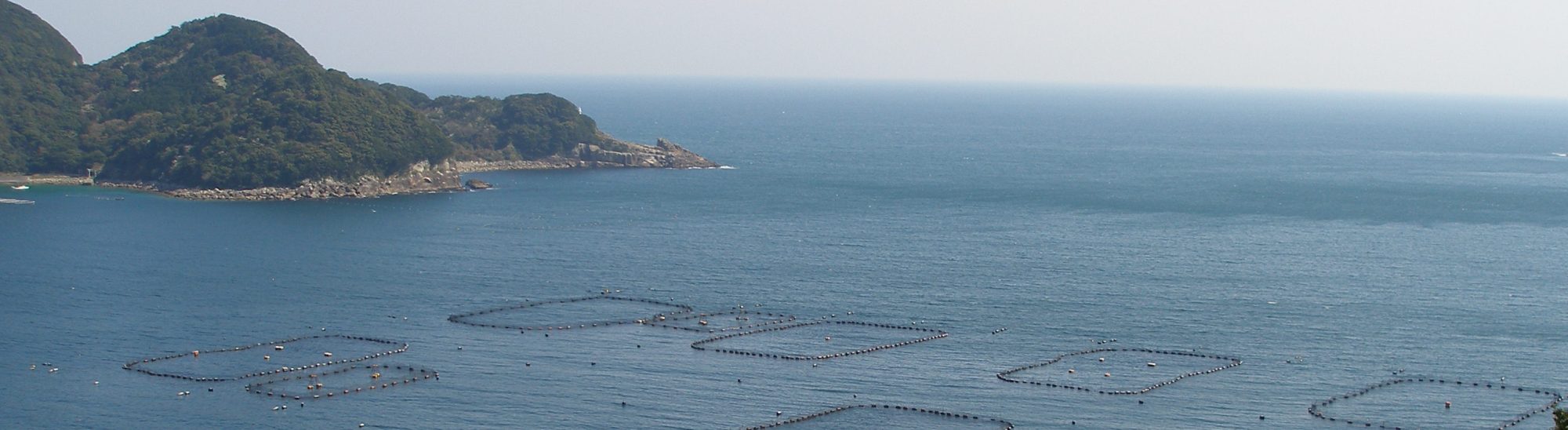
Bitagane, my first destination, is a short 5 minute boat ride near the port. We were separated into different groups, some diving in Bitagane, others around another site called Soudaine, and the more advanced divers heading out for a wreck dive. Dive sites in Atami contain plenty of spectacular soft corals, nudibranchs and moray eels as well as the Chinsen, one of the only divable wrecks in Japan. Unfortunately, visibility today wasn’t that good, but the water temperature was perfect, around 24C which made for a very smooth and comfortable dive. We stayed close to plenty of rocks and occasionally I spotted a few colourful fish including a great black and yellow one, about medium size, swimming on its own around the rocks. There were plenty of moray eels around the weed beds too. Our dive leader was fantastic, looking around to see if we were ok and even splitting us into groups according to how much air we had so those with less air could ascend first. I probably felt more relaxed on this dive than any other, thanks to the comfortable warm water and the feeling that I was definitely in good hands.

After Bitagane, we headed back to the dive school for a 2hr break and spent time chatting and taking it easy before our next dive to Soudaine. This time I was with another group, and happy to be able to dive in 2 different locations. Soudaine is also teeming with various creatures, and rocks with steep sides that drop deep deep down to the bottom. My buddy this time was my friend’s husband and three other divers were with us. On this descent I had some mild ear-clearing problems but managed to take it slow and was able to calmly head down without holding on to the rope as I approached the bottom. The others stayed close by and we spent the next 45mins literally drifting past walls and walls of rocks, sometimes swimming in between them, and heading out over huge gardens of kelp stretching for miles around. As we swam between the rocks we were surrounded by huge schools of tiny fish. If the visibility had been slightly better we would have seen much more, but once down below I could make out a lot of the marine life. We dived to around 15m, and ascended slowly, sticking close to the rocks for a better look at the plants and other creatures. I was delighted to spot my first octopus during this dive! A slight current made buoyancy and swimming a bit hard, but taking a slow ascent and seeing things up close was pretty special and really brought home to me just how varied the marine life of Atami is.

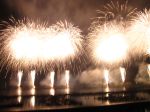
Both my dives were smooth, I was so relaxed and really got back into being underwater. After our dives we had an excellent barbecue, and then headed to our accommodation to watch Atami’s famous fireworks display. The fireworks were amazing, much better than I expected, and the perfect end to a great day of diving and socialising. Most importantly it was so nice to have finally met other divers to share stories with, and it was great getting advice, tips, seeing everyone else’s photos, and just talking diving! Am really looking forward to heading to Oshima with the group next month, where hopefully I can fit in at least 5 or 6 dives….

Practical information

  • In June I came across a divers’ group called Discovery Divers Tokyo (www.discoverydiverstokyo.com) and signed up for this month’s Atami trip through them.  They’re an excellent mix of foreigners and Japanese people, very friendly and sociable!
  • I took the morning bullet train direct to Atami from Shinagawa station, leaving at 07:34 and arriving at 08:12.  Cost of single ticket: around 4,200yen with reserved seat, about 3,500yen without.  Arriving around 8AM is good if you want a full day of diving.
  • Discovery Divers picked us up and took us to Atami Scuba (www.atamiscuba.jp), a 5-7min drive from Atami station.  The school is right on the port, with modern hot showers and toilets, a vending machine by the reception and a fairly large area with tables and chairs for a barbecue.  No tea, coffee or snacks are provided.  Good to bring your own snacks, but Discovery Divers organised an excellent barbecue.
  • The boat leaves for the first dive at 10AM.  Everyone puts on their equipment at the school and walks on to the boat to sit on the floor.  Entry into the water is by backflip.  Once off the boat, equipment is removed back at the school.
  • We had a 2hr break before our next dive around 13:30.
  • 2 boat dives cost 15,000yen, the barbecue 1,200yen and full equipment rental for one day 7,000yen, making a total of 23,200yen, not including train tickets and overnight stay.
  • All divers are responsible for setting up their equipment and tidying up after each dive.
July’s dives
Dive 1:  Bitagane:  depth: 19.9m, dive time: 35mins, dive in: 10:17AM, water temp: 24C, surface temp: 27C.  Used a 10L tank, 3kg weight belts and 5mm wetsuit.  Saw plenty of moray eels, soft coral and a black and yellow fish I’m trying to find out more about!
Dive 2:  Soudaine:  depth: 16.9m, dive time: 46mins, dive in: 13:40, water temp: 25C, surface temp: 27C.  Used a 10L tank, 3kg weight belt and 5mm wetsuit.  Saw my first octopus, moray eels, huge schools of small fish and gardens of kelp.  Slight current but nothing too serious.

June 2011: Kumejima, Okinawa, Japan

Sunday 19th June 2011

As I woke up this morning I was hoping today’s dives would be an improvement on yesterday.  I’d signed up for 3, which meant different dive spots and a bigger variety of marine life.  This time I was with a new group, 5 people all aged between 50 and 60, who were very friendly and asked me lots of questions about where I was from and what I was doing in Japan.  Our guide for dive number one was Shin, who gave a really excellent briefing.  He was great at describing the different coral, any dark tunnels or deeper areas we might have to enter, water temperature, hazards, currents, and of course the fish we might see.  As I entered the water I was 100% certain of what to expect, which really helped put my mind at ease. 

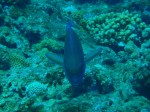
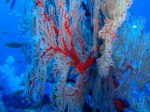
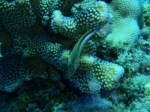
We went down to about 25m, and my highlight was swimming through a small dark tunnel, and then out again into the blue open water.  This particular dive spot is called Anmatenbusu (Mother’s Belly), and the coral walls are shaped in such a way that it looks like you are emerging from somebody’s belly.  I remember the water suddenly getting cold, so I knew we were pretty deep.  Shin was really helpful, he let me take my time as I entered the tunnel, and stayed close by as I made my way out, the others following behind.  It was amazing to come out from the dark into the light, to be greeted by lots of fish.  As we came out of the tunnel, we began to ascend, and the water soon became a lot warmer.  We stayed close to a massive wall of coral, holding on occasionally so as not to get swept away by the current, and looking out for different plants and other creatures.  We saw some incredible fan coral which glows bright red when you shine some light over it, and I managed to get a great shot of a parrot fish opening his mouth, about to have his lunch.  We were also introduced to the red-spotted blenny, a tiny little fish, very frog-like, poking his head out from among the coral to take a good look at us.

Shin accompanied us on dive 2 as well, and I felt much more confident descending by myself and meeting the others at the bottom of the rope.  This time the area we went to was flat, and full of dead coral, so we had plenty of space to crouch down in order to take photos, or simply hold on to something if the current was too strong.  But it’s the ideal environment for creatures such as sea snakes that can hide in small open areas and suddenly swim past you when you least expect it.  There was so much dead coral.  I could really see just how much danger it’s in, but after swimming along for a while you soon come to areas that are full of life.  Every time something interesting was found, Shin would lightly tap his tank to call us over.  We found some pink anemone fish, a cousin of Nemo, and a very interesting fish that stayed hidden among the coral watching us, unlike other fish that swim around or away.  Because he stayed in one place, it was really fun trying to get some close up shots. 

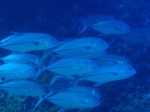
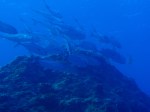
We then headed back to the dive school for a quick break, with lots of tea, a delicious sushi lunch, and plenty of space to sit in the shade, enjoy the sun, sleep a bit or simply read one of their many diving magazines and books.  Our 3rd and last dive was the most interesting and challenging.  The current made the descent a little difficult, and holding onto the rope was vital so as not to get swept away.  With this to think about, ear-clearing became much harder, and as it was already past 4pm the water temperature was slowly decreasing, so it wasn’t the most comfortable start.  Fortunately we’d been briefed on the strong current, and once we all descended we swam even deeper to a more protected place where we would have somewhere to hold on to.  Our guide wanted to show us a group of bigeye kingfish that congregate around our particular dive spot, so we swam against the current heading for their hiding place.  They’re a very unpredictable fish.  Either you see plenty, or just a small number.  On a good day you can be surrounded by millions, and as they don’t swim away so fast, there is plenty of time to stay and watch them.   By the time we arrived at the magic spot I was already pretty tired from all the swimming but we were really really lucky – there was a massive school of them, swimming around the cluster of coral walls.  They were quite big, very shiny and silver, with large inquisitive eyes.  They’re not the most exciting-looking fish, but seeing them in large groups like that was wonderful. 
Although Saturday was a bit disappointing, I’ve been really pleased with how the rest of my dives turned out.  This month was different in that I had to do a lot of things myself.  Having to set everything up, and dive with others allowed me to not rely on the guides too much, but to listen to my own body, feel my buoyancy or any ear pain and act accordingly.  That will all be really valuable for next month’s dives, so even though the school caters for the more experienced customer, I can see now that it was a good thing I decided to dive with them, although I don’t recommend Dive Estivant if you’re a beginner or out of practice!  I think I’ll sign up with them again once I’ve got a few more dives under my belt. 

Practical information:

  • I was introduced to Dive Estivan (www7b.biglobe.ne.jp/dive-estivant/ by Tokyo Diving Center and applied to dive with them online.
  • To get to Kumejima, fly from Haneda to Naha (2hrs 30mins) and then transfer to a smaller plane to Kumejima (30mins from Naha).  A return ticket is around 60,000yen, including all taxes, 2 nights in a hotel and breakfast.  I took an 8am flight from Haneda, had a short break at Naha and flew to Kumejima around 12:25.
  • The school offer a pickup service from the airport, and the drive to the school is around 20mins.  Dive Estivant is on the east side of the island, the airport along the west side.
  • First, you’re given a wetsuit and taken to your hotel for check-in.  The school will also pick you up and drive you back to the school after you’ve had a rest.
  • The school’s facilities are good.  They have showers and toilets, plenty of dive magazines and books to buy or borrow, lots of tables and chairs, and a space to sit outside.  Books are around 3,000yen.
  • The boat is also good, plenty of space to sit on the side, small toilet, and tea and sweets provided.  Entry into the water is by backflip.
  • Lunch is also available at the shop.  Many different packed lunches were on offer.  I chose a sushi one with rice, egg, prawns, and pickled vegetables.  Tea is free.
  • One dive costs 8,400yen.  I signed up for one on Saturday, and three on Sunday.  This price includes equipment rental.
  • There are about 30 dive spots on Kumejima.  We headed further east from the port, around Eef beach and beyond.  The time taken from the port to one dive spot is around 20mins.
  • Most divers bring their own gear.  You’re responsible for all your borrowed equipment, including setting up on the boat and tidying up after each dive.  I had to keep my wetsuit with me during my stay, wash it and hang it up on my balcony.
  • The school will drive you back to the airport after your stay. 

June’s dives:

Dive 1:  Anmatenbusu:  depth:27.7m, dive time: 44mins, visibility: 25m, average depth: 11.8m, dive in: 11:12AM, used a 10L tank, 3kg weight belts and 5mm wetsuit.  Really enjoyed going through a small tunnel out into the blue sea, and seeing all the fish again!

Dive2: Ryukau: depth: 18.5m, dive time: 49mins, visibility: 25m, average depth: 12.8m, dive in: 13:34, used a 10L tank, 3kg weight belt and 5mm wetsuit.  Saw pink anemone fish, coral cod and a sea snake.

Dive 3: Imazuni: depth: 15.8m, dive time: 40mins, visibility: 20m, average depth: 10m, dive in: 17:30, used a 10L tank, 3kg weight belt and 5mm wetsuit.  Saw lots of bigeye kingfish and some parrot fish.


June 2011: Kumejima, Okinawa, Japan

Saturday June 18th 2011

It’s now June, and summer is definitely here as I begin my dives on the island of Kumejima, Okinawa.  4-5 months since I was last in this area, and it’s already boiling hot, a little over 30 degrees, with a very strong sun.  Despite some slight humidity when I got off the plane, in terms of weather this was shaping up to be the ideal weekend for some serious dives. 

Kumejima consists of around 9600 people.  Located in the East China Sea, it’s the most popular of the islands around Okinawa.  The bays are surrounded by sand dunes and coral reefs, while mountains are spread out from north to southeast.  Eef beach, a major resort area, and where I went diving today, has some beautiful white sand.  It’s full of people, drinking and eating establishments, and of course accommodation.  But the most famous place on Kumejima is Hatenohama, a 5km sandbar on the east side of the island, and a popular sightseeing spot.  It’s only accessible through a day tour, and has crystal clear waters that are great for swimming, snorkeling and diving. 

Last month the excellent guys at Tokyo Diving Center recommended that I contact one of Kumejima’s main dive schools, Dive Estivant, for my June dives.  As a friend is off diving with the school next weekend, I decided to give them a try.  They came to pick us up at the airport, and we were soon on our way in a mini-van with about 6 other people.  But as much as I was excited about diving with others, I wasn’t overly impressed with how the day went.

When we arrived, everything was chaotic, rushed and busy.  Tourist season had definitely arrived.  I was immediately given a few wetsuits to try on, but with time limited, I had to rush to put on about 3, and trying on tight wetsuits indoors in boiling temperatures, 3 times, is not easy.  After being driven to my hotel, I had an hour to unpack.  Then I was picked up and driven back to the school.  No explanations were given on how the dive was going to proceed, and I was soon on a boat heading out to our first spot.  It later turned out that the other divers all flew to Kumejima quite regularly, and dived with the same school.  They were extremely experienced, laden with expensive equipment and heavy cameras, and familiar with all the good Kumejima dive spots.  This made me wonder whether a lot of the school’s customers are either local or regular, hence the lack of explanations. 

I dived once today, a deliberate arrangement on my part having learned from Ishigaki how exhausting it is to fly and get straight into the water.  I was paired up with my own guide, while the others paired up with each other, and were assigned another guide.  Our aim was to dive to around 20m, and watch the coral spawning. Corals must rely on environmental factors such as lunar changes, sunset time, and chemical signalling to determine the proper time to release gametes into the water.  As our dive began after 4pm, our guide reckoned we had a pretty good chance of seeing something. 

Unfortunately it was not to be, and despite the excellent visibility and warm water (25 degrees!), I didn’t spot anything that I hadn’t seen on previous dives this year.  There were some incredible tropical fish, but nothing that stood out.  As I swam past the different coral and rocks, I knew there was more to everything, and wished I understood more about spotting unusual fish, or rare coral features.  On the surface all you can see are beautiful coral or colourful fish, but the marine environment is about much more than that.  No spawning either.  The tropical fish did make up for that though, they were extremely fun and relaxing to watch.

During the dive we stayed close together in a group so I was no longer next to my guide all the time.  This was probably a good thing for me to experience. Although our guide was my dive buddy, it was more of an advantage to stay a little behind, and be among the other divers.  With nobody watching me all the time, I had to make my own judgments – control buoyancy, keep an eye on my air, and remove any water that got into my mask.  I began to feel happy about slowly being able to do that alone. 

I’m disappointed that I can’t really write in detail about what I saw.  The dive was smooth and nothing exciting, but it got my confidence levels up a bit.  Back on land, everything was rushed again, and I was told to be back at 10AM the next morning, with no explanation of where I would be going and who with.  It seems Dive Estivant really caters towards the more experienced diver, there was nobody available after the dive to tell me how deep I’d gone, where we went and what we saw.  As a new diver, I’m still keeping a record of all that, but the guides were simply too busy with other stuff.  On the plus side, it will be good to go through my photos and look up the names of fish by myself, rather than being told, and from now on as the summer tourist season begins, more and more people will be out diving, and I may have to get used to going it alone. 

June’s dives:

Tonbarazashi: depth: 15.8m, dive time: 47mins, visibility: 25m, average depth: 7.9m, dive in: 17:08, used a 10L tank, 4kg weight belt (later reduced to 3kg during the dive), and a 5mm wetsuit.  Saw lots of tropical fish, clown fish, parrot fish, moorish idol, and butterfly fish.