Category Archives: Uncategorized

February 2011: Ishigaki Island, Okinawa, Japan

Sunday February 27th

Today’s dives were fantastic.  A good night’s sleep works wonders, and the weather was even better than yesterday.  Fanie told me this weekend is the first warm and sunny one since January. I actually woke up this morning dreading my dives, and was worried about clearing my ears again, but when Kaito from the school came to pick me up, the weather was so clear and sunny that I soon began to feel more positive.

Our first destination was yesterday’s Manta Scramble.  Everyone was disappointed yesterday, and just as determined as me to spot some manta rays.  The water really was completely still, not a single wave, and we were all 100% certain that we would see something good, when just as we were setting up, a huge manta ray leaped out of the water really close to the boat.  Apparently it’s a very rare sight, and happened so quickly that nobody got a photo, but it was a stunning split-second moment.

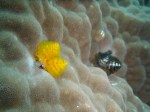
I hoped that was a sign of good luck, as I descended slowly with no ear clearing problems, but unfortunately it was not to be.  The mantas didn’t want to cooperate and disappeared entirely, leaving us to cruise around a little and enjoy the calm sea with no current this time.  Again very disappointed at missing the manta rays but I focused more on the fish around me.  Highlights were a sting ray slowly drifting past, and a tomato anemone fish.  Manta Scramble’s coral mountains are perfect to hold onto while waiting for the manta rays and also good for taking close-up shots of coral, but it is sometimes hard to spot your dive buddy, especially if he or she is hiding at the other side, so you can’t get too absorbed with the fish!

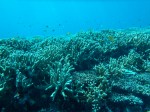
After indulging in chocolate biscuits on board, our next stop was Yonehara, where Fanie and I dived to 14.6m.  It’s a relatively shallow dive, but really worth diving to see the coral gardens and a cave.  I was really looking forward to this.  Swimming into a cave and then out onto some coral gardens sounded beautiful.  The water was so blue that even from the boat I could see carpets of coral down below.  This dive was spectacular.  The coral growth at Yonehara is remarkably good.  We began with a short swim around before arriving at the cave and then the coral gardens.  Highlights included a rare leaf fish, paper thin and white, hiding inside a cluster of rocks, and an electric clam, bright red and buried deep inside some rocks.  As I looked closely I could make out flashes of electricity across its centre.  We also saw 4 different types of anemone fish – clown, tomato, pink, and clanks, all cousins with very subtle differences in colour and stripes.  I became completely absorbed with what I saw, and even drifted away from Fanie to make my own discoveries, to the point that she had to remind me that if we wanted to visit the cave, we would have to do so immediately before running out of air.

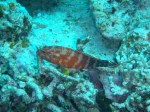
To enter the cave, we swam over a large mountain of coral teeming with coral branches and other fish, then downwards.  Once inside it felt cold and a little claustrophobic, but extremely cosy, and we discovered some big red fish staring at us with beautiful large eyes, huddled near the coral walls and lingering in dark tunnels. It was a tiny cave and ideal for getting a taste of more serious and deeper cave diving.  Soon we were back out into the coral garden, swimming out towards the sun and bright blue water beyond.

This month was shaky to begin with, but otherwise fantastic.  I’ve learned how important it is not to push myself, and to relax more, to focus on things 100% and really get the most out of the experience.  I’m definitely addicted, and looking forward to my March dives already.

Practical Information

Same as January

February dives

Manta Scramble: 16.5m, dive time: 33mins, average depth: 10.7m, water temp: 22C, land temp: 26C, visibility: 25m.  I used a 10L tank and wore a 5mm wetsuit.  Saw a blue spotted sting ray, tomato anemone fish, and a manta jump!

Yonehara Pukapi Minami: 14.6m, dive time: 40mins, average depth: 7.9m, land temp: 26C, water temp: 22C, visibility: 20m.  I used a 10L tank and wore a 5mm wetsuit.  Saw a leaf fish, electric clam, pink anemone, clown anemone, tomato anemone, clanks anemone, purple queen

http://en.wikipedia.org/wiki/Sting_ray

http://en.wikipedia.org/wiki/Anemone_fish

February 2011: Ishigaki Island, Okinawa, Japan

Saturday February 26th

This month I am back on Ishigaki island, and the weather is perfect, 25 degrees, really sunny with a slight breeze.  Everyone at the dive school and the place where I am staying are on top form, but today’s dives were disappointing, I had huge problems clearing my ears, especially during the first dive.  I knew I was capable, and yet today my skills simply didn’t work.  My mouthpiece was also not working as well as it should, and although it didn’t affect my dives, it did throw me a little, and added to the fear and frustration I was already experiencing.

But I dived at two new dive spots today, Arakawa and Manta Scramble.  Once again I dived with Fanie, the perfect dive buddy when you’re unsure and trying to get used to things.  When we descended at Arakawa, the first thing we saw was a huge carpet of coral spreading across for miles.  The coral life was rich, with interesting areas to swim through and a healthy collection of marine life.  A lot of the coral was flat and we had plenty of dead ones and rocks to hold on to.  After a while we reached a sandy area, the 18m spot, and found hard coral rising up from the seabed floor to the surface, ending with a beautiful explosion of colours at the top.  We ascended slowly from here, stopping to poke around in the dark spots and find sea snakes, nudibranches, and sea slugs, while small blue fish darted in and out of the coral branches.

After a short break back on board, we headed to our second destination, Manta Scramble.  Described online as “a legendary spot for manta ray spotting, just of the island’s north coast,” I’d been looking forward to visiting since last month.  Manta Scramble is probably Ishigaki’s biggest attraction, as scores of divers come here hoping to spot the manta rays feeding off plankton.  We descended one by one, holding on to the mooring line and slowly heading towards the bottom.  Once you arrive, you need to hide away between the coral so as not to disrupt the manta rays.  But we were so unlucky…..the only one we saw was, as Fanie cleverly described, “a racing manta” that quickly sped away when it saw us. We stayed at 14.9m for about 40 minutes, hoping to see more, but the current was extremely strong.  Mild for an experienced diver but not for a beginner.  Again a very disappointing dive, and such a shame because the marine life was superb, with lots of brain coral, smaller table coral, fissures and narrow canyons.  Unfortunately it’s not the right season for manta rays, and the current tends to be strong at this time of year, so if I’m determined to spot them, I need to arrange another trip back.

But tomorrow we’re heading back first thing.  Perhaps I’ll be in luck…

Practical Information

Same as January, although I paid about 80,000yen for my flights, accommodation (same place as Jan), and 3 dives.  When I got there I paid 2,100yen per day to hire a camera, and wanted to do a 4th dive which was an extra 8,400yen.  Bit of an expensive trip this time…..

February’s dives

Arakawa: 18m, dive time: 37mins, average depth: 11.9m, water temp: 22C, land temp: 25C, visibility 20m, used a 10L tank and wore a 5mm wetsuite.  Saw nudibranches, juvenile sea slugs and sea snakes.

Manta Scramble: 14.9m, dive time: 44mins, average depth 10.4m, water temp: 22C, land temp: 25C, visibility 18-20m.  One racing manta!

http://en.wikipedia.org/wiki/Manta_Rays

January 2011: Ishigaki Island, Okinawa, Japan

This is the first entry of what I hope will be a long and detailed blog of my underwater adventures in 2011. I’ve set myself a new challenge this year – to dive once a month, in Japan or abroad. It’s not going to be easy, especially financially, so why have I done this? To become a better diver. When I learned to dive last year, I soon realised that to get better, you need to continue. By diving once a month, not only do I hope to improve my skills but I also want to feel more relaxed and confident in the water, and learn something about all the wonderful marine life I’m going to see.

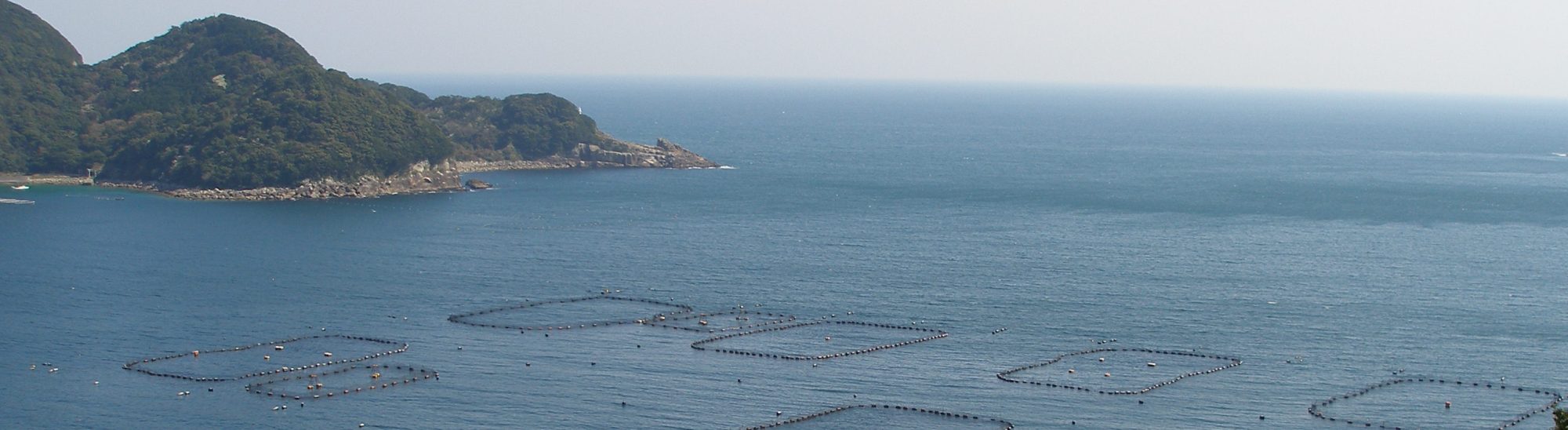
I’m writing my first entry in a tiny inn on Ishigaki island, Okinawa, where I’ve just completed my January dives. There is a storm outside, not the weather I was hoping for, but on the plus side coming here at such a time has been extremely interesting and a good chance to see the island which is normally a huge tourist spot. There is nobody around, and the city centre is really quiet. The island is full of coral reefs and the water crystal clear, which makes diving a very popular activity. There’s an area off the north coast for manta ray spotting, but this time I was unable to go due to the weather and strong currents.

At the northwest corner of the island is the stunning Kabira Bay where I’m staying. The emerald blue waters and white sand are beautiful (when it’s not raining!) and there are a few glass-bottomed boats around, so I made the most of a tour which gave me a taste of the marine life I was about to encounter.

I dived in two locations, Hanagoi Reef (16.5m dive) and Coral Bridge (14m dive). I rented my equipment and booked my dives with Umikoza (www.umikoza.com), an extremely friendly, family-run dive school recommended to me by a couple of friends in Tokyo, and which I would highly recommend myself. As we headed out on the boat to Hanagoi Reef, it was cold, wet and windy. I couldn’t believe I was about to go diving in such conditions, but the water temperature was quite warm, about 23 degrees, so once inside I felt much more comfortable.

The first thing that struck me was just how clear the water was. This seemed to be due to a lack of plankton as the water is not yet warm enough for them to appear. I could catch every single detail of the different coral, sea slugs and fish that we saw. There really is an incredibly rich marine life in Ishigaki, and so much colour!! My dive buddy Fanie was excellent. Positive and knowledgeable, she encouraged me throughout and made me feel totally at ease. I didn’t take my camera with me as Fanie didn’t want to risk it breaking. It’s only good until about 10m, and she knew we would probably go deeper than that. I wasn’t able to photograph anything, but what I saw was just like something out of a magazine – walls of coral rising up towards the surface, tomato anemone fish, purple queen, cornet fish…and the highlight? Two cuttlefish that slowly glided past us, lost in their own little world.

About 45 minutes after Hanagoi Reef, we headed to Coral Bridge for our second dive. This time we were in a coral garden. The coral spread out underneath us for miles around, with millions of tiny fish swimming between the branches. Here my buoyancy skills were really put to the test! I felt terrified of harming the coral, and it was painful to hear it breaking underneath me every time I came too close. I must have destroyed quite a bit, but it was the perfect location to practice neutral buoyancy. On this dive we found reef-top pipefish, box cleaner fish and trumpet fish. Fanie had a torch, which we used to look into holes and other dark areas at the bottom of the coral. I’d been following Fanie the whole time but towards the end she let me lead the way for a little while. I was much more calm, and stayed underwater for 46 minutes.

I couldn’t pass up the opportunity to dive with Umikoza once again, I’d been looked after so well and had such an incredible time, so after a delicious lunch with everyone, I booked my February dives and will return at the end of that month. Hopefully next time we’ll spot some manta rays.

Practical Information

The dive school Umikoza booked my flights, accommodation (2 nights, breakfast and dinner included) and two dives (including equipment rental) for about 70,000yen.  To get to Ishigaki, the usual route is to fly from Tokyo to Naha, then change for an hour flight to Ishigaki.  The best diving spots on the island are north, especially Kabira Bay, which is 30mins by car from the city centre.  Staff at Umikoza will pick you up at the airport and take you to your accommodation.  Public transport consists of one bus into town from Kabira Bay every 3 hrs, so it’s worth looking into car rental at the airport.  Flat wide roads make driving easy, and you can also cycle around the island in a day.

I stayed at a traditional inn based in Kabira Bay.  The place was old and run down, but the elderly couple running it were extremely friendly and made me some excellent meals – I ate set meals of rice, miso soup, fish (raw and cooked), tofu, salad, pickled cucumbers, noodles, very filling and healthy.

Umikoza is very well equipped, excellent shower facilities, lovely warm water (but bring your own soap and shampoo) and they are very organised in fixing you up with the right gear and wetsuit.  They offer courses in PADI Open Water, Advanced, Rescue and Dive Master, in addition to snorkel tours and fun dives.  On a typical day we did 2 dives starting around 9:30AM, with a break of 45mins or so in between, and then headed back to the school for lunch made by the owner’s wife.  Lunch was rice, soup, pasta, salad, bread, and she also caters to vegetarians if notified in advance.  The family have dogs and cats, and live next to the dive school overlooking the sea.  It’s a very homely, relaxed place, with a big garden.

January’s dives

Hanagoi Reef: 16.5m, dive time: 43mins, average depth: 9.8m, water temp: 23C, land temp: 25C, visibility: 25m, used a 10L tank, wore a 5mm wetsuit and 2mm vest underneath.  Saw two cuttle fish, tomato anemone fish, cornet fish.

Coral Bridge: 14m, dive time: 46 mins, average depth: 8.5m, water temp: 22C, land temp: 20C, visibility: 20m, used a 10L tank, wore a 5mm wetsuit and 2mm vest underneath.  Saw reef-top pipefish, mandarine fish, box cleaner shrimps and trumpet fish

http://en.wikipedia.org/wiki/Tomato_clownfish

http://en.wikipedia.org/wiki/Cornetfish

http://en.wikipedia.org/wiki/Cuttlefish

http://en.wikipedia.org/wiki/Cleaner_shrimp

http://en.wikipedia.org/wiki/Trumpet_Fish