Category Archives: Uncategorized

June 2011: Save Our Oceans – an exhibition to raise awareness

Today I attended a small exhibition in central Tokyo focusing on a few marine issues.  We all know that coral reefs worldwide are under increasing threat due to pollution, coastal development, farming, or even divers touching the coral, collecting it or dropping anchors on reefs.  This is obviously altering the whole nature of the sea, and the exhibition today offered an opportunity to think about that, as well as some more light-hearted topics like manta rays and popular diving sports in Palau.

There were three main parts: underwater photos, manta rays, and coral.

First up, I headed for the wonderful display of photos by underwater photographer David Doubilet.  Known for his work published in National Geographic Magazine, Doubilet started taking underwater photos aged 12.  He says his goal is to “redefine photographic boundaries” every time he enters the water.  Here are a couple of his comments:

“The sea is the most chaotic street in the world.  And what you have to do is simplify the chaos, to make a pattern out of the chaos that is at least visually arresting and not visually confusing.”

“My job description is to make a picture of a place no one has ever seen before, or to make a picture that’s different of a place that everyone’s seen before.”

Looking at his work made me think of my own photos, especially what I could do to improve.  He’d taken some fantastic shots of sea lions, sharks, clown fish, colourful tropical fish, as well as different seaweeds, rocks and other plants.  The colours were so vivid and his close-up shots of tiny obscure areas like rock surfaces were quite original.  He definitely gave me some ideas for my upcoming dive trip.

In the next section, a couple of Japanese celebrities who are scuba divers themselves, shared their own photographs, recounting trips to Ishigaki island Okinawa, and Palau.  A mini-theatre was available to show visitors the world of manta rays.  Although I didn’t get to see any manta rays when I went to Ishigaki in January and February, watching that simple footage of the animals brought back plenty of memories of my time there.  Palau, meanwhile, is one of the world’s most spectacular diving destinations.  In England I’d never really heard about it, but hoards of Japanese tourists visit to enjoy the crystal clear waters and superb marine life.  Myself and some other divers are hoping to go there in October, and today’s photos gave me plenty to think about. I heard about coral reefs, hidden caves and tunnels, and of course the famous jellyfish lake, teeming with 21 million stingless jellyfish!

The final part of the exhibition focused on coral reefs, with clear explanations of their biology, how they are formed, and many different photos of coral polyps.  Visitors are also able to pick up coral samples, and a special screening of “Umihanamushi” was held, a documentary focusing on the microscopic world of coral.  Here I was most reminded of how much danger the coral reefs are in.

I was also really impressed with a feature on Hope Japan, supporting the sea around Tohoku.  The group consists of voluntary divers who are going underwater to remove debris and clear the area.  A different way of volunteering up north perhaps?

The topics I saw today appeared very simple, but they are extremely important in understanding just a tiny part of the ocean.  As global warming accelerates, the more the oceans will be under threat, so it’s to be expected that many more exhibitions such as today’s will be held, aiming to at least make people aware of what is happening.

This weekend I’ll be in Kumejima, Okinawa, no doubt remembering the issues raised in this exhibition as I head back into the water.

June 2011: The National Institute of Polar Research

On Thursday 26th May, I was given special access to the National Institute of Polar Research west of Tokyo, thanks to a colleague who works there part time.

I had no idea such an institute existed.  Although it’s tiny, it’s buzzing with activity, and full of researchers studying subjects like meteorology, geology, glacier motion, life science and ice dynamics.  At first glance there doesn’t seem to be any obvious direct link with me scuba diving in places like Okinawa, but of course, all these subjects are significant to diving and marine biology, so I was more than keen to check the place out.

The institute’s focus is on Antarctica, a continent that is far from being about cute penguins and ice.  That’s what really struck me on my visit – just how much the continent has to offer, especially when it comes to rocks and magnetic fields.  I spoke with Professor Funaki, a geophysicist who reads the magnetic data of rock samples below the ice’s surface, based on the principle that magnetic particles (iron ore) contained in such samples will align themselves with the Earth’s magnetic field.  Professor Funaki explained that this opens doors to even more interesting subjects.  For example, you can find out more about how Antarctica fit together with Australia, and discover clues about early Earth climates and what may have influenced climate change in the past.  All this may also help scientists figure out the nature of the geology there.

Professor Funaki also focuses on the magnetic signal in the rock samples he collects.  I got to hold some, and the heavier ones have much more magnetic data than the lighter ones.  The strength of the magnetic signal is key to telling you how many magnetic minerals the rocks contain.  Volcanic rocks for example, apparently contain more magnetic minerals, whereas sedimentary rocks have much less.  A lot can be learned about the composition of the rocks as well.

What really got my attention was a plane the Professor is developing, which will contain a magnetometer to detect the magnetic properties of rocks below the ice, from high up in the air.  It’s a tiny piece of equipment that can be attached to the plane’s wings, but sometimes it can hang from the plane in a special container.  I was really impressed, not just by how far research has come, but also by the whole complexity and detail that went into this operation, how vast our planet really is, and how many different things there are out there waiting to be explored.

May 2011: Miyakejima, Japan

I was disappointed last month at the cancellation of a charity dive to raise money for the Tohoku earthquake victims.  This happened because of bad weather, but this month Japan is warming up, and the Kuroshio current is bringing with it higher temperatures and plenty of interesting marine life.  This month my journey began at night, as I headed to the island of Miyakejima, a 6hour overnight boat trip from Tokyo Bay, way south of the Izu Peninsula where I dived last month.

Japan tends to be overlooked as a dive destination but the island chain south of Tokyo is teeming with fish and other marine creatures.  I went to the first 3 islands of the chain as a child, but had never ventured further south, so I was really keen on going to Miyakejima.  The island was formed by eruptions and lava flows.  It contains thousands of tropical fish living in crystal clear water, while forests offer a quiet peaceful environment and 250 different types of birds.  There is excellent transparency and a rich marine life that attracts plenty of scuba divers.  It’s a paradise for marine sports.

Shimazaki-san from Tokyo Diving Center had come to meet me.  About my age, he operates the Miyakejima branch with a couple of other people.  I found the dive school online as I was searching for possible options for my May dives.  I got in touch with the owner who is based in Tokyo.  He was great in giving me plenty of detail about what to expect on a typical dive trip.  He’d told me there was a high chance of catching the bigfin reef squid laying eggs, as they tend to congregate around Miyakejima in May so I’d chosen the perfect time.

When we got to the dive school, I discovered that it works together with the hotel next door.  Because customers arrive from Tokyo at 5am and are usually pretty shattered, the hotel gives them a room to sleep in for a couple of hours and a buffet breakfast.  Facilities are old and basic, I had a comfortable mattress and blanket on the floor of a bare room, but the breakfast was excellent, consisting of rice, miso soup, pickled vegetables, grilled fish, salad and plenty of green tea.

After breakfast I helped Shimazaki-san load our equipment into the van.  I couldn’t help noticing that all their rental gear was relatively new.  I’d already formed a good impression of Tokyo Diving Center, and this just added to it.  I was going to enter the water from the beach, walking into the sea and swimming straight ahead before slowly descending.  I felt sure that this would help with my ear-clearing problems.

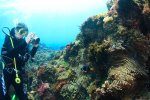
And it did.  We dived twice at Okubohama beach, one of Miyakejima’s main dive spots and a good place to spot squid.  As we moved out into deeper water, there was nothing but sand but I did spot my first turtle swimming off into the distance!  Further on, we arrived at a cluster of large round rocks covered with seaweed and various creatures, including a very small sting ray chilling out by himself, and a huge slug which we were able to pick up and hold.  He was massive, very slimy with interesting complex patterns.  Swimming on, we crossed a bed of sand and eventually arrived at some tree branches.  At 16m, this was where the squid came to lay their eggs.  The branches were surrounded by small fish and even a moray eel, so we swam up close and found a massive cluster of long white tubes stuck to the branches.  These were the squid eggs.  As I got closer I could make out tiny little white eggs inside the tubes.  They seemed to be hanging on to the branches by a thread, the slightest push or shove and I felt sure they would fall off.  There must have been hundreds, all clustered together to make a huge ball of white tubes.  As I looked closer, even the leaves seemed to be covered in them.

Once the squid feel that the area is safe, they slowly swim over in groups and deposit their eggs.  It was really magical to be surrounded by them.  I stayed near a rock, controlling my buoyancy, trying to get some good shots and making sure I didn’t disturb them.  The male and female swim in pairs, and once the female is ready to lay, the male which is darker, shields her from view.  They can rapidly change the colour of their skin which is used for camouflage and communication.  They can be over 30cm and eat small fish and crustaceans.  Each spring and summer they gather for courtship, mating and egg-laying.  When the water is warm they come inshore.  The male protects the female all the time as she deposits her eggs.  If another male approaches, the original male becomes defensive and agitated, sometimes flaring out its legs.  I was lucky enough to see this!  When they finish mating they die, which probably explains the presence of moray eels, waiting to grab a bite out of any squid (dead or alive) that they can find.

On my second dive I was able to observe this a lot more, having learned a bit about it and what to look out for.  It was impossible to get a photo of the actual moment the female deposits her eggs, but I did see plenty of other behaviour, in particular the males shielding the females, which seemed really romantic until Shimazaki-san later told me that the male is just making sure that the eggs have been deposited safely and correctly!

I think I saw a much larger variety of creatures than I had on previous dives.  The visibility was excellent, by far the best this year.  After our dives we still had plenty of time for a basic lunch at the shop and a quick shower before I was driven back to port for my 6hour trip back to Tokyo.  It was great sitting outside afterwards, enjoying the sun and going over my dives with Shimazaki-san discussing what we saw.  I’m not confident enough yet to dive with a large group of people, so I really appreciated the one-to-one guidance I got today.  Slowly but surely the weather is getting better and no doubt there will be plenty more opportunities for wetsuit dives around the Tokyo area.

Practical information

  • I found Tokyo Diving Center (www.tokyodc.info) online when their advertisement appeared on Facebook while I was searching for dive schools.
  • The Miyakejima branch is a 15min drive from the port
  • To get to Miyakejima, take the overnight ferry from Takeshiba pier, Tokyo Bay at 22:20.  This is the only boat that goes to the island.  To book, ring up the company Tokai Kisen (03-5472-9999, 9:30AM to 20:00 open 7 days a week).  They’ll give you a booking number.  Take your booking number on the day of travel and collect your ticket at Takeshiba pier after 20:00 on the night of travel.  I paid 10,000yen for a bunk bed.  Sleeping on the floor costs around 6,000yen (one way) and you can also get a reclining chair for the same price, or upgrade to a cabin which will cost more than 10,000yen.  It’s quite an expensive journey, the boat is also quite old with very basic food and vending machines, but there is plenty of room out on deck.
  • The school will pick you up at the port when you get in at 5am.  Then you’ll be taken to the hotel next door for a short sleep and breakfast.
  • The route to the school from the port is interesting – look out for rocks and other volcanic features!
  • Facilities at the school are good, their equipment is very new, and you can buy dolphin-shaped bottles of water (expensive at 300yen) and postcards.
  • Lunch, sweets and tea are provided.  Lunch is a small box of rice, chicken and vegetables, with a can of green tea.
  • Two guided dives with all equipment hire (except for mask, snorkel and fins as I have my own now) cost 20,000yen.
  • The main dive site on the island is Okubohama, 15-20mins by van.  Load all the equipment at the school, and set up on the beach.
  • Entry into the water is walking from the beach.  Because of the waves and everything you’re carrying, this is a little more difficult than you think!
  • Equipment is removed and rinsed back at the van.  The beach also has excellent warm showers.  I made the most of these after my first dive, during our break which is usually 30 to 45mins.
  • Back at the hotel you can take another shower.  Hair dryers, shampoo and shower gel are provided but bring your own towel.
  • The boat to Tokyo is 1 per day, leaving at 14:20, arriving at 20:25.  Tickets are sold at the port between 12:30 and 14:00.  The school will drive you in plenty of time, and wave goodbye as you said off!

May’s dives

Okubohama dive 1: depth 16.4m, dive time: 40mins, water temp: 22C, used a 10L tank, 4kg weight belts and a 5mm wet suit size ML.  Saw my first green turtle, bluespotted stingray, clown fish, and of course plenty of bigfin reef squid!

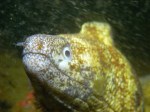
Okubohama dive 2: depth 15.4m, dive time: 41mins, water temp: 22C, used a 10L tank, 4kg weight belts and a 5mm wet suit size ML.  Saw an armored weasel fish, more bigfin reef squid, moray eels and clown fish.

April 2011: Shirosaki near Ito, Shizuoka Prefecture, Japan

This month I began my dives back in Shizuoka prefecture, following on from my trip to Atami in March, although this time I ventured further south to the beautiful chilled out areas of Ito and Rendaiji near the tip of the Izu Peninsula, which runs from Atami. Despite the high chance of aftershocks (since last month’s earthquake Tokyo has had at least 3 powerful tremors in the last few days) and feeling quite hesitant as a result, I decided to go ahead with my dives. The weather was a wonderful 22C, warm, dry and sunny, so I would have been crazy not to go. And over the past few weeks getting on with life as usual has been really comforting.

I booked my dives with Tago Diving Centre, an excellent school recommended to me by a fellow diver I met in Okinawa, extremely knowledgeable and professional with 300 or so dives in his log book. Tago Diving Centre is quite a difficult place to get to, taking over an hour after changing trains at Atami station. And that doesn’t include the time it takes to get to Atami from Tokyo! Because of the aftershocks the trains were running behind schedule, so I arrived one hour late, but the owner’s daughter Yoshida-san was waiting for me in her car, and despite my arrival time was really chatty and friendly. About my age and already a dive instructor, we talked loads on the short trip to the dive school. She dived for the first time aged 7, and I felt fortunate to be preparing to dive with someone so experienced.

Like last month I was going to be using a dry suit but Yoshida-san was very much of the opinion that, even though I’ve only dived 10 times, I’m qualified so I don’t need any lengthy explanations or somebody to hold my hand as I got my equipment ready. I was on my own, but we were pushed for time and soon I was all kitted up and ready to head out. I felt a slight boost of confidence at being left to my own devices.

Our first dive spot was Shirosaki Bay. The dive school is located right on this bay so the boat journey was about 2 mins. We boarded a medium-sized boat with plenty of space and more than adequate for our trips to the dive sites. The rope we used to descend only went down to about 5m, after which we had to swim downwards ourselves. This was quite difficult and took time, but surprisingly I was quite calm, perhaps because I’d already tried a dry suit last month and been in murky water. Once down below (23m), we saw some incredible marine life. Compared to Atami, visibility was a lot better. Shirosaki Bay is much more out there, and far from any busy congested areas. Soft corals several feet high were attached to rocky outcrops and boulders. My highlight was spotting a lion fish and taking a quick photo as it sat on the rocks observing us closely. I also noticed crabs nestled amongst the rocks, algae covering the sea floor, a moray eel quickly swimming back into the rocks, and plenty of striking sea anemones and sea slugs, with stunning orange, white and purple colours. During our ascent and while completing a decompression stop at 5m, we got to rest near the buoy close to the boat, and study the different shellfish and seaweed clinging to the rope.

After our first dive Yoshida-san let me soak in the school’s hot tub wearing my dry suit, a fantastic way to get warm and enjoy the feeling of sitting in water and being 100% dry. After donning our gear and preparing our cameras, we headed out to Benten-jima for our 2nd dive. Benten-jima is a small island just off Shirosaki Bay and seemed the ideal place for more fascinating discoveries. The descent was extremely smooth, and before I knew it I was swimming quite comfortably but the current was fairly strong and I found buoyancy control really difficult. Yoshida-san had to take my hand and lead me around most of the time, but the marine life more than made up for that. The waters off Benten-jima are relatively clear, and the soft corals large and healthy-looking. I saw venomous sea urchins, some with tiny crabs nestled inside, a red brittle star stretching out its long arms, a large stingray that swam off behind Yoshida-san leaving a cloud of sand, and two frogfish sharing a rock ledge, both brilliant orange. At one point, we approached a cave. Cold and pitch black, I wondered how deep we’d come. I could really feel the chill through my dry suit and was a bit apprehensive as we peered inside only to find nothing, when just as we were swimming off, a Zeiform fish (a small order of marine ray-finned fish) slowly appeared from inside the cave. He was quite big, a mysterious creature from the deep with a dark spot on his side. Finding him was very special, and we watched him slowly disappear into the distance. Bentenjima is surrounded by rocks to hold on to, and offered plenty of areas to shine torches through, poke around and discover more fascinating things. I loved watching the sea slugs chilling out on the huge seaweed and moving with the current.

I wanted to sit and talk to Yoshida-san a lot more, but we were still short of time and I had to take a mid-afternoon train if I wanted to reach Tokyo at a reasonable hour, so after quickly going over my dives and listing the creatures we saw, she sent me on my way armed with a bag of seaweed that her Mum had prepared and which I can use in salads and other dishes.

Fortunately my April dives are not yet over! I’m delighted to have been asked to take part in a charity dive on Saturday 23rd, to raise money for the earthquake victims up north. We’ll all be making a donation to the dive school and doing 2 dry suit dives in Osezaki, west of where I dived today. Am really really excited!

Practical information

  • Tago Diving Centre (www.tagodc.com) is close to Shimoda, a city located south of the Izu Peninsula.
  • The nearest station is Rendaiji. Take the bullet train to Atami from central Tokyo which takes about 45mins, and change to the Itokyu line which takes you direct to Rendaiji. A one-way trip is 1800yen. When I went I had to change trains due to the earthquake but usually this is not required.
  • When you arrive at Rendaiji, the school will pick you up by car. The journey is about 30mins from Rendaiji station.
  • Along the route are plenty of cherry trees and mountains. It’s a stunning area.
  • Tago Diving Centre is family-run by Mr and Mrs Yoshida and their daughter who was my guide for the day.
  • Facilities are excellent – 2 toilets, 3 showers, basic but spacious changing rooms with private cubicles, and a bathtub overlooking the bay. You can use the bathtub anytime to get warm, it’s always full of hot water.
  • No lunch, snacks, tea or coffee provided so try and bring your own.
  • Two guided dives with all equipment hire and drysuit rental came to about 20,000yen.
  • Set up your equipment and put it on before you get on to the boat.
  • The boat is basic, no seats, roof, it’s completely open. Perch on the side and put on your fins, mask and gloves before arriving at the site.
  • Entry into the water is the backward roll. A rope is provided for the descent.
  • Equipment is removed after arriving back at the dive school. The school will also drive you back to the nearest station after your dives, and look up train times for you.
  • Diving in this area is possible year-round but conditions vary. In summer and early autumn popular dive sites can be extremely crowded but visibility is much better. In winter although the water temperature drops, there is still plenty to see as long as you can relax, and put up with some murky water.

April’s dives:

Shirosaki: depth: 22.6m, dive time: 37mins, average depth: 13.7m, water temp: 14-15C, visibility: 5m, used a 10L tank, 8kg aluminium weight belts and ankle belts, and a dry suit. Saw a lion fish, algae, crabs, a moray eel, sea anemones, sea slugs.

Benten-jima: depth: 27.9m, dive time: 37mins, average depth: 12.9m, water temp: 14-15C, visibility: 5-6m, used a 10L tank, 8kg aluminium weight belts and ankle belts, and a dry suit. Saw sea urchins, crabs, a red brittle star, a stingray, frogfish, sea slugs, sea anemones and a Zeiform fish.

en.wikipedia.org/wiki/Brittle_star

en.wikipedia.org/wiki/Stingray

en.wikipedia.org/wiki/Pterois

en.wikipedia.org/wiki/Zeiformes

en.wikipedia.org/wiki/Moray_eel

en.wikipedia.org/wiki/Frogfish

March 2011: Atami, Shizuoka Prefecture, Japan

Wednesday March 30th

Following the Tohoku earthquake and tsunami, March has quite naturally been crazy and unpredictable.  I’d just received my course materials for my marine biology diploma when the earthquake struck.  With so many things to think about, I wasn’t focusing on studying or diving at all.  During a recent trip to Thailand I’d hoped to complete my March dives, but a huge thunderstorm made conditions too dangerous.  I’d begun to wonder whether I was destined to dive this month, when I came across a school in Atami that was more than happy to take me diving for a day.  Atami, meaning “hot ocean,” a reference to the town’s famous hot springs, is at the far eastern corner of Shizuoka prefecture, southwest of Tokyo.

Diving Service Atami is a tiny school about 10mins by bus from the train station and just next to Atami port.  I thought about how cold the water was going to be, and how insane I was to contemplate diving in such conditions, but perhaps it would be fun after all, so I decided to be brave and head out.  My guide Toyoshima-san met me at the bus stop.  He was extremely professional, lending me all my gear, showing me a safety video and requesting that I fill in a couple of forms declaring that I am fit to dive.  But the most important thing he had to cover was how to use a dry suit for today’s cold dives.

Dry suit dives are not usually recommended to beginner divers, especially ones like me who only have 8 certified dives in their logbooks, but Toyoshima-san’s attitude was “let’s try it and see what happens.”  He was very good at explaining the advantages of a dry suit.  Obviously the whole point is you stay dry during your dive.  As I put my suit on over a pair of yoga trousers, ordinary socks and a couple of thin long-sleeved tops, I began to wonder about the feeling of staying dry while in water.  The suit has an inflator on the chest and another valve on the left arm to release air.  It must be inflated and deflated upon ascent and descent, to avoid “squeeze” when the suit sticks to you the deeper you go, and to avoid a rapid ascent due to over-buoyancy.  Mine fit quite well, and I thought it must be nice afterwards to just rinse your hair and not have to take a whole shower.  I was also given a hood, gloves and my own dive computer.  I felt very well prepared.

Our first dive site was called Bitagane, about 5mins away from the port.  Atami’s main dive spots are deep, some go to about 70m, and certified divers usually go to 18m or maybe more.  I was happy to try going over 18m, but when we began to descend, I freaked out.  It was green and murky all around me, except for the sight of Toyoshima-san using the rope to slowly descend next to me.  Not knowing where I was going, and seeing nothing below was pretty scary.  I wanted to give the ascend signal and cancel the dive, but Toyoshima-san was so calm and patient!  I took forever descending, and must have used up so much air, but once we started to swim around, we found some incredible stuff thanks to Toyoshima-san’s torch – lots of moray eels, beautiful orange starfish, some nudibranches and crabs.  Obviously Atami’s marine life is totally different to Okinawa – much more in the way of rocks, sand, soft coral, starfish, and seaweed.  It’s not the world’s most exciting dive spot but there was still plenty to see.  During our ascent we even swam through a school of shimmering sardines looking beautiful against the sunlight.

We also practised using the dry suit.  As it began to feel tighter, Toyoshima-san helped me put more air into it, and remove the air again, to achieve neutral buoyancy. I was definitely dry underneath, and it felt good.  Despite a few headaches brought on by the sudden temperature change from entering cold water, I felt fine, and very snug.

After an hour’s break back at the dive shop, we headed to our second site, about 10mins from the port, called Soudaine.  We found walls of rocks everywhere, and slowly worked our way up these before starting our final ascent.  This time I knew what to expect, and was much more calm during the descent, holding onto the rope, clearing my ears and staying calm.  I’d been so impressed with what I saw at Bitagane, that I asked Toyoshima-san to bring a camera in case we found anything worth capturing.  What we saw was very similar to our previous dive – sea urchins, starfish and different seaweed.  The walls of rock allowed me to hold on and get up close to several creatures, taking in their different patterns, shapes and sizes.  One nudibranch was fairly big with a wonderful orange colour, and we also saw a big purple sea urchin with long protective spines like a hedgehog!  On the surface of the sea urchin was a tiny little zebra crab, so-called because of its brown-ish stripes.

Toyoshima-san was spot on about the dry suit.  After removing and rinsing my equipment, the first thing I did was rinse my hair and then remove the suit.  It felt incredible, to be bone dry and not need a shower.  Soon I was back in my jeans and ready to discuss the dives.  Dry suit diving is definitely an interesting thing to try, but it does take some getting used to, and nobody wants to start out in cold water so I understand why it is not recommended to beginners.  I also found today that I’d dived to 25m.  Such a deep depth but it didn’t feel any different to 10m or 15m!  As much as I loved diving in Atami and am proud of what I achieved today, I would take the warm tropical waters of Okinawa anytime 🙂

Photos coming soon!

Practical information

l       I found Diving Service Atami (www.atami.biz) online after a Google search.

l       Atami is about 50mins by bullet train.

l       To get a full day’s worth of diving, take a train around 7:30AM from Tokyo.  Trains are extremely regular, and the Tokaido line is another option too – longer journey, cheaper tickets.

l       A bullet train return ticket is about 8,000yen with no reserved seat.

l       From Atami station, take the bus to “Korakuen” the final stop.  Diving Service Atami is opposite the bus stop.

l       The school is small and quiet with basic facilities.  Tea and coffee are provided but no lunch or snacks.  Their office is really cosy, with lots of photos and magazines.

l       It costs 16,500yen for 2 guided dives, and an extra 8,500yen to rent a dry suit.

l       At the school you set up the equipment and put it on before getting on to the boat.  The boat is basic, with bench-style seating for the divers.  Take off your equipment on land when you’re safely off the boat.

l       Breaks in between dives are long – return to the school, then an hour to take it easy before starting your next dive.

l       Because of the Tohoku earthquake, power cuts and fears over aftershocks, business is very quiet.  Diving with me were 6 other divers from the area.

l       The waters of Atami are cold and murky in March.  A friend cleverly described them as “miso soup” waters.  Summer is a much better time, when the water becomes clear and blue, especially around June

l       Other good dive spots in the Atami area include a 30m dive to see an 85m cargo vessel called the Chinsen, and Kosaga Dokutsu (cave), open from Nov to Mar.

March’s dives

Bitagane: depth: 25.1m, dive time: 39mins, average depth: 13.7m, water temp: 15C, visibility 5:6m, used a 10L tank, 5kg weight belt, 1kg ankle belt and a dry suit.  Saw moray eels, orange starfish, nudibranches, and sardines!

Soudaine: depth:22.3m, dive time: 41mins, average depth 13.6m, water temp: 15.9C, visibility: 5-6m, used a 10L tank, 5kg weight belt, 1kg ankle belt and a dry suit.  Saw purple sea urchins and zebra crabs.

http://library.thinkquest.org/J002608/urchin.html

http://www.animalsandearth.com/photo/view/id/47972-xeno-crab-xenocarcinus-tuberculatus-on-wire-coral-cirrhipathes-sp-70-feet-deep-papua-new-guinea#1#tag#Xenocarcinus%20tuberculatus#viewed#

http://en.wikipedia.org/wiki/Moray_eel

http://www.seadb.net/en_Zebra-crab-Zebrida-adamsii_664.htm
March 2011: Marine Biology online

This week I enrolled on a marine biology distance learning course with a college in England.  Although it’s a bit daunting having to knuckle down for the next year studying an unfamiliar subject, it’ll be exciting to see what kind of challenges this is going to bring.  I have one year to complete 10 modules, with an online assessment at the end.  During the year I need to answer questions at the end of each module and submit my answers to a tutor.  The course is not as demanding as a degree, no big essays, field trips or practical work, but hopefully the certificate I get upon completion will be useful if I ever decide to pursue marine biology further.  As I nervously look through my new folder containing 280 sheets of paper, I keep reminding myself how much I enjoy diving and discovering different fish.  And that’s bound to help me along the way.